Introduction to How Interpol Works
Interpol is an international police agency that helps other law-enforcement agencies track criminals who operate across national borders. Although Interpol's work is not always as exciting or glamorous as fictional accounts would have you believe, the organization's databases, communications protocols and international notices are vital tools in the fight against international crime.
![]() Photo courtesy of Interpol Interpol uses communication and databases to track criminals across international borders. See more spy pictures. |
The full name of Interpol is the International Criminal Police Organization, or the ICPO. It may also be abbreviated as OICP, for Organisation Internationale de Police Criminelle, the French version of the name. Usually, it is referred to as Interpol, a name first selected as the telegraph shorthand name for the agency.
The theft and trafficking of stolen art is a particularly international crime because there are dealers and collectors all over the world. Interpol maintains a database of stolen artworks and publishes documents showing clear photos of them so art dealers and collectors will recognize stolen goods when they see them. In 2005, the system helped police in the Netherlands recover a very rare Grancino violin [Source: Interpol]. |
Interpol is fully autonomous and independent of any single country. There are 186 member countries (see the full list here). Interpol remains politically neutral and does not participate in any action involving politics, race or religion. The agency is focused on several key areas of crime:
- Terrorism
- Sexual abuse of children and child pornography
- Organized crime
- International fugitives
- Computer crime, including identity theft and theft of financial information
Interpol also monitors and fights against human trafficking, the smuggling and sale of illegal drugs, money laundering, environmental crime, fraud and intellectual property crimes.
Watch this video about diamond thieves on HowStuffWorks. The $28 million dollar diamond robbery happened at the ABN Amro bank in the heart of Antwerp's diamond quarter; the city is known as Europe's diamond capital since more than half the world's diamonds pass through this district.
Identity theft --one of society's scariest concerns -- is one of America's fastest growing crimes. Largely brought about by advances in technology, identity theft costs us more than $50 billion every year. See how identity theft works in this video from the University of Tennessee. Watch this video from TED on HowStuffWorks featuring Oxford statistician Peter Donnelly. Donnelly explores the common mistakes humans make in interpreting statistics and the devastating impact these errors can have on the outcome of criminal trials. See how statistics and the legal process work in this video. |
Interpol's Job
|
Interpol's databases help law enforcement see the big picture of international crime. While other agencies have their own extensive crime databases, the information rarely extends beyond one nation's borders. Interpol can track criminals and crime trends around the world. They maintain collections of fingerprints and mug shots, lists of wanted persons, DNA samples and travel documents. Their lost and stolen travel document database alone contains more than 12 million records [Source: Interpol]. They also analyze all this data and release information on crime trends to the member countries.
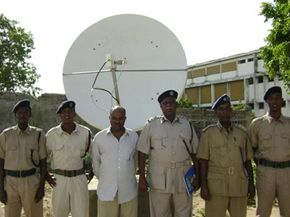
![]() Photo courtesy of Interpol The National Central Bureau (NCB) in Mogadishu is connected to the I-24/7 network system by satellite. The system allows contact with other countries around the clock. |
In the event of an international disaster, terrorist attack or assassination, Interpol can send an incident response team. This team can offer a range of expertise and database access to assist with victim identification, suspect identification and the dissemination of information to other nations' law enforcement agencies [Source: Interpol]. And, at the request of local authorities, they can act as a central command and logistics operation to coordinate other law enforcement agencies involved in a case. Such teams were deployed 12 times in 2005.
Interpol isn't the only law-enforcement agency operating on an international level. Europol functions much like Interpol, but works within the European Union. In fact, membership in Europol is a prerequisite for entrance into the EU. The International Police are a peacekeeping force made up of volunteer civilians. They are sent to trouble spots around the world (often at the behest of the United Nations) to monitor situations and protect civilians when needed. They're usually only lightly armed, if at all. |
Interpol's Organization
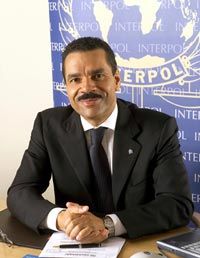
![]() Photo courtesy of Interpol Ronald K. Noble, Secretary General of Interpol |
Interpol headquarters (called the General Secretariat) is located in Lyons, France. It is operational around the clock, 365 days a year. The General Assembly, made up of delegates from all the member countries, meets once each year. The assembly votes on all major Interpol decisions - resolutions are passed by a simple majority, with each member nation receiving a single vote. The General Assembly also elects the Executive Committee, a 13-member group that does administrative work. The Secretary General is the head of Interpol. Appointed by the General Assembly, each Secretary General serves for five years and runs Interpol's daily operations. The Secretary General is also in charge of implementing the decisions made by the General Assembly. As of 2007, the current Secretary General is Ronald K. Noble, an American who formerly worked in the U.S. Department of Treasury. He is serving his second term as Secretary General after being re-elected in 2005 [Source: Interpol-Governance, Interpol-General Assembly].
In addition to the main General Secretariat, there are six regional offices, plus the U.N. liaison office. They are located in Argentina, El Salvador, Thailand, Côte d'Ivoire, Kenya, Zimbabwe and New York. The New York office is a special liaison within the United Nations.
Most of Interpol's funding comes from the member countries themselves, with each nation contributing a portion based on its size, gross domestic product and other factors. The 2007 Interpol budget was 44.7 million Euros (roughly $61.4 million U.S.) [Source: Interpol].
Interpol can quickly alert police agencies worldwide about a particular situation or suspect with their system of international notices. Each notice contains as much pertinent information as possible to help authorities deal with situations such as finding a dangerous person or identifying a body. More than 3,000 are issued each year, and the notices are color-coded as follows:
|
Interpol History
The International Criminal Police Commission (ICPC) formed in 1923. With headquarters in Vienna, Austria, the organization published a journal containing wanted notices for international criminals. World War II interrupted the growth if the ICPC -- the Nazis took control, deposed the current Secretary General and moved the headquarters to Berlin. Following the war, the organization was rebuilt and new headquarters were established in Paris. The group officially took the telegraph code name "Interpol," and adopted the colored notice system. The headquarters moved to Lyons in 1989. The 1990s and 2000s saw the rapid development and expansion of communications and database systems.
The official Interpol emblem is a globe, which is flanked by olive wreaths and a justice scale, in front of a sword, with the agency's initials at the top and the name Interpol along the bottom. The Interpol flag features the emblem on a white circle against a light blue background with white bolts of lightning pointing toward the corners, symbolizing the speed of communications accomplished by Interpol [Source: Interpol].
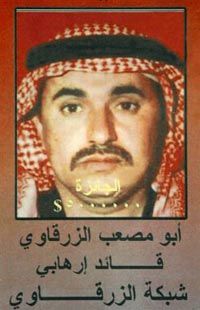
![]() Photo courtesy of the U.S. Department of Defense of Abu Musab Al-Zarqawi, one of the world's most wanted terrorists. |
In a 2005 speech, Interpol President (a position on the Executive Committee) Jackie Selebi provided a prime example of Interpol at work:
"Interpol success stories demonstrate the critical roles our different NCBs play in global police cooperation. For instance, a Serbian national, Milan Lukic, wanted by the United Nations International Criminal Tribunal for the Former Yugoslavia (ICTY) and Serbia and Montenegro, for war crimes against Bosnian Muslims in 1992-94, was arrested in Buenos Aires last August 7, 2005. This could not have been possible without the close collaboration between ICTY, the Interpol General Secretariat, and the NCBs in Argentina and Chile. The true identity of Mr. Lukic, who was using a false name when accosted by the Argentinean authorities, was confirmed when his fingerprints were sent by NCB Buenos Aires to IPSG for immediate comparison and confirmation. This success story clearly demonstrates that our NCBs play a very key operational role in global police cooperation, and utilizing them to their fullest potential will make a difference in our fight against transnational crime and terrorism."
[Source: Interpol]
For more information on Interpol, police agencies and related topics, check out the links on the next page.
Lots More Information
Related HowStuffWorks Articles- How the FBI Works
- How the CIA Works
- How Spy Gadgets Work
- How Wiretapping Works
- How Spies Work
- How James Bond Works
- How Spy Gadgets Work
- How Lie Detectors Work
- How Hostage Negotiation Works
More Great Links
Sources
- Interpol - Official website. http://www.interpol.int/
- National Center for Missing & Exploited Children. “International Abduction Success Stories.” http://www.missingkids.com/missingkids/servlet/PageServlet?
LanguageCountry=en_US&PageId=1839