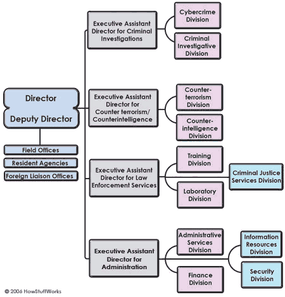
The Federal Bureau of Investigation is the most powerful government agency in the United States. Some call it the largest law enforcement agency in the world. In its 100-year history, the agency has been at the heart of several infamous cases -- some successful, some controversial. In the age of terrorism, the FBI is as complicated and powerful as ever.
In this article, we'll find out what the FBI does, how it started, and how you can become an FBI agent. We'll take a look at some of the tools and techniques used by the FBI, and we'll learn about J. Edgar Hoover, the man who molded the Bureau into a powerful crime-solving agency.
Advertisement
The FBI is the investigative arm of the U.S. Department of Justice, and its specific mission is constantly evolving. Currently, the FBI's focus is on stopping terrorism, corruption, organized crime, cyber crime and civil rights violations, as well as investigating serious crimes such as major thefts or murders. They also assist other law enforcement agencies when needed. Crimes that specifically fall under FBI jurisdiction include those in which the criminal crossed state lines, violations of federal controlled substance laws, and other violations of federal laws.
According to its Web site:
To dispel some myths about the FBI, here are some things that it doesn't do:
- It is not a national police force; state and local law enforcement agencies are not subservient to the FBI. It's simply a different jurisdiction for different kinds of crimes.
- It doesn't "take over" cases from local agencies. If a crime partly involves FBI jurisdiction, or if it is serious enough to require FBI involvement, then the FBI forms a task force in which agents will work closely with state and local police.
- The FBI does not prosecute cases. It provides investigative information to United States attorneys, who then use that information to decide whether to prosecute.
FBI agents can carry firearms, and their use is restricted by the same rules that restrict all other law enforcement offices in the U.S. Deadly force can only be used when necessary to prevent death or injury to the agent or others. Agents cannot wiretap suspects (use electronic means to listen in on telephone conversations) without receiving a court order. To get a court order, they have to prove probable cause that the suspect is engaged in an illegal activity, and that a wiretap will help them gain crucial information. A federal judge must approve and monitor the tap. Wiretapping without a court order is a felony.
Advertisement