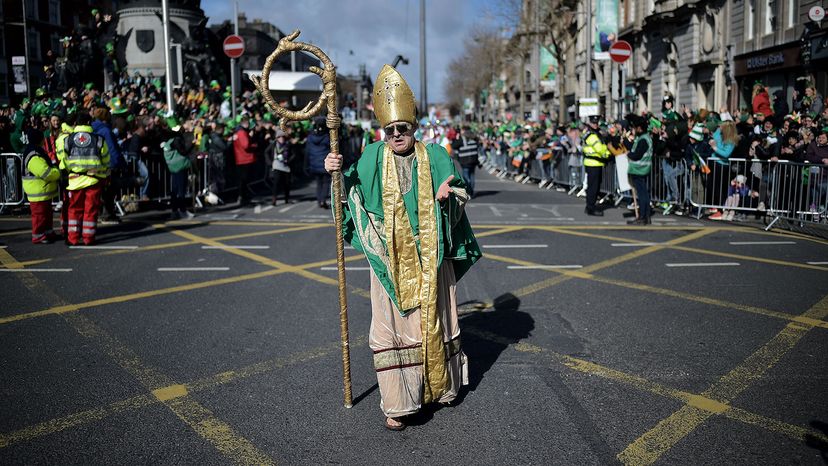
Regardless of your heritage, you're probably very aware of St. Patrick's Day. Celebrated each year on March 17, it's a day when people from all sorts of national and ethnic backgrounds dip a toe in Irish culture. Many observe the day by sporting a bright green shirt and meeting up with friends at a favorite local Irish pub. But there's a lot more to St. Patrick's Day than simply wearing green and knocking back a pint of Guinness.
For instance, who was St. Patrick? Is it true that he was taken prisoner by Irish raiders? And how do shamrocks and the Blarney stone fit into this holiday's history?
Advertisement
Important historical figures are frequently shadowed by the myths and legends attributed to them over the course of centuries, and St. Patrick is no exception. He is believed to have been born in the late fourth century, and is often confused with Palladius, a bishop who was sent by Pope Celestine in 431 to be the first bishop to the Irish believers in Christ. According to Encyclopedia Britannica, St. Patrick was the patron saint and national apostle of Ireland who is credited with bringing Christianity to Ireland. Most of what is known about him comes from his two works, the "Confessio", a spiritual autobiography, and his "Epistola", a denunciation of British mistreatment of Irish Christians. St. Patrick described himself as a "most humble-minded man, pouring forth a continuous paean of thanks to his Maker for having chosen him as the instrument whereby multitudes who had worshipped idols and unclean things had become the people of God."
St. Patrick is most known for driving the snakes from Ireland. It is true there are no snakes in Ireland, but there probably never have been – the island was separated from the rest of the continent at the end of the Ice Age. As in many old pagan religions, serpents were often used as symbols. Driving the snakes from Ireland was probably symbolic of putting an end to that pagan practice. While not the first to bring Christianity to Ireland, it is Patrick who is said to have encountered the Druids at Tara and abolished their pagan rites. The story holds that he converted the warrior chiefs and princes, baptizing them and thousands of their subjects in the "Holy Wells" that still bear this name.
There are several accounts of St. Patrick's death. One says that St. Patrick died at Saul, Downpatrick, Ireland, on March 17, 460 C.E. His jawbone was preserved in a silver shrine and was often requested in times of childbirth, epileptic fits, and as a preservative against the "evil eye." Another account says that St. Patrick ended his days at Glastonbury, England and was buried there. The Chapel of St. Patrick still exists as part of Glastonbury Abbey. Today, many Catholic places of worship all around the world are named after St. Patrick, including cathedrals in New York City, Dublin, and Toowoomba, Queensland, Australia.
Advertisement