
The Pony Express and Eventual Reform
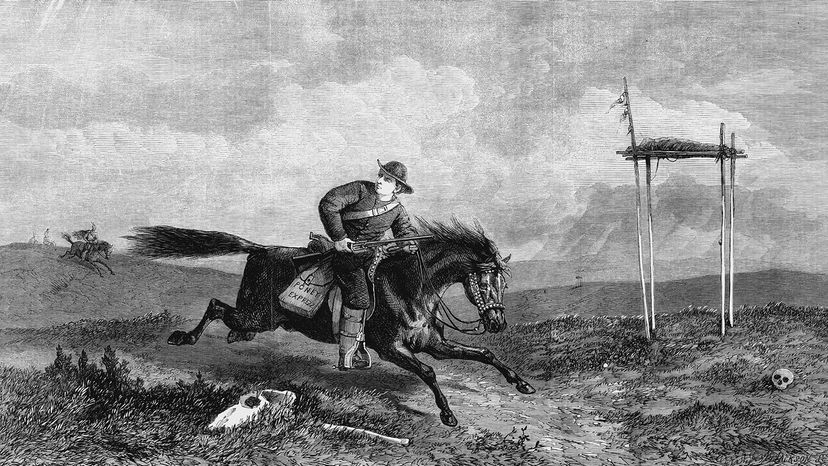
In the early 19th century, as the country's population began moving westward into the newly acquired territories of Louisiana, Oregon and California, the mail had to travel a much greater distance — particularly during the California gold rush. To meet the needs of the quarter-million people who now lived in the West, the Post Office Department awarded a contract to the Pacific Mail Steamship Company to carry mail to California. Mail traveled by ship from New York to Panama, moved across Panama by rail, then went on to San Francisco by ship. It should have taken three to four weeks for a letter from the East to travel to California, but it usually took longer.
There were also two stagecoach routes — the Southern and Central routes. The Central Route (from St. Joseph, Missouri, to Sacramento, California, via Salt Lake City) was shorter, but couldn't be used year-round because of cold weather through the Sierra Nevada Mountains. The Southern Route, from St. Joseph, Missouri, to San Diego, California, via San Antonio) took 25 days and carriers faced attacks from hostile Native Americans, as well as a lack of water. (St. Joseph was the most western point reached by the railroad and telegraph, which is why all the routes originated from there) [source: USPS].
Advertisement
The Butterfield Overland Mail Company had a government contract to carry mail using a third route that was even longer. Both Northern and Southern congressmen wanted the route to go through their territories as it was believed that the route would determine the future path of the transcontinental railroad. A compromise route included both St. Louis and Memphis as starting points, but mostly went in a southern direction. It took 21 days to make that trip, the shortest yet, but people wanted something even quicker.
The Pony Express was founded in 1860 by the Central Overland California and Pikes Peak Express (COC&PP), a freight company that supplied goods to the western part of the United States. COC&PP wanted the Butterfield Overland Mail Company's million-dollar government contract, so it set out to prove that the shorter Central Route could actually be used all year long. Original Pony Express mailing rates were $5 per half-ounce, but that was later lowered to $1 per half-ounce. This was at a time when ordinary mail costed 10 cents [source: USPS].
Eighty to 100 Pony Express riders made $100 a month to cover the 1,966 miles (3,164 kilometers) from St. Joseph, Missouri, to Sacramento, California — through Kansas, Nebraska, Colorado, Wyoming, Utah, Nevada and California. They crossed the Missouri River by ferry. At any given time, two riders were traveling on the route, one in each direction. They changed horses every 10-15 miles at one of the almost 200 stations located every 5-20 miles along the route. The riders went 75 to 100 miles before stopping and handing off the mail to the next rider. They averaged 10 miles per hour and completed the route in only 10 days, proving that the Central Route was faster. Riders had to be tough and fast. A famous hiring ad noted that orphans were preferred.
Despite its high rates, the Pony Express never made money. It never got the million-dollar government contract it hoped to receive. Further, on Oct. 24, 1861, the transcontinental telegraph line was completed, allowing people to send messages in minutes rather than days. So the Pony Express was shut down after only about 18 months in service, and COC&PP eventually sold it to Wells Fargo. Most mail for the next century was sent by rail and sorted on "mail trains." This declined during the 1960s with the widespread use of air travel.
Around this time, the Post Office Department was in financial trouble. Its management had little control over operations. As part of the ensuing reform, on July 1, 1971, the Post Office Department officially became the United States Postal Service (USPS). At that time it became an independent establishment of the executive branch of the U.S. government, not part of the cabinet. It also began operating more like a corporation, in that it had to use the money it earned, thanks to the official mail monopoly that was established under the Private Express Statutes in 1792, to fund itself. (Other government agencies are simply funded from general government revenue). Package delivery and express services do not fall under this law, which is why other companies can offer these services.