Introduction to How Serial Killers Work
![]() Pool/AFP/Getty Images Dennis Rader, the BTK Killer, on trial in 2005. |
This kind of killer doesn't just "go crazy" one day and kill a lot of people. He doesn't kill out of greed or jealousy. So what makes a person not only murder, but murder multiple people over periods of days, weeks and years? There's a special name for these types of murderers: serial killers. In this article, we'll learn about what makes them tick.
The term "serial killer" was coined in the mid-1970s by Robert Ressler, the former director of the FBI's Violent Criminal Apprehension Program. He chose "serial" because the police in England called these types of murders "crimes in a series" and because of the serial films that he grew up watching. Prior to this, these types of crimes were sometimes known as mass murders or stranger-on-stranger crime.
The FBI defines a serial killer as one who murders three or more victims, with "cooling-off" periods between each murder [source: U.S. Code]. This sets them apart from mass murderers, who kill four or more people at the same time (or in a short period of time) in the same place, and spree killers, who murder in multiple locations and within a short period of time. Serial killers usually work alone, kill strangers and kill for the sake of killing (as opposed to crimes of passion).
According to a recent FBI study, there have been approximately 400 serial killers in the United States in the past century, with anywhere from 2,526 to 3,860 victims [source: Hickey]. However, there's no way to really know how many serial killers are active at any point in time -- experts have suggested numbers ranging from 50 to 300, but there's no evidence to support them.
Serial murders also appear to have increased over the past 30 years. Eighty percent of the 400 serial killers of the past century have emerged since 1950 [source: Vronsky]. Why this is happening is a question of some debate; there is no answer, just as there is no simple answer as to why some people become serial killers.
In the next section, we'll look at some classifications of serial killers in use by criminal researchers and profilers so we can begin to understand this phenomenon.
Serial Killer Classifications
![]() Bill Frakes/Time & Life Pictures/Getty Images Serial killer Ted Bundy at his trial in 1979. |
According to Holmes typology, serial killers can be act-focused (who kill quickly), or process-focused (who kill slowly). For act-focused killers, killing is simply about the act itself. Within this group, there are two different types: the visionary and the missionary. The visionary murders because he hears voices or has visions that direct him to do so. The missionary murders because he believes that he is meant to get rid of a particular group of people.
Process-focused serial killers get enjoyment from torture and the slow death of their victims. These include three different types of hedonists -- lust, thrill and gain -- and power-seeking killers. Lust killers derive sexual pleasure from killing. Thrill killers get a "kick" from it. Gain killers murder because they believe they will profit in some way. Power killers wish to "play God" or be in charge of life and death.
Serial Killer Behavior
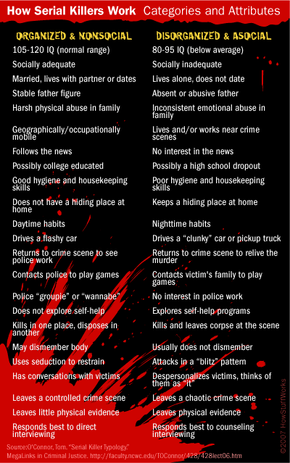
Serial killers can also be classified by their organizational and social skills. They can be organized or disorganized (depending on the type of crime scene) and nonsocial or asocial (depending on whether they are excluded by society or exclude themselves). The following chart illustrates behaviors of the two most common types.
![]() |
The majority of identified serial killers are organized and nonsocial. Most of them also follow some other basic patterns. More than 80 percent of serial killers are male, Caucasian and in their 20s or 30s [source: Hickey]. Serial killers are generally intelligent, and they usually kill Caucasian women. There's no way to "tell" a serial killer simply by his appearance -- most of them look like everyone else. Ted Bundy, who was convicted of 30 murders, was often described as attractive, charismatic and articulate. John Wayne Gacy was a popular figure in his community and often performed as a clown at block parties. He met with first lady Rosalynn Carter when he was precinct captain of his local Democratic Party. He was also convicted of the murders of 33 boys and men.
Often, serial killers exhibit three behaviors in childhood known as the MacDonald triad: bed-wetting, arson and cruelty to animals. They are also likely to have come from broken homes and been abused or neglected. Although some are shy and introverted, others are gregarious and outgoing but actually feel very isolated.
Many theorists point to the troubled childhoods of serial killers as a possible reason for their actions. We'll explore this and other theories for why they do it in the next section.
|
Serial Killer Motives
![]() Eugene Garcia/AFP/Getty Images Jeffrey Dahmer at his trial in 1991. He killed at least 17 men and boys. |
Neglect
and Abuse
One theory
centers around the neglect and abuse that many serial killers experience as
children. Robert Ressler and Tom Shachtman describe a study conducted by the FBI, which included
interviews with dozens of murderers (mostly serial killers). In each case, they
found “similar patterns of severe childhood neglect” [source: Ressler &
Shachtman]. During a child's development, there are important periods in which he learns about love, trust, empathy and basic rules about how to interact
with other human beings. If these traits aren't imprinted upon the child during
that period, it may not be possible for him to learn them later in life.
Serial killers were often physically or sexually abused as children or witnessed the abuse of family members. This pattern of neglect and abuse, some researchers say, leads serial killers to grow up without a sense of anyone other than themselves. But at the same time, many children grow up neglected and abused, but do not become violent criminals or serial killers.
On the next page we'll learn about mental illness and brain injury in serial killers.
|
Serial Killer Sanity
Serial-killer quiz |
Basically, a serial killer arguing "not guilty by reason of insanity" must prove that he did not understand right from wrong at the time that he killed. But it can be difficult to prove that he really did not understand that his actions would result in the death of the victims. Only two serial killers have successfully pled insanity. John Douglas, long-term head of the FBI's Investigative Support Unit, believes that serial killers "don't have a problem understanding what death means, and that they have the power to kill" [source: JohnDouglas.com].
Some serial killers have been diagnosed by psychologists and psychiatrists as psychopaths. The official term in the Diagnostic and Standard Manual of Mental Disorders, fourth edition (DSM-IV) is antisocial personality disorder (APD). According to the DSM-IV, a person with APD follows a pattern of "disregard and violation of the rights of others occuring since age 15 years." This pattern includes seven factors (three of which must be met for diagnosis), such as "failure to conform to social norms," "irritability and aggressiveness" and "lack of remorse" [source: Vronsky]. Psychopaths are not insane -- they do know right from wrong. But this diagnosis may explain their behavior during their killing cycles.
|
Brain Injury
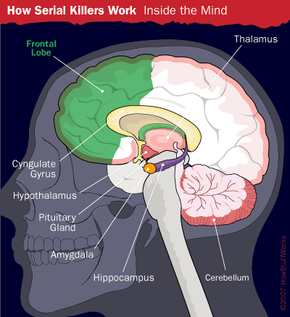
Some researchers theorize that serial killers have brain damage or other biological abnormalities that contribute to their actions. Damage to areas like the frontal lobe, the hypothalamus and the limbic system can contribute to extreme aggression, loss of control, loss of judgment and violence. Henry Lee Lucas, who was convicted of 11 murders, was shown to have extreme brain damage in these areas, probably the result of childhood abuse, malnutrition and alcoholism. Arthur Shawcross, another 11-time serial killer, was found to have had several brain injuries, including two skull fractures. While in prison, he suffered from headaches and often blacked out. Bobby Joe Long, convicted of nine murders, stated at one point, "After I'm dead, they're going to open up my head and find that just like we've been saying a part of my brain is black and dry and dead" [source: Scott].
In the next section, we'll see how law enforcement catches serial killers.
Catching a Serial Killer
A serial killer keeps killing until one of four things happens: he is caught, he dies, he kills himself or he burns out. Obviously once law enforcement determines that a string of murders can be attributed to one person, the goal is to catch him as soon as possible. But how do they figure this out? And how are serial killers caught?
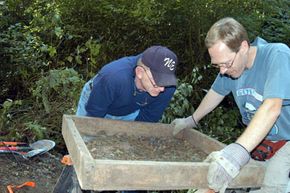
![]() King County Prosecutor's Office/Getty Images Investigators search for the remains of a victim of Gary Ridgway, the Green River Killer. |
In the aftermath of any homicide, investigating the crime scene and performing an autopsy are routine steps that law enforcement takes in an attempt to solve the crime. Once all of this information has been collected, it can be entered into a nationwide database run by the FBI, as part of ViCAP (Violent Criminal Apprehension Program). This program can help to determine patterns, or signatures, that link separate homicides.
According
to FBI profiler John Douglas, a signature "is a ritual, something the
subject does intentionally for emotional satisfaction -- something that isn't
necessary to perpetuate the crime” [source: JohnDouglas.com].
Some serial killers pose their victims in a certain way or leave them in a
certain place after killing them. Another signature might be a method of torture
or mutilation. It's what the killer does to fulfill his fantasies, and it can
tell investigators a lot about his personality.
Investigators also look at the MO, or modus operandi, of the crime. The MO reflects what the killer had to do to commit the crime. This includes everything from luring and restraining his victim to the way that he actually murders her. A serial killer's MO can change over time. Essentially, he learns from past mistakes and improves with time.
1 in 500 and 1 in 1,000 births [source: Palomar College]. So while it may be a factor, it certainly cannot be the only factor in determining the makeup of a serial killer |
Serial Killer Profiling
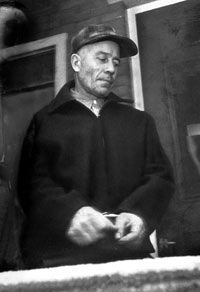
![]() Francis Miller/Time & Life Pictures/ Getty Images Ed Gein, the inspiration for the Buffalo Bill character in "The Silence of the Lambs" |
Profiles are not 100 percent accurate, but they're usually found to be very close. According to Robert Keppell, the detective who took Bundy's confession, the profile assembled for Bundy's crimes was perfect, "even to the point where they predicted he'd have a step-brother and that's what he had" [source: Bellamy].
Son of Sam Timeline |
But not all serial killers are caught. Some are arrested or picked up for other crimes, and evidence leads investigators to their murders. Ted Bundy was caught at a routine traffic stop, while David Berkowitz, the "Son of Sam," was initially picked up for loitering and was thought to be a witness to the crimes instead of the killer.
Once convicted, most serial killers either spend their lives in prison or are executed if the death penalty exists in their state. Ed Gein is one exception. At first found incompetent to stand trial, Gein was sent to a mental institution. Later his psychiatrist determined that he was competent, and a judge found him not guilty by reason if insanity. Gein died in 1984 of heart failure.
Most researchers agree that there is no way to "cure" a serial killer. Some serial killers who spent time in mental institutions after committing their crimes or received psychiatric treatment were deemed "cured" and released. But they went on to kill again. Peter Woodcock spent 35 years in a criminal psychiatric hospital in Ontario, Canada, after murdering three children. Within a few hours of his release, he killed a fellow psychiatric patient and was immediately sent back to the institution.
Until we know more about how to stop serial killers before they start to kill or refine ways of capturing them before they continue the cycle of murder, they will continue to be as much a part of reality as murder itself.
For lots more information about serial killers and related topics, check out the links on the next page.
Some people take this fascination a step further. Until recently, a search on eBay for "serial killer memorabilia" turned up personal items of convicted serial killers, including clothing, paintings and letters. EBay banned the sale of these and other "murderabilia" items after protests by victims' rights groups. One Web site sells serial killer action figures, calendars and trading cards. |
Lots More Information
Related HowStuffWorks Articles- How Crime Scene Investigation Works
- How Autopsies Work
- How Crime-scene Clean-up Works
- How DNA Evidence Works
- How Blood Works
- How Luminol Works
- How Profiling Works
- How Your Brain Works
- How Prisons Work
- Do criminal psychopaths enjoy other people's fear?
More Great Links
Sources
- Bellamy, Patrick. "On the Trail of Ted Bundy." The Crime Library. http://www.crimelibrary.com/criminal_mind/profiling/keppel1/1.html
- Douglas, John. "Violent Predators Hide Behind the Insanity Defense But They Know the Difference Between Right and Wrong." John Douglas: Mind Hunter. http://www.johndouglasmindhunter.com/articles/030201.php
- Douglas, John. "Linking Cases Together: Following a Killer's Signature." John Douglas: Mind Hunter. http://www.johndouglasmindhunter.com/articles/030210.php
- "Green River Killer avoids death in plea deal." CNN.com, November 5, 2003. http://www.cnn.com/2003/LAW/11/05/green.river.killings/index.html?
iref=newssearch - Hickey, Eric W. "Serial Murderers and Their Victims." Wadsworth/Thomson Learning, 2002.
- Holmes, Ronald M. and Stephen T. "Profiling Violent Crimes." Sage Publications, 2002.
- Karr-Morse, Robin and Meredeith S. Wiley. "Ghosts From the Nursery: Tracing the Roots of Violence." Atlantic Monthly Press, 1997.
- "Murder - Crime in the United States 2004." FBI. http://www.fbi.gov/ucr/cius_04/offenses_reported/violent_crime/murder.html
- O'Connor, Tom. "Serial Killer Typology." MegaLinks in Criminal Justice. January 23, 2006. http://faculty.ncwc.edu/TOConnor/428/428lect06.htm
- O'Neil, Dennis. "Sex Chromosome Abnormalities." Behavioral Sciences Department, Palomar College, January 1, 2007. http://anthro.palomar.edu/abnormal/abnormal_5.htm
- Ressler, Robert K. and Tom Schactman. "Whoever Fights Monsters." St. Martin's Press, 1993.
- Rhodes, Richard. "Why They Kill." Knopf, 1999
- Scott, Shirley Lynn. "What Makes Serial Killers Tick?" The Crime Library. http://www.crimelibrary.com/serial_killers/notorious/tick/victims_1.html
- U.S. Code. Title 18. Part 1, Chapter 1, Section 17 - Insanity Defense. http://www.law.cornell.edu/uscode/html/uscode18/usc_sec_18_
00000017----000-.html - U.S. Code. Title 28. Part II, Chapter 33, Section 540B - Investigation of Serial Killings. http://www.law.cornell.edu/uscode/html/uscode28/
usc_sec_28_00000540---B000-.html - ViCAP: FBI Investigative Programs Critical Incident Response Group. http://www.fbi.gov/hq/isd/cirg/ncavc.htm#vicap
- Vronsky, Peter. "Serial Killers: The Method and Madness of Monsters." Berkley Books, 2004.