Rosh Hashanah is one of the most important holidays in the Jewish religion. You may know quite a bit about the holiday, or you may know that it has something to do with apples and honey, and that it is a Jewish "High Holiday." You might have heard the greeting on this holiday "Shana Tova!" Or perhaps you know nothing about it at all.
In this article, you will learn about Rosh Hashanah -- where the holiday comes from, how people celebrate it, and what the "High Holiday" period is all about.
Advertisement
We'll start with the most basic question: What does Rosh Hashanah celebrate?
Rosh Hashanah is many things, but most people know it as the Jewish New Year. In fact, the significance of Rosh Hashanah encapsulates four major and interconnected themes. The holiday is:
- The Jewish New Year
- The Day of Judgement
- The Day of Remembrance
- The Day of Shofar Blowing
Rosh Hashanah is one of two High Holidays in the Jewish religion, the other being Yom Kippur, which occurs 10 days after Rosh Hashanah begins. These two holidays form the High Holiday period, arguably the most significant time in the Jewish year, as it marks the chance for repentance and forgiveness in the eyes of God. During the High Holidays, Jews cleanse their soul and get the chance to start fresh with an unburdened conscience and the intention of doing better in the coming year.
According to the Talmud, God created mankind on the first day of the month Tishri. As such, Rosh Hashanah commemorates the creation of the human race. It is a time for cleansing and renewal, a chance to receive forgiveness and clear the slate. The importance of the holiday is reflected in its two-day observance; most Jewish holidays are celebrated for only one day.
Rosh Hashanah, literally translated as "head of the year," is considered the Jewish New Year. But the holiday does not fall on the first day of the first month of the Jewish calendar. Rosh Hashanah begins with the first day of the seventh month, Tishri, and so is something of a symbolic New Year (at least in terms of what most people think of as "New Year's"). It is actually one of several New Year observations that occur throughout the year, and this particular New Year marks the opportunity to put the sins of the previous year in the past, and move forward having received God's forgiveness.
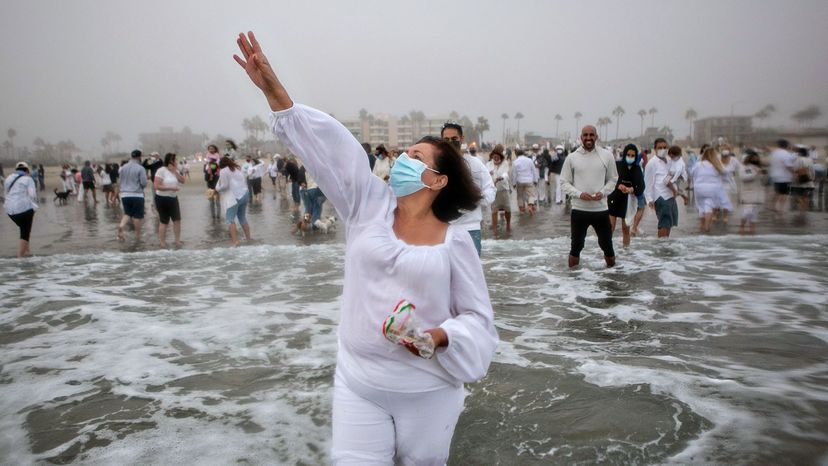
In this way, Rosh Hashanah is the Day of Judgement. One of the most prominent themes of the holiday revolves around the symbolic "Book of Life." A Jew's life depends on whether or not he or she makes the decision to make amends during the High Holiday period through the means of repentance (teshuvah), prayer (tfiloh), and charity (tzedakah). It is a key moment, a time to reflect on past mistakes and resolve in front of God to not repeat them in the coming year. It is also a celebration of man's free will -- making the conscious decision to look inside oneself, to look truly at one's life and make amends. In exercising this choice, which was given to him by God, man makes himself worthy of God's mercy.
On Rosh Hashanah, Jews often say to one another, "May you be inscribed and sealed in the Book of Life." The High Holiday period is a choice between life and death, righteousness and sin, and those who repent are on their way to being inscribed in the "Book of Life," which brings with it the promise of a good year. The belief is that on Rosh Hashanah, the names are written in the book, and on Yom Kippur (10 days later) the book is sealed. These 10 days are referred to as the Days of Awe.
As the Day of Remembrance, Rosh Hashanah recalls the story of Isaac's near-sacrifice, which Jewish tradition states occurred on the first of Tishri. In this biblical account, God commanded Isaac's father, Abraham, to sacrifice his only son as an offering. Abraham accepts God's command, builds an altar, and prepares to sacrifice his son to prove his obedience and faith in God. At the very last minute, an angel conveying God's wishes stopped Abraham from killing Isaac, and pointed out a ram caught by its horns in a nearby bush. The angel told Abraham to sacrifice the ram in place of Isaac -- Abraham had passed God's test.
As a result, God blessed Abraham. This story is recalled on Rosh Hashanah to remind Jews that submission before God is the way to attain God's mercy, and the truly righteous do not question God's will. They do as God commands and are rewarded for their faith.
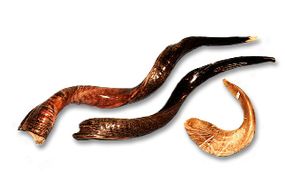
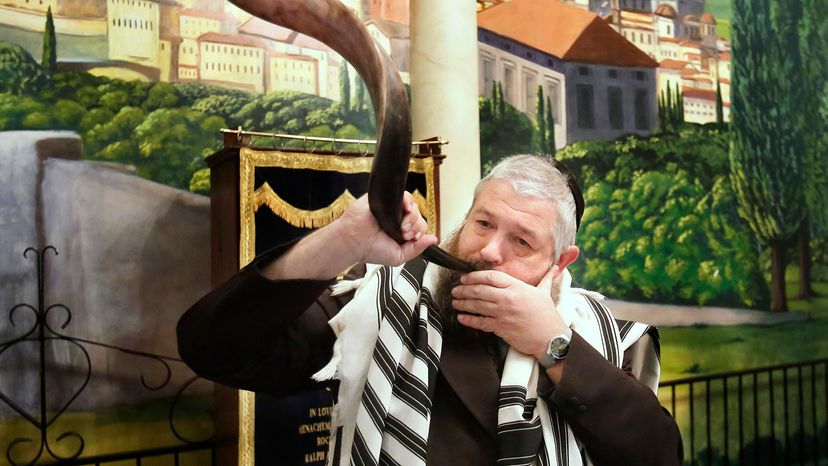
The last of Rosh Hashanah's main symbols is the shofar, which is a hollowed out ram's horn. The Day of Shofar Blowing has several implications, but there are at least three widely recognized meanings. One is to recall the story of Isaac -- of God sparing his life as a reward for Abraham's faith -- and to remember the ram that was sacrificed in Isaac's place.
Aside from recalling the story of Isaac, the shofar also calls to mind a coronation of sorts. Inasmuch as Rosh Hashanah is a celebration of the creation of human beings, it is also a celebration of God's kingship over human beings. The blowing of the shofar announces and reaffirms God as ruler of all mankind. The "trumpet-like" sound of the shofar also serves to stir the soul of all Jews, to awaken the Jewish people to the omnipotence and omnipresence of God and the chance to receive his mercy through prayer and repentance.
To hear what a shofar sounds like, visit this page from Torah Tots and scroll down to "The Shofar."
Advertisement