Preparation
More than 3,315 men and women were serving death sentences in American prisons as of December 2004, according to the U.S. Department of Justice. Many of these people have been on death row for decades, waiting as their cases work their way through the appeals process. Some will die before ever having to face the execution chamber. Still, the number of executions taking place in the United States continues to grow.
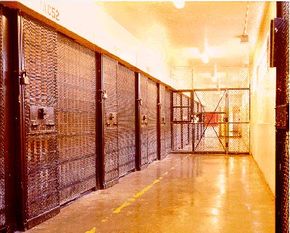
![]() Photo courtesy California Department of Corrections Condemned-inmate housing Adjustment Center at San Quentin State Prison |
Between 1977 and 1982, the years immediately following the reinstatement of the death penalty, there were a total of two executions. In 2004, there were 59 executions. An overwhelming number of these executions were carried out by lethal injection. On December 2, 2005, Kenneth Lee Boyd became the 1,000th person to be executed since 1977.
The capital-punishment process begins when a person is convicted of a crime and sentenced to death. However, the execution can be delayed for years while the condemned prisoner makes his appeals to the courts. In the meantime, the prisoner lives in a section of a state or federal prison called death row. The specific events that follow can vary from state to state, but the overall process is generally the same.
Once a prisoner's appeals are exhausted, an execution order is given and a date is set for the execution. The condemned inmate may be moved from the general condemned housing area into a special area of the prison, called death watch. This area may be housed in the same building as the execution chamber. Some states move the inmate to another prison -- a central prison where executions are carried out.
![]() In North Carolina, condemned inmates spend their last three to seven days in this death-watch cell at Central Prison in Raleigh, where 175 people are currently on death row. |
The Last 24 Hours
In the final 24 hours before the execution, a prisoner can be visited by several people, including family, friends, attorneys and spiritual advisors. These visits take place in the death watch area or a special visitation room, and are halted sometime during that last day.
![]() Just outside the death-watch cell at North Carolina's Central Prison. Some inmates are allowed to spend time in this area. Their last meal is served at this table. |
In the final few hours, several events take place in preparation for the execution. They do not necessarily occur in the order listed here and don't apply to every state:
- Last meal is provided - Prisons try to provide whatever meal is requested by the condemned prisoner.
- Warden and chaplain visit - The warden and the state-appointed chaplain visit with the inmate and stay until the end of the execution.
- Witnesses arrive - There is no contact allowed between witnesses and the condemned prisoner. Witnesses are typically restricted to the witness room adjacent to the execution chamber, and are instructed to remain silent.
- Inmate makes final preparations - In some states, male inmates are given a fresh pair of pants and a shirt, female inmates a dress, and the prisoner is allowed to shower before getting dressed. In other states, the inmate must remove all outer clothing.
- Heart monitor is connected - The inmate is connected to an electrocardiogram (EKG) machine, which will be monitored for flat line to determine when the heart stops and death has occurred.
Once the inmate is dressed, he or she waits in the death-watch cell with a spiritual advisor until the warden gives the signal to bring the prisoner to the execution chamber. The prisoner is brought to the chamber just a few minutes before the scheduled execution.


