What was the largest protest in history?

AP Photo/Aaron Favila
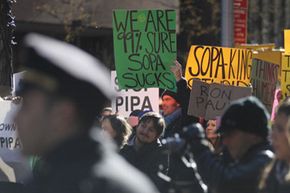
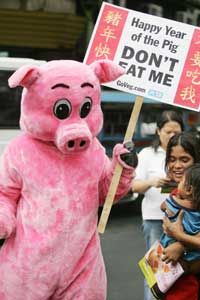
You don't need thousands of people for a protest -- one man in a pig costume can grab plenty of media attention on his own.
Unless you've just recently wandered out of a magical kingdom, you've probably noticed something about the human race: People don't get along with each other all that well. Oh sure, in small groups, they'll forge unbreakable bonds of friendship and love. In larger numbers, they can even prove remarkably tolerant at times. Nevertheless, in the end, the old adage holds true: You can't please all of the people all of the time.
The tiniest of issues, such as choosing a pizza topping, can prove violently divisive, and the big issues of religion, politics and human rights are the stuff of unending warfare and long-standing cultural division. When humans disagree with a stance or policy maintained by either the social majority or a center of political or economic power, they often lift their voice in protest.
Up Next |
The methods of protest vary greatly. One activist may create a stirring piece of art to highlight his or her cause, or a thousand activists may rally together in the streets. Either way, the aim is simple: Draw enough attention to a message, convince enough people of your cause's moral superiority and you can change the way a government, industry or society acts and thinks.
But just how unified can such an argumentative species get? If you look back through the annals of recorded history, what protest has gathered the largest number of people to a single place?
Read the next page to find out.The Voice of Millions

AP Photo/Plinio Lepri
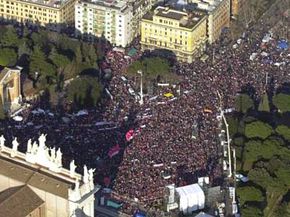
Protesters fill St. John Lateran square during an antiwar rally in Rome on Feb. 15, 2003. An estimated 3 million participants turned out for the event.
The Earth is currently home to an estimated 6.7 billion people, distributed among roughly 240 countries, 6,912 languages and more branches of religion and personal belief than can be counted easily. Our numbers continue to grow to this day.
Yet there are still events and causes that can unite mere millions of us. Wars have long brought together millions in pitched battles. In 480 B.C., the Persian Army marched into the Battle of Thermopylae with between 200,000 and 500,000 men. More than 2,000 years later, in 1943, the Soviet Union's Red Army suffered more than a million casualties at the Battle of Stalingrad. Still, humans often come together for reasons that don't involve massive invasions by foreign forces. During January 2007, an estimated 60 million Hindu pilgrims gathered at the convergence of the Ganges and Yamuna rivers in northern India for the Ardh-Kumbh Mela, or festival [source: BBC].
When it comes to protests, the book of Guinness World Records currently lists the Feb. 15, 2003, Iraq War protest in Rome as the largest antiwar rally in history. The event drew an estimated crowd of 3 million. On that same day, protesters gathered in nearly 600 cities in a coordinated global effort to express moral outrage against the U.S. invasion of Iraq. This included a reported 1.3 million protesters in Barcelona, Spain, and between 750,000 and 2 million protesters in London [sources: Guinness Book of World Records, BBC]. All told, between 6 and 10 million people participated in the global protest [source: BBC].
Of course, not all protests are rallies. During the early 20th century, Mahatma Gandhi led millions of Indians in protest against British rule through noncompliance. Indian public officials resigned, parents withdrew their children from British schools and participants boycotted British goods. Exact figures for such a movement are difficult to calculate.
Explore the links on the next page to learn even more about protests.Lots More Information
Related HowStuffWorks Articles
- How Protests Work
- How Terrorism Works
- How Riot Control Works
- How the ACLU Works
- How the Civil Rights Movement Worked
- How Labor Unions Work
- How the U.S. Draft Works
- How Strikes Work
More Great Links
Sources
- "Battle of Stalingrad." Britannica Online Encyclopædia. 2009. (Jan. 27, 2009)
http://www.britannica.com/EBchecked/topic/562720/Battle-of-Stalingrad - "Languages of the world." National Virtual Translation Center. 2007. (Jan. 27, 2009)
http://www.nvtc.gov/lotw/months/november/worldlanguages.htm - "Largest Anti-War Rally." Guinness World Records. 2004. (Jan. 27, 2009)
http://web.archive.org/web/20040904214302/
http://www.guinnessworldrecords.com/content_pages/record.asp?recordid=54365 - Miller, J.D. "Thermopylae." Millitary History Online. April. 17, 2005. (Jan. 27, 2009)
http://www.militaryhistoryonline.com/ancient/articles/Thermopylae.aspx - "'Million' march against Iraq war." BBC News. Feb. 16, 2003. (Jan. 27, 2009)
http://news.bbc.co.uk/2/hi/uk_news/2765041.stm - "Millions bathe at Hindu festival." BBC News. Jan. 3, 2007. (Jan. 27, 2009)
http://news.bbc.co.uk/2/hi/south_asia/6226895.stm - "Millions join global anti-war protests." BBC News. Feb. 17, 2003. (Jan. 27, 2009)
http://news.bbc.co.uk/2/hi/europe/2765215.stm - "Rank Order -- Population." C.I.A. World Fact Book. Jan. 22, 2009. (Jan. 27, 2009)
https://www.cia.gov/library/publications/the-world-factbook/rankorder/2119rank.html