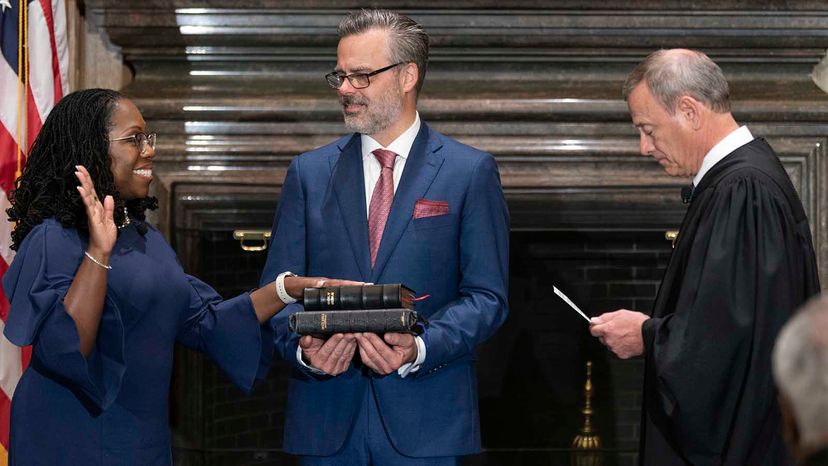
Chief Justice John G. Roberts, Jr. (right) administers the Constitutional Oath to Judge Ketanji Brown Jackson (left) in the West Conference Room of the Supreme Court June 30, 2022, in Washington, D.C. with her husband Patrick Jackson looking on. Fred Schilling/Collection of the Supreme Court of the United States via Getty Images
On Jan. 27, 2022, long-time Supreme Court Justice Stephen Breyer announced that he would retire, effective at the end of the current term, giving President Joe Biden his first opportunity to appoint a justice to the bench since being elected president. After a rigorous search to identify Breyer's replacement, Biden announced Feb. 25, 2022, he selected Judge Ketanji Brown Jackson to serve as the next associate justice on the Supreme Court.
Of course, appointing Supreme Court justices is the job of the POTUS. Former president Donald Trump nominated — and the Senate confirmed — three justices while he was in office. Trump's last nominee, associate justice Amy Coney Barrett, was confirmed just 30 days after Trump nominated her and less than six weeks after her predecessor, the late justice Ruth Bader Ginsburg, died.
Advertisement
These nominations are nothing new. But they have been matters of tremendous importance to American law almost since the inception of the United States.
A president's nomination to the Supreme Court can make a profound impression on history, so it's important to understand how these appointments work. From how justices are nominated, to who's qualified to serve and how a nominee is approved, it's a pretty involved process. And of course, there are some complicated politics that come into play.
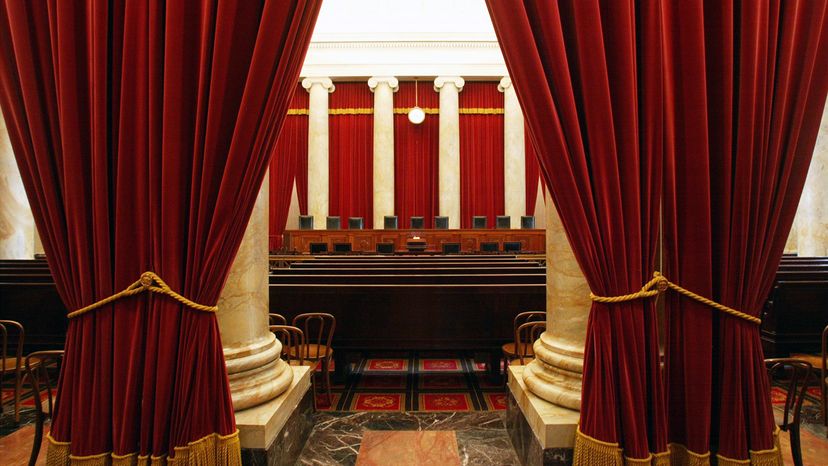
An interior view of the courtroom of the U.S. Supreme Court as seen in August 2003 before a five-year modernization project was completed in 2008. Alex Wong/Getty Images
The Supreme Court is the highest court in the United States. As the judicial branch of the U.S. government, it serves to balance the powers of the legislative and executive branches and stands as the final word in any given legal dispute. Once the Supreme Court makes a decision, no other court can review or overturn that decision.
Today, the authority of the Supreme Court is very clear. Roughly 7,000 to 8,000 cases are submitted to the court every year, but it only has time to take on about 80 of them [source: Supremecourt.gov]. Usually, the Supreme Court only accepts cases that:
involve treason, ambassadors or disputes with other countries
The Supreme Court did not always have this power, however. The Constitution is very vague about the authority of the court, saying only that its "Power shall extend to all Cases, in Law and Equity, arising under this Constitution." The specifics, such as where and when the court would meet, how many justices there would be and exactly what is covered under "cases arising under this Constitution" were left to Congress to decide later. It wasn't until Justice John Marshall's 1803 decision in Marbury v. Madison that the Supreme Court's authority to judge matters of constitutionality was determined.
When the Supreme Court renders a decision (by a simple majority, or at least five of the nine justices), all other courts in the country follow the precedent set by that decision. So when a case comes before the court, the ruling affects not only the specific case and law in question, but also similar laws and cases nationwide.
For example, if the Supreme Court decides that a law in Maine banning signs on front lawns with anti-war messages is unconstitutional, any state or municipality with the same kind of law would be unable to prosecute anyone for breaking it. Judges all the way from county courts to state supreme courts would look to the Supreme Court's decision and throw out the case because it was based on an unconstitutional law.
Supreme Court justices have a great deal of power for another reason, too: They are appointed for life. That means that they never have to face re-election, and they don't have to make sure that their decisions please the president who appointed them. The average justice serves for 14 years and retires at age 71 [source: Supremecourt.gov].
When a justice retires, he or she usually tries to time it with the court's summer recess so a replacement can be found before the next session. If a replacement hasn't been found in time, the court can operate with however many justices are present. If the court operates with an even number of justices, and a decision results in a tie, the lower court decision in the case is "passively upheld." That is, it is upheld for that particular case, but the Supreme Court doesn't issue an opinion or set any kind of legal precedent. Thus, a similar case could come before the Supreme Court in the future.
Next, we'll find out how Supreme Court justices are nominated and approved.
Advertisement
Who Is Qualified?
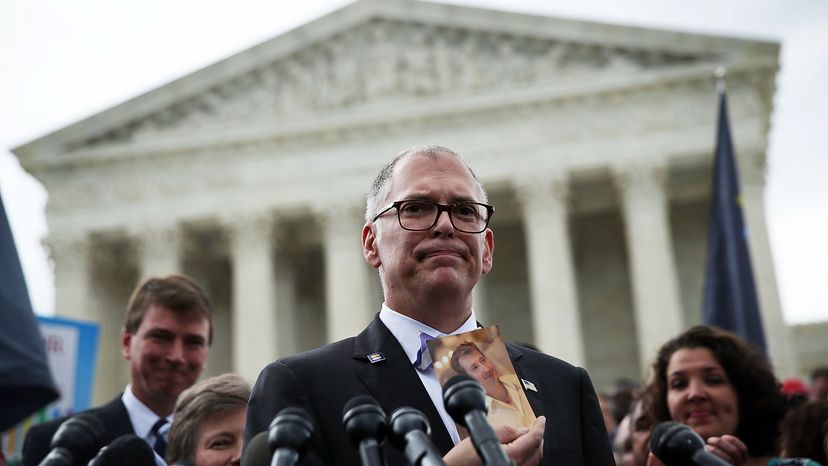
Plaintiff Jim Obergefell holds a photo of his late husband, John Arthur, as he speaks to the media on June 26, 2015, after the U.S. Supreme Court handed down a ruling that legalized gay marriage in all 50 states. Alex Wong/Getty Images
The president nominates justices to the Supreme Court, subject to majority approval by the Senate. There are no rules spelled out in the Constitution regarding the qualifications of judicial candidates, so technically, the president can nominate any judge he or she wants. However, there are certain traditional attributes that viable candidates for a spot on the Supreme Court should have if he or she is to have any chance of Senate approval.
Every Supreme Court justice has been a lawyer, and for the last 150-plus years they have all been graduates of accredited law schools. John Marshall, considered one of the greatest justices to ever serve on the Supreme Court, only attended law school for a few weeks. He studied law as a teenager by borrowing law books from a nearby lawyer.
Advertisement
For the last few decades, almost all Supreme Court nominees have previously been federal judges. Nominees generally have participated in politics to some extent, though this can take many forms. Some have been involved in unions or other politically active groups, while some served in Congress or were state governors. One chief justice was a former president — Howard Taft became Chief Justice in 1921, eight years after he left the Oval Office.
Landmark Cases in Supreme Court History
1803: Marbury v. Madison established the Supreme Court as the ultimate word on constitutionality.
1857: Dred Scott v. Stanford found that slaves have no legal rights under the Constitution.
1896: Plessy v. Ferguson determined that "separate but equal" treatment of blacks and whites is constitutional.
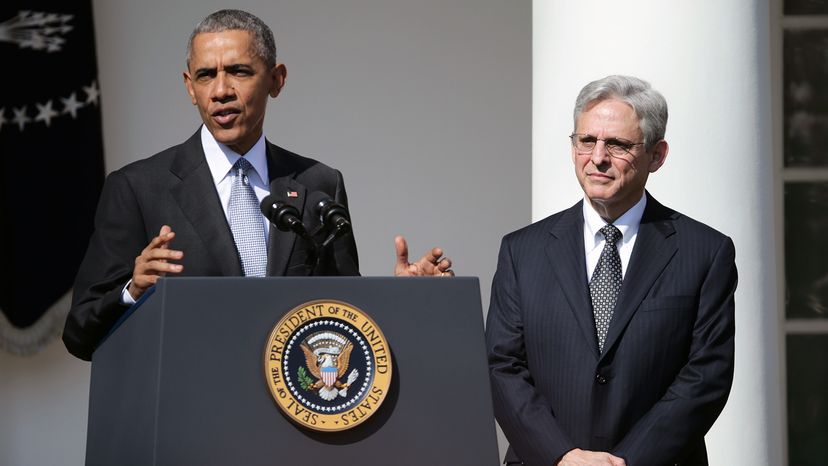
U.S. President Barack Obama stands with Merrick B. Garland, his nominee for Supreme Court justice, on March 16, 2016, in Washington, D.C. Garland's nomination was never brought to a vote in the Senate by then-Majority Leader Mitch McConnell. Chip Somodevilla/Getty Images
Once the president nominates someone (usually via personal phone call to that person) and releases the name, the Senate holds hearings. At these hearings, senators interview the nominee regarding his or her record as a judge and lawyer and where he or she stands on key issues. If the nominee has any dark secrets or past indiscretions, they are likely to come out in the Senate hearings, as well.
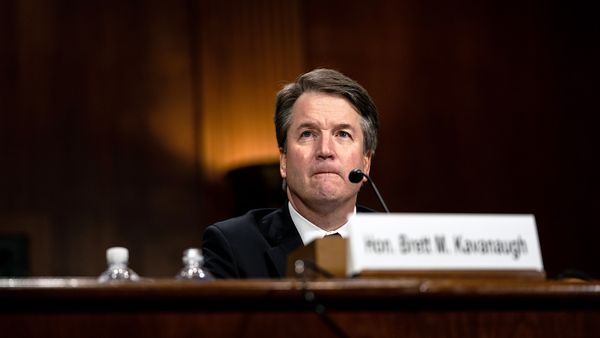
Until the controversial and contested 2018 hearings for Brett Kavanaugh, perhaps the most infamous instance of the past coming to light occurred at the confirmation hearings for Clarence Thomas, who was accused of sexual harassment by former colleague Anita Hill. Thomas was eventually confirmed by the Senate despite the controversy, as was Kavanaugh.
Advertisement
The overwhelming majority of Supreme Court nominees are approved by the Senate. There are some conflicting statistics, but the Congressional Research Service (CRS) reports there have been only 36 rejections out of 158 nominees since 2007 [source: Hogue].
Before the 20th century, these hearings were held behind closed doors. In fact, the nomination process was almost completely unseen to the public. The president might seek the advice of friends and associates, but he made the choice on his own and even contacted and interviewed potential candidates on his own time. Today, members of the White House staff and the Justice Department are all involved in the decision, creating lists of candidates and sometimes competing with one another to promote a particular candidate. Former president Trump's shortlist to replace retiring Justice Kennedy was assembled with the help of both the conservative Federalist Society and Heritage Foundation [source: Wolf].
President Biden vowed to nominate the first Black woman to the Supreme Court. He followed through on that promise when he nominated Ketanji Brown Jackson Feb. 25, 2022. She was confirmed by the Senate April 7, 2022 with bipartisan support in a 53-47 vote. Also, since 1930, the confirmation hearings have been completely open to the public. They have been televised since 1981.
There are several ways that a nominee can fail to become a Supreme Court justice. Seven nominees throughout history have simply declined the nomination. If it appears that there is great opposition to a candidate, the president can withdraw the nomination, or the nominee can withdraw him- or herself. The Senate also can reject a nominee. Once rejected, a nominee can be submitted again, but this is a foolish course of action for the president unless something has changed that might lead to a different vote by the Senate. In 1836, Andrew Jackson nominated Roger Taney, but the Senate rejected him. A few months later, Jackson nominated Taney again. In that time, congressional elections had been held, and the Senate was now more favorable to Jackson. Taney was confirmed.
And then of course there's the case of Merrick Garland, who President Obama nominated in March 2016 to replace the late Justice Antonin Scalia. Senate Majority Leader Mitch McConnell (R-Ky.) refused to bring a vote to the floor of the Senate to confirm Garland because it was an election year. McConnell said the new president — not Obama — should be the one to decide on the new justice, which experts at the time said was unprecedented. However, McConnell's gamble paid off, and Trump took the Oval Office, eventually appointing conservative Neil Gorsuch to the bench in place of Garland.
Advertisement
The Politics of Nomination
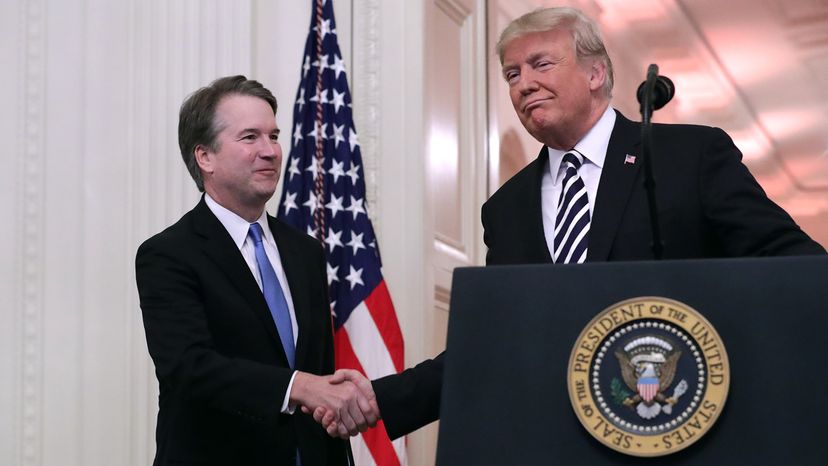
Supreme Court Justice Brett Kavanaugh shakes hands with Donald Trump during Kavanaugh's ceremonial swearing in at the White House Oct. 8, 2018. Kavanaugh was confirmed in the Senate 50-48 after a contentious process that included several women accusing Kavanaugh of sexual assault. Kavanaugh denied the allegations. Chip Somodevilla/Getty Images
It is not a simple matter for the president to make a Supreme Court appointment. Many factors can influence the choice, and the consequences for the president and their political party can be dramatic even if the nominee is approved.
First, the president and their advisers must consider the qualifications of the candidates. In recent decades, almost all nominees have been federal judges. However, there is no rule that requires this. Even looking beyond the ranks of federal judges, the list of candidates who are both qualified and likely to accept the nomination may not be extremely long.
Advertisement
The factor that draws the most political and media attention is the ideology of the nominee. The president wants to appoint someone who agrees with their views. A president who opposes abortion would want a justice who shares that opposition. However, there are a lot of issues to worry about, and it is nearly impossible to find a candidate who is a "perfect fit" on all of them.
Even if the president finds a candidate with the desired outlook on important issues, those issues might conflict with the majority in the Senate. If the Senate is ruled by the opposing party, the president will have a difficult time getting a confirmation on a nominee with radical views. If the president's party controls the Senate, it will be much easier to confirm a nominee with views in line with that party, but it could still have a political cost in terms of public approval.
The president's popularity with the public is an important factor. If the president has low popularity, or popularity is evenly split, then pushing through a nominee with views that are perceived as "outside the mainstream" can galvanize opposition to the president and his party, leading to potential defeats in upcoming elections. This also explains why nominees who are named closer to an upcoming election tend to be more moderate — the president doesn't want to anger the public.
The political leaning of the outgoing justice typically plays a role in the politics of nomination, as well. If a retiring justice is a political liberal, Senate liberals might fight a conservative candidate in order not to lose a seat on the court that supports their ideology. In that case, the president might do better to nominate a moderate candidate. If the outgoing justice is a conservative, however, the Senate liberals might accept a conservative appointment as maintaining the status quo.
Still, as we'll find out in the next section, there's no guarantee that the judges the president does appoint will vote the way he or she thinks they will.
Advertisement
Independent Judges
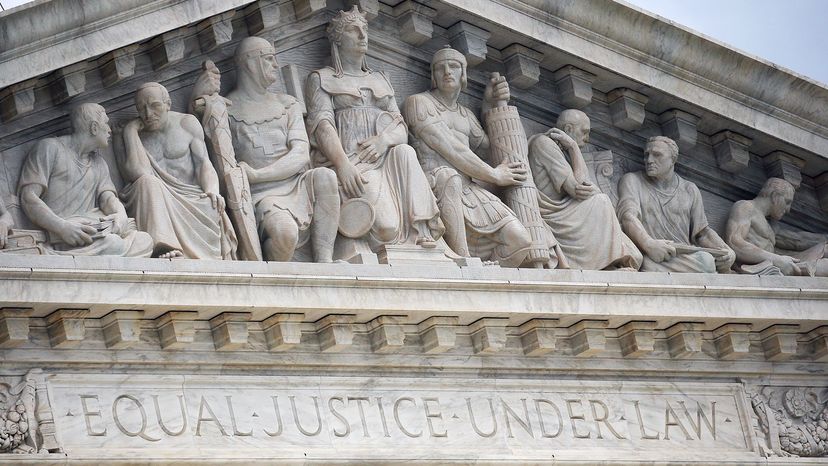
The carving on the front of the U.S. Supreme Court building reads 'Equal Justice Under Law.' Mark Wilson/Getty Images
Even if the president gets his or her ideal nominee confirmed by the Senate, there are no guarantees that the justice will decide cases in the way the president hopes. Why would justices fail to cooperate with the president's wishes? Because that's their job.
Although the president appoints the justice, there is no political loyalty owed to the president. The Supreme Court is equal in power to the executive branch. The job of the justices is to weigh the law against the rights guaranteed by the Constitution, not to support any one political ideology. Obviously, the personal opinions of the justices come into play, and in many cases, these coincide with those of the president. When that happens, the president gets exactly what he or she intended — a Supreme Court justice who supports the president's doctrines and beliefs.
Advertisement
However, when a justice enters the Supreme Court building, which bears the motto "Equal Justice Under Law," even those who were certain they would bring the weight of their views to the position and reshape the law are often impressed by the honor and responsibility with which they have been entrusted. Justice Felix Frankfurter once said, "As a member of this court I am not justified in writing my private notions of policy into the Constitution, no matter how deeply I may cherish them or how mischievous I may deem their disregard." Many justices have felt the same. The justices who are regarded as the greatest in history are those who were able to examine cases logically, understand both sides of an issue and render judgment based on facts and the law rather than their personal feelings.
One example of judicial independence occurred during the Watergate scandal. In 1974, the Supreme Court decided that President Richard Nixon had to turn over his White House audio recordings to investigators, discarding his contention that executive privilege should allow him to keep the tapes private. Three of the justices who sided against Nixon had been appointed by him.
More recently in 2022, the Supreme Court refused an appeal from former president Donald Trump to block the release of White House records related to the Jan. 6, 2021, incident at the Capitol. Trump sought to block the release of the papers claiming executive privilege. Justice Clarence Thomas was the lone justice to dissent.
For more information on Supreme Court appointments and related topics, check out the links that follow.
Aaseng, Nathan. "Great Justices of the Supreme Court." Oliver Press, 1992. 1-881508-01-3
Chung, Andrew. "Biden vows to nominate Black woman to U.S. Supreme Court by end of February." Reuters. Jan. 27, 2022 (Feb. 2, 2022) https://www.reuters.com/world/us/retiring-us-justice-breyer-appear-with-biden-white-house-2022-01-27/
Hogue, Henry. "Supreme Court Nominations Not Confirmed, 1789-August 2010." Congressional Research Service. (June 28, 2018) http://www.fas.org/sgp/crs/misc/RL31171.pdf
Landmark Cases of the Supreme Court. "Brown v. Board of Education." (June 28, 2018) http://landmarkcases.org/en/landmark/cases/brown_v_board_of_education
Landmark Cases of the Supreme Court. "Dred Scott v. Sandford." (June 28, 2018) http://landmarkcases.org/en/landmark/cases/dred_scott_v_sandford
Landmark Cases of the Supreme Court. "Marbury v. Marshall." (June 28, 2018) http://landmarkcases.org/en/landmark/cases/marbury_v_madison
Landmark Cases of the Supreme Court. "Plessy v. Ferguson." (June 28, 2018) http://landmarkcases.org/en/landmark/cases/plessy_v_ferguson
Landmark Cases of the Supreme Court. "Roe v. Wade." (June 28, 2018) http://landmarkcases.org/en/landmark/cases/roe_v_wade
Landmark Cases of the Supreme Court. "United States v. Nixon." (June 28, 2018) http://landmarkcases.org/en/landmark/cases/united_states_v_nixon
Liptak, Adam. "In Rebuke to Trump, Supreme Court Allows Release of Jan. 6 Files" The New York Times. Jan. 19, 2022. (Feb. 2, 2022) https://www.nytimes.com/2022/01/19/us/politics/trump-supreme-court-jan-6.html
Mazzotta, Symone. "West Virginia v. Barnette: The freedom to not pledge allegiance." National Constitution Center. June 14, 2017. (Feb. 2, 2022) https://constitutioncenter.org/blog/west-virginia-v.-barnette-the-freedom-to-not-pledge-allegiance
Oyez.org. "Marbury v. Marshall." (June 28, 2018) https://www.oyez.org/cases/1789-1850/5us137
Oyez.org. "Obergefell v. Hodges." (June 28, 2018) https://www.oyez.org/cases/2014/14-556
Scotusblog.com. "Shelby County v. Holder." (June 28, 2018) http://www.scotusblog.com/case-files/cases/shelby-county-v-holder/
Supreme Court of the United States. "FAQs - General Information." (June 28, 2018) https://www.supremecourt.gov/about/faq_general.aspx
Supreme Court of the United States. "Trump v. Thomas." Jan. 19, 2022. (Feb. 2, 2022) https://www.supremecourt.gov/opinions/21pdf/21a272_9p6b.pdf
Wolf, Richard. "Justice Anthony Kennedy to retire, opening Supreme Court seat for President Trump." June 27, 2018 (June 28, 2018) https://www.usatoday.com/story/news/politics/2018/06/27/justice-kennedy-retiring-opening-supreme-court-seat/952716001/
Yalof, David Alistair. Pursuit of Justices. University of Chicago Press, 1999. 0-226-94545-6.
Cite This!
Please copy/paste the following text to properly cite this HowStuffWorks.com article: