Introduction to How the Papacy Works
|
|
![]() Photo courtesy Adam J. Polczyk-Przybyla / DHD Multimedia Gallery Inside the Vatican |
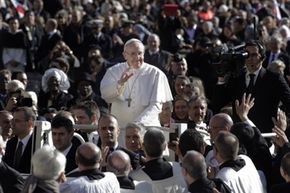
Catholics look to Vatican City in Rome, where the pope lives, for their spiritual leadership. The pope is the head of the Roman Catholic Church and the Vatican's head of state. The pope's governance of the Catholic Church is termed his Papacy. You often hear the pope called by many other names, including Papa, Vicar of Christ, Holy Father, and Bishop of Rome.
In this article, we will examine the jurisdiction of the Papacy of the Roman Catholic Church, discuss how someone becomes pope, and review some of the duties a pope performs.
|
Born: April 16, 1927 Birthplace: Marktl am Inn, Germany Original name: Joseph Ratzinger Elected pope: April 19, 2005 Only three days after his 78th birthday, Joseph Ratzinger was named as the successor to Pope John Paul II -- making him the oldest Pope at the time of his election in more than 250 years. During his first mass as Pope, Benedict XVI declared that he wants to work toward unifying all Christians. He also stated that he wants to continue an "open and sincere dialogue" with other religions. Reportedly, Ratzinger took on the name "Benedict" in honor of the last Pope Benedict (Benedict XV, an Italian, served as Pope from 1914 to 1922). An accomplished linguist much like his predecessor John Paul II (who spoke eight languages), Benedict XVI speaks 10 languages. Life Highlights
|
Papal Authority
As head of the Roman Catholic Church, the pope is the supreme spiritual leader of the Church and controls the church doctrine. With a billion followers, the pope's decisions impact societies and governments all over the world.
![]() Photo courtesy Adam J. Polczyk-Przybyla / DHD Multimedia Gallery Pope John Paul II at his window above St. Peter's Square in Vatican City |
To understand the authority of the papacy, we should first understand a little history of the Roman Catholic Church.
The Catholic Church dates back to the time of Jesus Christ, when Christ selected Peter to lead his Church. In the book of Matthew (16:18) of the Bible, Christ says to Peter, "And I say also unto thee, That thou art Peter, and upon this rock I will build my church; and the gates of hell shall not prevail against it." This statement, now known as the Petrine guarantee, gave Peter the fullness of power, according to the New Catholic Encyclopedia.
Many theologians believe the "rock" of which Christ spoke is Peter himself. Peter's original name was Simon; Christ gave Peter another name, Cephas, an Aramaic word meaning "rock." Aramaic is the language that Christ spoke. Knowing this, Matthew 16:18 can be interpreted as Christ saying that he is building his Church on the strength of Peter. Further evidence of this conferment of power is in John 21:15-19, when Christ tells Peter, "Feed my sheep."
Upon Christ's ascension, Peter became the undisputed leader of the Church based on the powers given from Christ to Peter. At some point in his life, likely at the end of his life, Peter moved to Rome to spread the word of Christ, according to the New Catholic Encyclopedia. It was in Rome where Nero, the Roman emperor who persecuted the church, killed Peter. Through his death, Peter became a martyr. His body was buried on Vatican Hill. St. Peter's Cathedral was later erected over his grave.
![]() Photo courtesy Caroline Skene / DHD Multimedia Gallery St. Peter’s Square in Vatican City |
During his life, Peter was never officially the bishop of Rome or the pope, but in honor of his work and his role as the head of the Church, he is recognized as the first pope. Every pope since Peter is considered the immediate successor of Peter, and not of that pope's immediate predecessor. A pope is considered to be carrying on the power that Christ granted Peter. Today, a great amount of the pope's powers are derived from the Petrine guarantee, which is etched in Latin around the perimeter of dome of St. Peter's Cathedral.
The pope's powers were bolstered in the First Vatican Council in 1870, when 433 bishops passed the decree of papal infallibility. This decree declared that the pope was infallible in matters of faith and morality. According to the decree, the pope "is possessed of that infallibility with which the Divine Redeemer wished His Church to be endowed."
The next two sections explain the process of papal succession.
|
The Passing of a Pontiff
When a pope dies, the non-theological authority of the papacy passes temporarily to the Cardinal Camerlengo, or chamberlain, who is the Vatican's Secretary of State. Camerlengo has many responsibilities when the pope dies. First, he confirms the pope's death by calling the pope's name three times without response. He then authorizes the pope's death certificate, and closes and locks the pope's private apartment in the Apostolic Palace of the Vatican. The Camerlengo also organizes and presides over the election of the next pope.
![]() Photo courtesy Adam J. Polczyk-Przybyla / DHD Multimedia Gallery St. Peter's Basilica, Vatican City |
The pope's body lies in repose for nine consecutive days, during which time the Cardinals of the Catholic Church celebrate the funeral rites. No one is allowed to photograph or film the pope while he is on his sickbed or after his death. The Cardinal Camerlengo may permit post-mortem photographs for documentary purposes only after the pope is attired in his pontifical vestments.
Prior to burial, the pope's body is placed inside a coffin that is encased in two others. The coffins are made of cypress, elm, and lead. The pope is typically buried in the tombs below St. Peter's Basilica, where St. Peter is buried.
During the time between the pope's death and the election of a new pope, the world focuses on the tiny sovereignty of Vatican City. In the next section, we will examine the complex process by which a pope is elected.
Electing the Next Pope
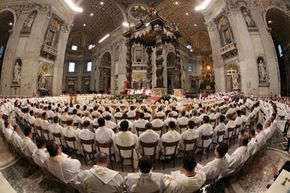
The College of Cardinals elects a new pope in conclave, which is the process of sequestering the voting members of the college in Vatican City so that they have no contact with the outside world. The word "conclave" comes from the Latin phrase cum clavis, meaning "with key." The term is suitable since the cardinals are locked inside the Sistine Chapel in the Apostolic Palace during the voting process.
|
|
In 1996, Pope John Paul II described the complex procedures that would be used to elect the next successor to St. Peter, in an Apostolic Constitution called Universi Dominici Gregis (UDG). It is an accepted practice for popes to publish the norms that regulate the election of their successors, and popes often make small adjustments to the procedures. According to John Paul II, these changes are made "with the intention of responding to the needs of the particular historical moment."
The UDG laid out these rules for electing a new pope:
- The maximum number of electors from the College of Cardinals is 120. The college is currently composed of 194 cardinals.
- Any cardinal who turns 80 before the day the Papacy is vacated, either by death or resignation, cannot take part in the election. Currently, 135 cardinals are eligible to vote under this rule (15 of those 135 would be disqualified from the vote because the limit is 120).
- A two-thirds-plus-one majority is required to elect a pope.
- Two ballots each are held in the morning and afternoon, for a total of four per day.
- If a new pope is not selected after 12 to 13 days, the cardinals may choose to impose a majority vote, which would allow selection of a new pope by a simple majority.
Each rectangular ballot is inscribed at the top with the words Eligo in Summum Pontificem, meaning "I elect as supreme pontiff." Below these words, each cardinal writes down the name of the person he chooses as the pope. The vote is done in secret with paper and pen. The voting cardinal then folds the ballot twice, holds it in the air, and carries it the chapel's altar. He then says, "I call as my witness Christ the Lord who will be my judge, that my vote is given to the one who before God I think should be elected." The cardinal places the ballot on a plate that sits atop the ballot receptacle and uses the plate to drop the ballot into the receptacle. After bowing before the altar, he returns to his seat.
Three Scrutineers, who are selected by all of the cardinals, are charged with counting the ballots. Once the ballots are collected, the Scrutineers count the ballots to determine if everyone has voted. If the number of ballots doesn't match the number of electors, the ballots are immediately burned and another vote is taken.
Here are the steps for the vote-tallying procedure:
- The first Scrutineer takes a ballot, notes the name on it, and passes it to the next Scrutineer.
- The second Scrutineer notes the name and passes it to the third Scrutineer.
- The third Scrutineer reads aloud the name on the ballot, pierces the ballot with a needle through the word Eligo at the top of the ballot, and slides the ballot onto a string of thread.
- Each elector notes the name that is read.
- Once all ballots are read, the Scrutineers write down the official count on a separate sheet of paper.
- The third Scrutineer ties the ends of the thread on which the ballots are placed in a knot to preserve the vote.
- The ballots are placed in a receptacle.
The newly elected pope remains pope for the term of his life, or until he retires. His reign is referred to as a pontificate. In the next section, you will learn what the pope does during his pontificate.
|
While some that followed John II chose to retain their original name, it soon became commonplace for new popes to choose a new moniker. The name change also symbolizes the new life that the new pope is entering as the head of the Catholic Church. Typically, the new pope selects the name of his favorite Saint or a former pope whom he admires. John Paul II chose his name to honor his predecessor, John Paul I, who died just 33 days after being elected pope. John Paul I chose his name to honor predecessors Pope John XXIII and Pope Paul VI. |
The Next Pope
![]() Photo courtesy Office of the Public Registrar Public Papers Pope John Paul II with U.S. President Clinton and then-First Lady Hillary Clinton, St. Louis, MO, 1999 |
- Do you accept your canonical election as Supreme Pontiff?
- By what name do you wish to be called?
After an election, it is tradition for the oldest cardinal in conclave to step to the balcony above St. Peter's Square and announce, "Habemus papam," which means "We have a new pope." The new pope then steps out on the balcony, addressing the world as pope for the first time, and imparts the Apostolic Blessing.
Once his inauguration is over, the new pope begins the day-to-day duties of papal responsibility. As spiritual leader of the world's largest religious following, and as the Vatican's head of state, the pope's responsibilities are vast. Here are just a few of his duties and activities:
- Serves as bishop of the archdiocese of Rome, providing spiritual guidance to its members
- Appoints bishops and cardinals
- Presides at beatification and canonization ceremonies
- Spreads the word of the Roman Catholic Church through his travels
- Writes documents that define the Catholic Church's official position on issues facing the world
- Confers with global leaders and politicians about these issues
![]() Photo courtesy FirstGov.gov The U.S. Secret Service escorting Pope John Paul II during a visit to the United States |
For more information on the Papacy, the Catholic Church and related topics, check out the links on the next page.
Lots More Information
Related HowStuffWorks Articles
More Great Links
- New Advent: Catholic Encyclopedia
- Catholic Answers: Church & Papacy
- Catholic Online
- Resources for Catholic Educators: The Papacy
- Catholic-Pages.com: Papacy