As head of the Roman Catholic Church, the pope is the supreme spiritual leader of the church and controls the church doctrine. With more than a billion followers, the pope's decisions affect societies and governments all over the world.
To understand the authority of the papacy, we should first understand a little history of the Roman Catholic Church.
The Catholic Church dates back to the time of Jesus Christ, who selected Peter to lead his church. Peter's original name was Simon. In the New Testament book of Matthew (16:18), after Simon recognizes Jesus as the Christ (or Messiah), Jesus changes his name, replying, "And I say also unto thee, that thou art Peter, and upon this rock I will build my church; and the gates of hell shall not prevail against it." This statement, now known as the Petrine guarantee or Petrine theory, gave Peter the fullness of power and is the scriptural basis for papal authority [source: Britannica].
Most theologians believe the "rock" of which Christ spoke is Peter himself. Peter's name in Aramaic is Cephas, a word meaning "rock." Aramaic is the language that Jesus spoke. Knowing this, Matthew 16:18 can be interpreted as Jesus saying that he is building his church on the strength of Peter. Further evidence of this conferment of power is in John 21:15-19, when Christ tells Peter, "Feed my sheep."
Upon his ascension, Peter became the undisputed leader of the group of followers of Christ. At some point in his life, likely near the end, Peter moved to Rome to spread the word of Christ, according to the Catholic Encyclopedia. It was in Rome that Nero, the Roman emperor who persecuted the church, killed Peter. Tradition holds he was crucified upside down. Through his death, Peter became a martyr. His body was buried on Vatican Hill and St. Peter's Cathedral was later erected over his grave.
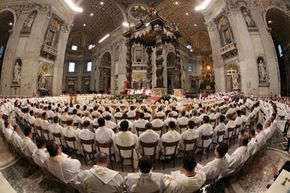
During his life, Peter was never officially the bishop of Rome or the pope, but in honor of his work and his role as the head of the church, he is recognized as the first pope. Every pope since Peter is considered the immediate successor of Peter, and not of that pope's immediate predecessor. A pope is considered to be carrying on the power that Christ granted Peter. Today, a great number of the pope's powers are derived from the Petrine guarantee, which is etched in Latin around the dome of St. Peter's Cathedral.
The pope's powers were bolstered in the First Vatican Council in 1870, when 433 bishops passed the decree of papal infallibility. According to the decree, the pope "is possessed of that infallibility with which the Divine Redeemer wished His Church to be endowed in defining doctrine regarding faith and morals" [source: Catholic Encyclopedia].
The next two sections explain the process of papal succession.