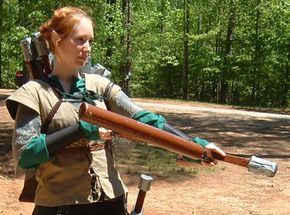
It's a Saturday afternoon. I'm standing in line at the grocery store, and something seems a little out of place. I realize that the teenager in front of me is wearing a long, green tabard with gold trim, and he has a wide, leather belt around his waist. He's buying lots of bottled water and Gatorade.
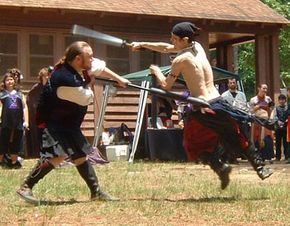
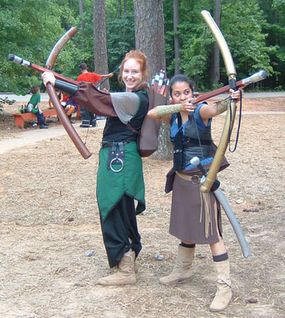
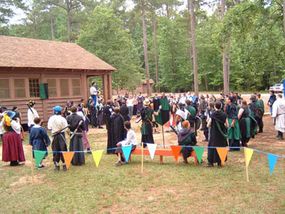
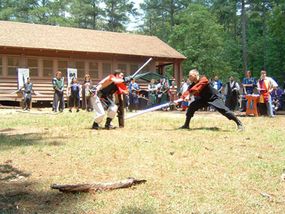
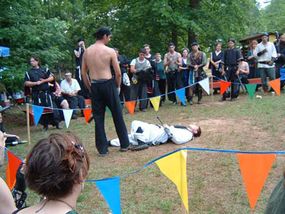
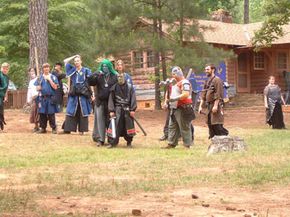
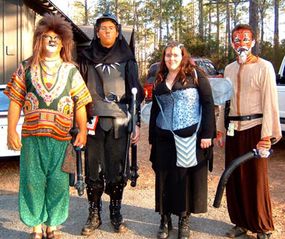
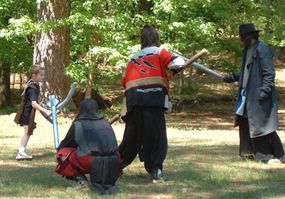
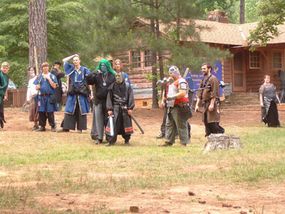
On my way out of the parking lot, I see him cross the street toward the park. There, two lines of similarly dressed combatants, some with brightly painted shields, face off against each other. They're armed with puffy, slightly oversized mock weapons that are covered in duct tape.
Advertisement

The people in the park are playing a live-action role playing game, or LARP. A LARP is a grown-up version of playing make-believe, and each LARP has its own rules and invented history. The game in the park is a battle game, one that focuses more on active combat than on an unfolding story.
To learn more about LARP, we interviewed Laurie Zolkosky, who has years of experience with live-action games and even started her own. In this article, you'll learn all about LARPing, including how the games work, why people play and what it takes to start a new game.
As Zolkosky describes it, a LARP is:
In other words, a LARP is an extended interaction between three things - a world, its rules and the people in it.
Long before the game begins, someone invents an imaginary world in which the action will take place. In the case of King's Gate, Zolkosky spent about a year and a half designing the game world, which is similar in some ways to the early European Renaissance. However, it's also a post-cataclysmic world filled with magic, monsters and non-human, intelligent races.
The process of designing a game world is lengthy because its creator has to address virtually everything that appears in the real world. For example, the world of King's Gate has an extensive recorded history as well as documented fighting styles, races and monsters. The description of the game world also includes what its people, technology and cultures are like. The people of King's Gate have a very basic understanding of astronomy and mathematics. There's no electricity, and the lower classes do not know how to read or write. The world's most complex weapons are crossbows and siege weapons. Players have access to pages of details about what the world they'll be playing in is like.
The next part of the equation is the game's rules. Game designers have the option of creating an entirely new rule system to address combat, magic, death and characters' skills. Or, they can use an existing rule system. For King's Gate, Zolkosky leased a rule system from Chimera Interactive.
The final component of a LARP is people. You can separate the people involved in a LARP into three categories:
- The people who run the game: In some games, one person, usually called a game master (GM), leads the action. In larger games, a plot committee or several GMs work together to keep the game moving.
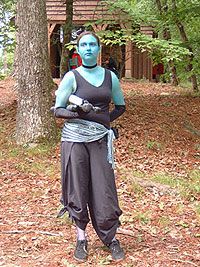
- The people who are part of the game: These are non-player characters (NPCs). For example, an NPC could be a bartender who tells players about rumors of bandit attacks on the outskirts of town. The bandits themselves are also NPCs.
- The people who play the game: These are player characters (PCs). Unlike an NPC, a PC can develop and learn new skills over the course of a campaign. In other words, the NPCs are part of the story, and the PCs experience and learn from that story.
This interaction between a world, its rules and its people takes place within the context of a game session or campaign. It's a lot like a story or a little piece of the world's history. A game session can last anywhere from a few hours to a few days, and a campaign can go on for months. During that time, players will congregate at the game site, often a campground or a park, on a regular schedule. While the game is in progress, the players pretend to be their characters - they walk, talk and act the way their characters would.
Advertisement