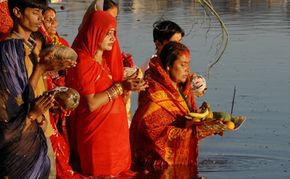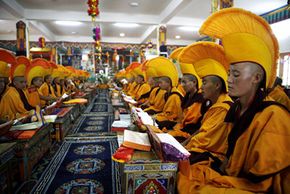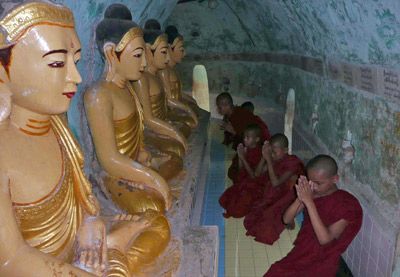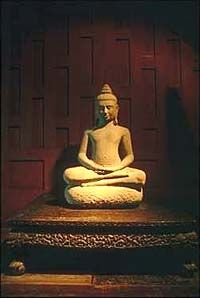
Natural life is cyclical. Day fades into night and turns back into day as the sun rises. One season gradually gives way to the next. Over the passage of time, new generations are born and old ones die. The continuous succession of birth, death and rebirth permeates nature even though our own lives seem linear. So it's no surprise that some ancient observers looked at the seeming linearity of human existence and decided that life, like the natural world, might actually be more cyclical than linear. Multiple religions, philosophies and movements adopted this belief in cyclic life, or reincarnation.
Advertisement
Reincarnation, also called transmigration or metempsychosis, is the concept that the soul, or some aspect of the soul, is reborn into new lives. Depending on the religion or philosophy, the soul can appear incarnate in humans, animals or plants as it works its way toward an eventual escape from the cycle of birth, death and rebirth. Most religions that believe in reincarnation consider it the path to purity and salvation.
Reincarnation is widely accepted by the major Eastern religions -- most prominently Hinduism and Buddhism. It also has a history in ancient Greek philosophy. However, for people more familiar with the major monotheistic religions -- Christianity, Judaism and Islam -- the idea of reincarnation seems foreign and maybe even a little strange. That's because Christianity, Judaism and Islam conceive of time linearly. Life is simply a short step that determines the quality of an afterlife. For those who believe in only one life followed by an eternal afterlife, reincarnation is like an unwieldy marathon run by relay instead of a short, concise sprint.
Advertisement