It may surprise you to know that Russia has a more direct presidential election process than the United States. In the United States, a system called the Electoral College periodically allows a candidate who receives fewer popular votes to win an election. In fact, there have been several presidential candidates who won the popular vote, but lost the election because they received fewer electoral votes. In Russia, where no such system exists, the candidate who receives a majority of popular votes wins the election.
Every four years, on the Tuesday following the first Monday of November, millions of U.S. citizens go to local voting booths to elect, among other officials, the next president and vice president of their country. Their votes will be recorded and counted, and winners will be declared. But the results of the popular vote are not guaranteed to stand because the Electoral College has not cast its vote.
Advertisement
The Electoral College is a controversial mechanism of presidential elections that was created by the framers of the U.S. Constitution as a compromise for the presidential election process. At the time, some politicians believed a purely popular election was too reckless, while others objected to giving Congress the power to select the president. The compromise was to set up an Electoral College system that allowed voters to vote for electors, who would then cast their votes for candidates, a system described in Article II, section 1 of the Constitution.
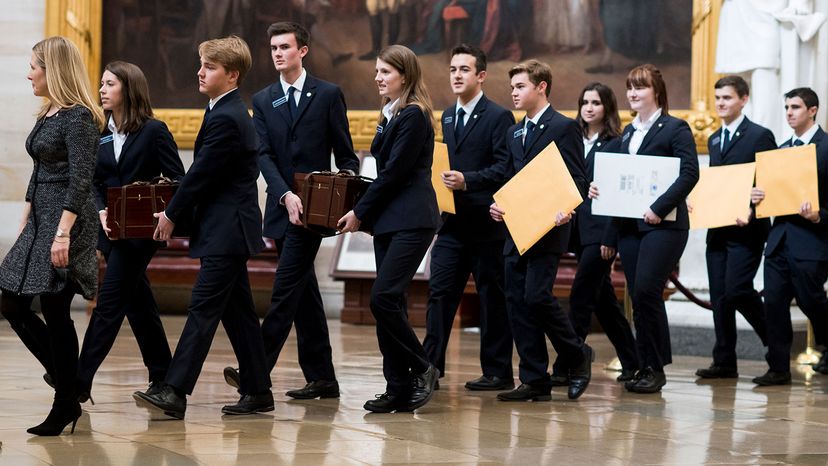
Each state has a number of electors equal to the number of its U.S. senators plus the number of its U.S. representatives. Currently, the Electoral College includes 538 electors, 535 for the total number of congressional members, and three who represent Washington, D.C., as allowed by the 23rd Amendment. On the Monday following the second Wednesday in December, the electors of each state meet in their respective state capitals to officially cast their votes for president and vice president. These votes are then sealed and sent to the president of the Senate, who on January 6th opens and reads the votes in the presence of both houses of Congress. The winner is sworn into office at noon on January 20th.
Most of the time, electors cast their votes for the candidate who has received the most votes in that particular state. Some states have laws that require electors to vote for the candidate that won the popular vote, while other electors are bound by pledges to a specific political party. However, there have been times when electors have voted contrary to the people's decision, and there is no federal law or Constitutional provision against it.
Advertisement