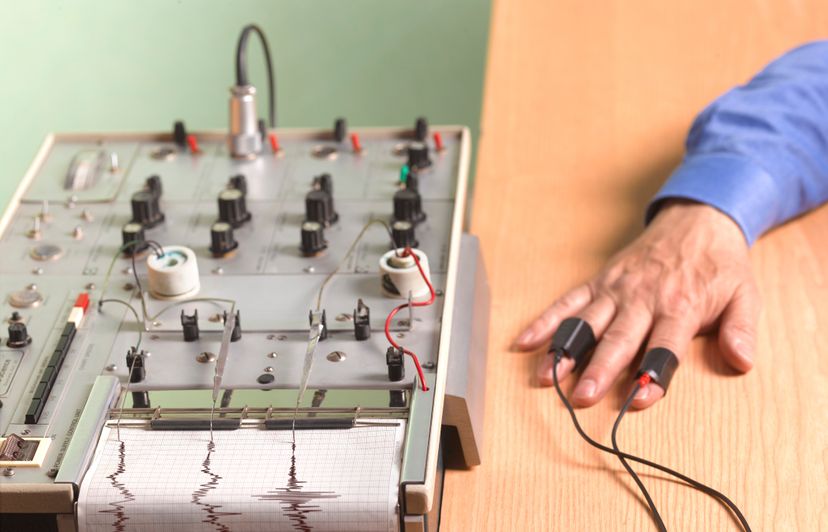
Often, people who are being given a polygraph exam will employ certain countermeasures in an attempt to beat the instrument. There are Web sites and books that instruct you on how to fool the polygraph. Here are just a few examples of how people try to trick the device:
- Sedatives
- Antiperspirant on fingertips
- Tacks placed in the shoe
- Biting tongue, lip or cheek
The idea of countermeasures is to cause (or curtail) a certain reaction that will skew the test's result. A subject may attempt to have the same reaction to every question so that the examiner cannot pick out the deceptive responses. For example, some people will place a tack in their shoe and press their foot down on the tack after each question is asked. The idea is that the physiological response to the tack may overpower the physiological response to the question, causing the response to each question to seem identical.
Whether you pass or fail a polygraph exam will often have very little legal ramification. Often, defense lawyers brag that their client has passed a polygraph. Of course, you will rarely hear of a defendant taking a polygraph if he or she failed it.
Polygraphs are rarely admissible in court. New Mexico is the only state in the United States that allows for open admissibility of polygraph exam results. Every other state requires some type of stipulation to be met prior to admitting polygraph exams into record. In most cases, both sides of a legal case have to agree prior to the trial that they will allow polygraphs to be admitted. On the federal level, the admissibility criteria are much more vague and admission typically depends on the approval of the judge.
The main argument over the admissibility of polygraph tests is based on their accuracy, or inaccuracy, depending on how you want to view it. The level of accuracy of a lie detector depends on whom you talk to about it, Horvath said. Both sides of the argument have the same research to look at, but they come to very different conclusions.
Employee Polygraph Protection Act of 1988
Employees in the private sector are not subjected to polygraph exams like employees of the federal government. The U.S. federal government is the largest consumer of polygraph exams. Private sector employees are protected by the Employee Polygraph Protection Act of 1988 (EPPA). This law only affects commercial businesses. It does not apply to schools, prisons, other public agencies or some businesses under contract with the federal government.
EPPA provides that a business cannot require a pre-employment polygraph and cannot subject current employees to polygraph exams. A business is allowed to request an exam, but cannot force anyone to undergo a test. If an employee refuses a suggested exam, the business is not allowed discipline or discharge that employee based on his or her refusal.
"We have people in the scientific community who look at the same research that I look at and they reach a conclusion that is quite different," Horvath said. "From their point of view, they allege that polygraph testing is probably only around 70 percent accurate, and it has a great bias against truthful people. Then, what the proponents say, looking at the same research, they reach a quite different conclusion, and that is that polygraph testing is around 90 percent accurate."
At the federal level, there have been specific legal cases that have shaped the admissibility of polygraphs. The results of these cases are mixed: There have been some federal circuits that have admitted polygraph results, while others have flatly denied them. Here are just a few of the legal cases that have shaped how polygraphs are viewed by the U.S. courts:
- Frye v. United States (1923) - U.S. Court of Appeals of District of Columbia - This is the original decision dealing with scientific evidence and its admissibility in court. Frye was accused of murdering a doctor. At the time, he took a unigraph, a precursor to the polygraph. The unigraph measured only the cardiovascular activities of the body. The examiner reported Frye to be truthful, and Frye moved to have that evidence admitted in court. The court ruled that before any scientific evidence could be admitted into the court of law it must first be accepted by the scientific community. At that time, there were no studies done on unigraphs or polygraphs, so the evidence was not admitted.
- United States v. Piccinonna (1989) - U.S. Court of Appeals, 11th Circuit - This decision allowed for polygraph results to be admitted in court, but only if one of two requirements is met: Either the two parties in the case agree to allow it, or the judge decides to allow it based on criteria established by the 11th Circuit.
- Daubert v. Merrell Dow Pharmaceuticals (1993) - U.S. Supreme Court - The court opened the door for scientific evidence, and gave judges broader discretion as to whether or not to admit polygraphs. This applies to all federal courts but does not apply in state courts, although particular states do accept this ruling.
- United States v. Scheffer (1998) - U.S. Supreme Court - Moving beyond the broader topic of scientific evidence, this military case directly involved polygraphs. The court ruled that the U.S. president has the prerogative to deny polygraph results in military tribunals because polygraph testing is so controversial.
It seems clear that no final decision has been made on the federal level. At the state level, polygraph admissibility is generally handled on a case-by-case basis. The courts' ambiguity stems from the questionable validity of polygraph exams. Interestingly, the biggest opponent to polygraph admission in court is the U.S. federal government, which happens to be the largest consumer of polygraphs exams.
There are still many questions that must be answered before polygraphs are accepted by the courts and the public at large. Of course, we may never see this broad acceptance. No matter if you agree or disagree with the use of polygraphs, thousands of people undergo these tests every year, and many people's lives are changed forever by their results.