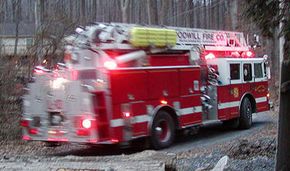
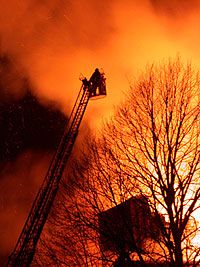
To a typical kid, the only thing cooler than a fire truck is somebody who rides in one. Firefighters maneuver through the city at high speeds and climb ladders to sickening heights. These highly trained specialists risk their lives every day fighting fires. It's easy to see why so many people aspire to become firefighters: serving as one is heroic and adventurous. But becoming a firefighter takes more than brute strength and guts of steel.
Advertisement
In this article, we'll take a closer look at what it takes to become a municipal firefighter and examine different elements of their training.
Before you can become an active-duty firefighter, you need to spend about 600 hours in training, over the course of 12 to 14 weeks. That's somewhere between 40 to 48 hours per week, which makes firefighter training a full-time job. Training typically occurs at a fire academy, which is often run by the fire department, a division of the state government or a university.
Be at least 18 years old (sometimes 21)
Have a high school diploma or equivalent, though many career fire departments now require a college education
Be physically fit
Have a clean criminal record
Have corrected 20/20 vision
Firefighting is a highly competitive field. Thousands of applicants apply every year across the country, but most are rejected. Many departments hire every two years, and typically give staff positions to about 30 applicants at a time. While some fire departments only require applicants to hold a high school diploma, many look for applicants with two years of college credits from an accredited college or university. Firefighting is so competitive, in fact, that many applicants obtain EMT or paramedic certification before applying to become a firefighter, making them more desirable to hiring departments. Today, more applicants than ever before have four-year degrees in Fire Science or related fields, which has made the field even more competitive.
To enter a training program, applicants take three exams: a written test, a Candidate Physical Ability Test (CPAT) and an aptitude test. The written exam typically consists of around 100 multiple choice questions and covers spatial awareness, reading comprehension, mechanical reasoning, logic, observation and memory.
To pass the physical portion of the firefighter exam (CPAT), recruits must be able to quickly climb an extended ladder.
The primary focus of the physical ability test is agility, upper body strength and endurance. Each task is timed and tests the applicant's capacity to endure sustained physical activity. These tasks are reflective of what students do in the fire academy throughout their training day in and out. It's unlikely that an applicant who strains to complete the tasks will survive 14 weeks of training, and so is a strong indicator of future success.
Physical tests vary from academy to academy, but here are some common tasks:
Applicants train for the CPAT in some unusual ways. Often, applicants run up and down stairs or stadiums, lift heavy sacks of sand by rope, or jog in multi-level parking garages.
Next, we'll take a look at the most exciting and dangerous aspect of firefighter training.
Thank You
Thanks to Mike Wieder for his assistance with this article.
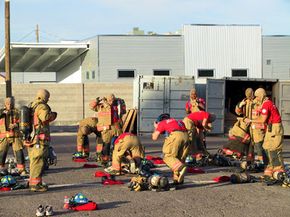
Firefighter recruits prepare for training in Las Vegas, Nev.
Image courtesy Mike Weider
In order to survive, firefighters must be able to think critically and clearly and solve problems quickly, under extreme stress. This can be especially difficult in an actual fire, so training instructors conduct live fire training drills: they purposely set buildings on fire to give students opportunities to develop these skills. The overall goal of this behavioral training is to instill good habits in students through repeated exposure. Live fire training is conducted in burn buildings, which are structures, built or acquired, to be intentionally burned for firefighter training. Let's take a look at what a typical live fire training session looks like, according to the NFPA (National Fire Protection Association).
An instructor gives a briefing of the day's activities, and students dress in their high-tech, multi-layered specialty clothing. These clothes can withstand temperatures up to 1,200 degrees Fahrenheit. In addition, each student wears an SCBA, tacking on an extra 30 pounds.
Advertisement
Next, the students enter the burn building. One instructor goes before the students, and one trails behind. The students place themselves on the same side of the hose and distance themselves an arm's length from each other. Other students, who won't be operating the hose in the structure, prepare to move the hose line forward as the crew goes further into the structure. The crew gets down into a crawling position as they enter the burn area, making sure to keep the hose line between themselves and the flames. As the students approach the area they will attack, they take their positions on the line, one operating the nozzle, the others supporting.
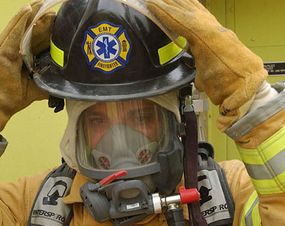
An Army National Guard firefighter puts on his SCBA (self-contained breathing apparatus) and helmet.
Image courtesy Cpl. Benjamin Cossel / U.S. Army
The instructor gives the go-ahead and the students open the nozzle, attacking the flames. At the instructor’s command, the crew closes the nozzle positioned away from their bodies to avoid steam burns on exposed skin. Now the students rotate. The nozzle operator moves to the back of the line and everyone else moves forward. The crew repeats this process until everyone has a turn operating the nozzle. When they extinguish the fire, the crew leaves the structure quickly but safely, leaving only the nozzle operator and a back-up crew member behind. The two of them stay to make sure the fire doesn't re-ignite. When it's clear the fire is permanently extinguished, the crew works together to retract the hose line from the structure.
After the training drill, the instructor checks the students for injuries. Once everyone is checked out and accounted for, the instructor reviews the activity and provides constructive feedback.
Next, we'll look at the different types of burn building used in training and learn about firefighter ranks and volunteers.
Live Fire Training
There's much more to live fire training than just setting a building on fire. See what happened when HowStuffWorks joined firefighters from eight North Carolina counties for a live fire training exercise.
Advertisement
Burn Buildings and Firefighter Ranks
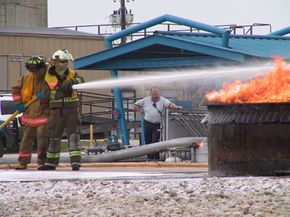
Trainees practice operating a fire hose and put out a small fire on training grounds.
Image courtesy Mike Weider
There are three types of burn buildings: traditional, acquired structures and simulated structural fire buildings. Traditional burn buildings, built with special materials, can withstand multiple fires, although they do break down over time. Traditional burn buildings exist in communities, at fire academies and on university campuses. The fuel used to ignite fires in these structures is typically straw, hay or wood pallets.
Acquired structures are condemned houses or other abandoned buildings. Instructors locate a suitable building and begin a tedious process. First, an instructor gets written permission from the building's owner and acquires necessary permits and health clearances to proceed. They notify everyone in the surrounding community of the pending burn, including residences and businesses. Instructors make certain there's no insurance or liens on the property to prevent fraudulent claims and legal trouble. With the legal issues out of the way, site preparation begins. Here's how the process works:
Advertisement
Inspectors approve the building's structural integrity and make sure it's safe for training exercises.
A crew repairs unsafe conditions such as broken stairs and rotted floors for interior training.
They remove fuel sources other than Class A. Live fire training only involves ordinary combustibles, or Class A fuels (fabric, wood, paper and rubber).
A crew member cuts a hole into the roof to channel convection currents out of the structure. When fuel sources burn, they produce gases. Convection happens when these gases move together, creating a wave of heat that moves upward. These currents, if not given an outlet, can make the fire spread or build up, causing a spontaneous explosion called a backdraft.
They score chimneys near their bases to ensure they fall when the structure collapses.
The instructor identifies positions on the site for the instructors and emergency medical personnel to safely observe.
The site is ready for training to begin.
Even with the preparations and precautionary measures, using an acquired structure can still be very dangerous. The fire is controlled, but that doesn't mean it's any less real. From 1994 to 2004, 99 firefighters were killed during training, some of these in live fire training. Statistics like these led fire instructors to adopt a new, safer method for live fire training: simulated structural fire buildings.
Simulated structural fire buildings are far more advanced and rely on computers to control the fire. These burn buildings' computers control built-in fire-producing devices that run on propane and natural gas, and use a non-flammable aerosol to synthetically create real smoke. If there's an emergency, the burn building has systems to extinguish the fire and extract all of the smoke with the push of a button. The computer also lets the instructor choose in how the fire will burn and at what temperature. The computers are capable of simulating fire scenarios for different occupancies in the building, residential or otherwise. They can even simulate inflamed furniture, such as burning sofas or tables.
Engineers design these burn buildings with a variety of materials, including masonry, concrete and metal. The walls and ceilings of the building are covered with heat-resistant tiles with built-in sensors to keep track of the fire's intensity. The roof contains "chop-out panels" made of wood, which gives students the opportunity to learn how to properly ventilate a burning house and deal with major burns to the building's structure. When the training crew applies extinguishing agents, the building has sensors that can tell which one the crew applies and whether or not it has been appropriately applied. The sensors communicate to the main computer how to respond to the crew's method. If a crew inappropriately applies an agent, it will simulate a real-world response.
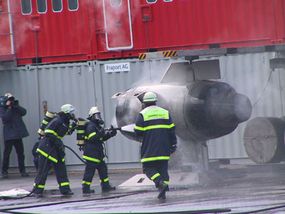
Airport firefighter trainees put out a simulated engine fire.
Image courtesy Mike Weider
Specialty firefighters, like airport firefighters, also use this technology in training props. For instance, an airport fire crew may attack flames on a section of an airplane fuselage sitting in a gravel pit. For their prop, the computer controls a system of gas pipes that come up from under the fuselage.
Simulated structural fire buildings are the safest and most durable out of the three burn building options. Conducting live fire training in an acquired structure can be a gamble, because there's no guarantee how long the building will stand. It's common to schedule training in an acquired structure only to have it fail halfway through. Training in acquired structures and traditional burn buildings can also be more labor intensive. If the fire goes out, the crew stops the training drill to reignite the controlled burn. And no matter how durable the materials used in a traditional burn building are, fire is a formidable force and eventually the structure breaks down and becomes unusable.
If maintained properly, a simulated structural fire building can last indefinitely. Also, their durability produces not only better-trained firefighters, but more of them -- a noteworthy advantage over their more primitive counterparts. When instructors don't have to relight fires or spend time acquiring and prepping new structures, they're free to focus on training. Further benefits include significantly reduced air pollution, making it easier to conduct training in populated communities.
But some critics claim that buildings with simulators don't reproduce fires to realistic temperature or magnitude, giving students a false perception of real-world fires. Some of the mechanisms for responding to the application of extinguishing agents have also been criticized for the same reason. Though they are severely limited and hazardous, acquired structures provide the most realistic training experience currently possible.
Volunteers and Ranks
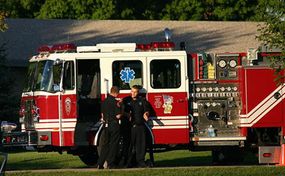
Volunteer firefighters adhere to the same guidelines and requirements that career firefighters do, as outlined by the document NFPA 1001, but in many states and jurisdictions, volunteers aren't required to become certified. Only a minority of volunteers ever make it that far. Most volunteer firefighters work other jobs and can't devote full-time hours to training. Instead, local fire departments offer weekly or monthly training events to ensure everyone develops the skills they need. Other than in the state of Florida, volunteer firefighters aren't restricted from any firefighting tasks. Some departments consist entirely of volunteers, including the truck drivers, called engineers, who often have experience driving big rigs or school buses. In addition to driving, engineers operate the hose pumps.
Image courtesy Kathy Bishop / MorgueFile
For a career firefighter, becoming an engineer is a first-level promotion in the department. Firefighters are usually eligible for such a promotion after a few years of working for the department. It is then up to newer crew members to battle the blazes. From there, one can move up the ranks of the department. Standard ranks go as follows:
Firefighter
Engineer
Lieutenant
Captain
Battalion Chief
Deputy Chief
Assistant Chief
Chief
For more information on firefighter training and related topics, check out the links on the following page.
NFPA 1403: Standard on Live Fire Training Evolutions. http://www.ci.yakima.wa.us/services/fire/NFPA1403.pdf
Masi, Mary. (1998) Firefighter Career Starter: Finding and Getting a Great Job. New York: Learning Express.
Campbell, Colin A. "Burn Building Basics." February 15, 2006. http://firechief.com/news/firefighting_burn_building_basics/index.htm
United States Fire Administration. "Firefighter Fatalities in the United States in 2004." http://www.usfa.fema.gov/downloads/pdf/publications/fa-299.pdf
White, Clarence. "Conducting a Safe Structural Burn Training Drill". February 15, 2006. http://cms.firehouse.com/content/article/printer.jsp?id=39285
Brady, Don T. (2003) Carolina Fire Rescue EMS Journal. "Gas-fueled, computer-controlled, systems: Delivering Safe, Live Fire Training." http://www.kiddeft.com/Article_Delivering_Safe.shtml
Colletti, Dominic, and Davis, Larry. "Calculated Risk." February 15, 2006 http://firechief.com/mag/firefighting_calculated_risk/index.htm
Pikulsky, Jeff. (2003, August 18). "Burn Building' unveiled at Cal U." The Valley Independent: PittsburghLIVE.com. http://www.pittsburghlive.com/x/valleyindependent/news/s_150478.html
City of Denton Fire Department: Fire Extinguishers http://www.cityofdenton.com/pages/fireextinguishers.cfm
Cite This!
Please copy/paste the following text to properly cite this HowStuffWorks.com article: