
Enhanced 911
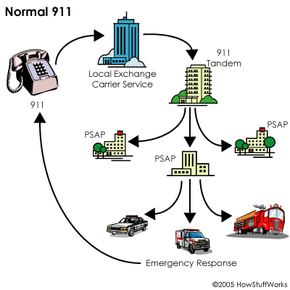
In America, we learn from an early age to call 911 when there's an emergency. When we dial 911, the call is automatically forwarded to a public-safety answering point (PSAP), also called a 911 call center. When the call is answered, the 911 operator is provided with automatic location information (ALI), pinpointing the exact position of the call. Today, many areas also have Enhanced 911 (E-911), which allows a PSAP to determine the general location from where the call originated, but cannot yet pinpoint the location.
According to the Cellular Telephone Industry Association (CTIA), 150,000 emergency wireless calls are made in the United States each day. The government has stepped in to ensure that E-911 capabilities are improved. New technologies being developed by wireless service providers at the demand of the Federal Communications Commission are expected to enhance the location-finding ability of E-911 to locate the exact position of a wireless emergency call.
Advertisement
The FCC is rolling out E-911 in phases:
- Phase 0 - This is the basic 911 process. Wireless calls are sent to a PSAP. Service providers must direct a call to a PSAP even if the caller is not a subscriber to their service.
- Phase I - The FCC's rule requires that a phone number display with each wireless 911 call, allowing the PSAP operator to call back if there is a disconnection.
- Phase II - The final phase requires carriers to place GPS receivers in phones in order to deliver more specific latitude and longitude location information. Location information must be accurate within 164 to 984 feet (50-300 meters).
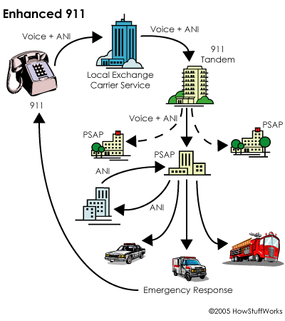
Without Phase II, a caller's location can only be narrowed down to the cell from which the call originated. When Phase II is implemented, a cell-phone user's phone number, or Automatic Number Identification (ANI), and the address and location of the receiving-antenna site will be sent to the E-911 Tandem, the switch that routes 911 calls to the appropriate PSAP based on the ANI-defined geographic location. Once the caller's voice and ANI are transferred to the PSAP, the PSAP operator will be able to view a graphic display that shows the longitude and latitude of the person as accessed through GPS satellites. The operator's computer will link to the ALI database, which stores address data and other information.
The implementation of Phase II technology introduces new commercial opportunities. As mentioned in the previous section, location-based services will leverage the infrastructure of E-911 technology to deliver commercial services to phones, including advertising. These new technologies also create concerns over privacy, which we will examine in the next section.
On February 16, 1968, Alabama Senator Rankin Fite made the first 911 call in the United States in Haleyville, Alabama. The Alabama Telephone Company carried the call. A week later, Nome, Alaska, implemented a 911 system. In 1973, the White House's Office of Telecommunication issued a national statement supporting the use of 911 and pushed for the establishment of a Federal Information Center to assist government agencies in implementing the system.