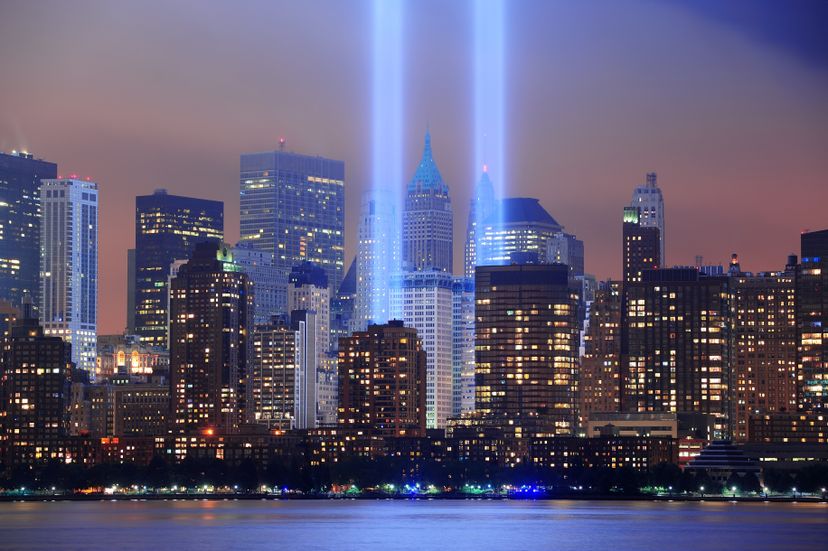
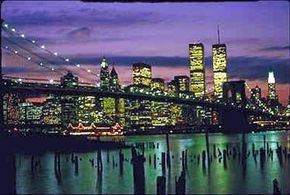
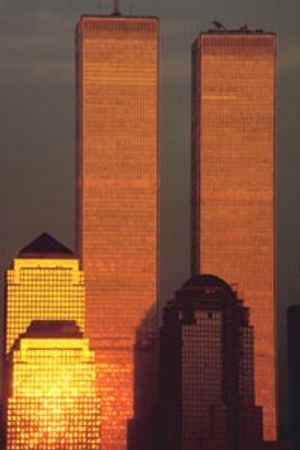
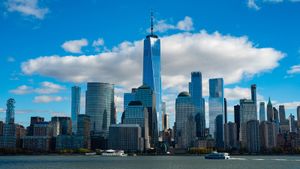
An annual light show commemorates the fallen Twin Towers in Manhattan. Thinkstock
When we look back on September 11, 2001, we think mainly of people. We mourn for the victims of the attacks; we empathize with their families; we honor the rescue workers; and we reflect on our own experience.
At the same time, we remember many other details of that day — the airplanes, the buildings hijackers damaged and destroyed and the heavy equipment used in the massive rescue effort. Like countless events throughout history, the attacks of September 11 were a crushing mesh of man and machine.
Advertisement
In this article, we will answer questions like: When were the Twin Towers built? Who was behind the World Trade Center's design? And what are the origins of the original World Trade Center complex? We will also remember the Twin Towers for everything they were: a remarkable technological achievement, a representation of an ideal and ultimately, a staggering reminder of our own vulnerability. In remembering this proud structure, we honor the spirit in which it was built, and we memorialize the victims of the attacks.
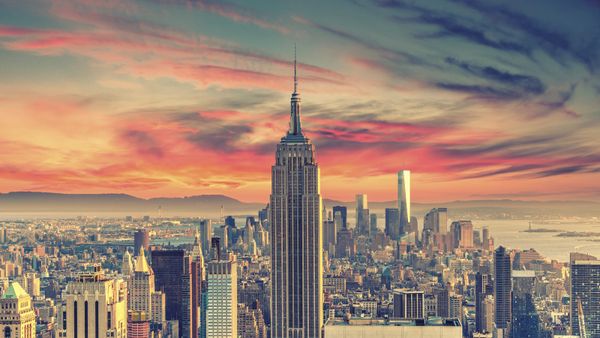
The World Trade Center opened its doors on April 4, 1973. The towers, which surpassed the Empire State Building, were once among the world's tallest buildings. But it took a lot of effort to get there.
David Rockefeller, one of industrialist John D. Rockefeller's many grandsons, is generally credited with the original idea for a world trade center in New York. Ideation on a world trade center began after World War II, a decade before Rockefeller ever got involved, but he was the one who actually got the ball rolling.
Advertisement
In the 1950s and '60s, while serving as chairman of Chase Manhattan Bank, Rockefeller dedicated himself to revitalizing lower Manhattan. He hoped to energize the area with new construction, in much the same way his father revitalized midtown Manhattan in the 1930s with Rockefeller Center.
As part of his plan, David Rockefeller proposed a complex dedicated to international trade, to be constructed at the east end of Wall Street. Rockefeller believed that the trade center, which would include office and hotel space, an exhibit hall, a securities and exchange center and numerous shops, would be just the thing to spur economic growth in the area.
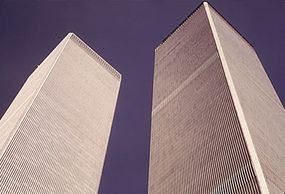
The looming Twin Towers went far beyond the original concepts for the WTC.
Photo courtesy NARA
By the 1960s, he certainly had something to gain from the world trade center project. He had just put up the expensive, 60-story Chase Manhattan Bank tower in the Financial District and wanted to increase the value of the bank's investment. But he was also driven by the spirit of international unity. A world trade center would bring together people from all over the globe, a noble ideal in the decades following World War II.
With the help of his brother, Nelson Rockefeller, the governor of New York state at the time, David Rockefeller got The Port of New York Authority involved.
Looping in the Port Authority of New York and New Jersey
The Port of New York Authority, now known as the Port Authority of New York and New Jersey, is a government institution that heads up public projects in the New York and New Jersey port area. While the Port Authority is a public organization, it functions like a private corporation — it charges its "customers" directly and profits from investments, rather than taking tax money.
Since its creation in 1921, the Port Authority had focused mainly on bridges, tunnels, airports and bus transportation. It had never undertaken anything near the scale of the World Trade Center before, but nonetheless, the organization was the most logical choice to head up the project. It had the rare combination of government connections, diverse resources and the power of eminent domain.
Rockefeller commissioned early designs for the WTC in 1958, the Port Authority got involved in 1960 and the initial plans became public in 1961.
Then things slowed down considerably.
For years, the Port Authority slogged through fiscal problems, public relations debacles and legal wrangling, not to mention the unpopular task of evicting the hundreds of businesses and homes occupying the building site.
With all the negotiations and logistical conflicts, excavation didn't actually start until 1966. By that time, the design and scope of the project had changed completely.
Advertisement
The World Trade Center Tube
The World Trade Center towers had an innovative "tube" design, with a perimeter support structure joined to a central core structure with horizontal floor trusses.
The final design for the WTC was a group effort, bringing together the work of dozens of architects, structural engineers and managers, led by a few prominent talents.
The Port Authority's Guy Tozzoli selected the final team and managed the entire design and construction process; the chief architect on the project, Minoru Yamasaki, came up with the twin towers concept, as well as the basic layout for the rest of the complex; structural engineers Leslie Robertson and John Skilling figured out how to make the towers stand up.
Advertisement
The final complex consisted of seven buildings, dominated by the twin, 110-story towers rising more than 1,360 feet (415 meters) above an open plaza. The monumental tower design was innovative, ambitious and deceptively simple.
At the time of construction, workers built most new skyscrapers around grid-style steel skeletons. In this design, the support structure was spread throughout the entire building. Metal beams were riveted end to end to form vertical columns, and at each floor level, these vertical columns were connected to horizontal girder beams.
The support columns were all internal, so the outside of the building didn't have to hold up anything but its own weight. These outer curtain walls can be made of just about anything, including ordinary glass.
A Box Within a Box
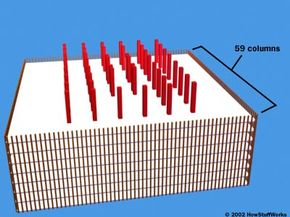
The WTC team took a slightly different approach. They decided to build long "tubes," where all the support columns would be around the outside of the building and at the central core of the building. Essentially, each tower was a box within a box, joined by horizontal trusses on each floor.
The outer box, measuring 208 feet by 208 feet (63 x 63 m), was made up of 14-inch (36-cm) wide steel columns, 59 per building face, spaced just over 3 feet (1 m) apart.
On every floor above the plaza level, the spaces between the columns housed 22-inch (56-cm) windows. Yamasaki, who had a pronounced fear of heights, felt that the small windows made the building feel more secure.
Aluminum covered the columns, giving the towers a distinctive silver color. The inner box at the core of each tower measured about 135 feet by 85 feet (41x26 m). Its 47 heavy steel columns surrounded a large open area housing elevators, stairwells and restrooms.
This design had two major advantages. First of all, it gave the building remarkable stability. In addition to shouldering some of the vertical load (the weight of the building), the outer steel columns supported all of the horizontal forces acting on the tower (the force of the wind). This meant the inner support structure was completely dedicated to the huge vertical loads.
Secondly, the tube design made for great real estate. With the support structure moved to the sides and center of the building, there was no need to space bulky columns throughout each floor. Clients could configure the available space, about 3/4 of an acre per floor, as they wanted.
Spread Footing
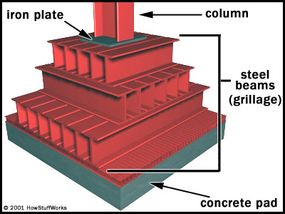
The vertical support columns at the core of the building went all the way down below the bottom floor, through the basement structure, to the spread footing structure below ground. In the spread footing design, each support column rested directly on a cast-iron plate, which sits on top of a grillage.
The grillage is basically a stack of horizontal steel beams, lined side by side in two or more layers. The grillage rested on a thick, concrete pad poured on the solid bedrock deep underground. This pyramid shape distributed the concentrated weight from the columns over a wide, solid surface. With the steel in place, the entire structure was covered with concrete.
Basic spread footing design.
Near the base of each tower, at the plaza level, the narrowly spaced perimeter supported columns rested on "column trees." The arched column trees spread the weight from the narrowly spaced columns over thicker columns spaced about 10 feet (3 m) apart. Each of these columns rested on additional, smaller support footings in the foundation.
Advertisement
World Trade Center Elevators
The WTC towers' innovative elevator system.
To stand up to the horizontal force of wind, skyscrapers need the right combination of stability and flexibility. They have to be rigid enough that the wind can't push them too far from side to side but flexible enough that they can give a little, absorbing some of the wind energy.
The WTC crew ran extensive tests to find out just how much sway they could allow without disturbing the building occupants. They put structural models in wind tunnels and even lured unsuspecting test subjects to movable rooms hooked up to heavy hydraulics.
Advertisement
In the end, they designed the towers so they could sway about 3 feet in either direction. To minimize the sway sensation, they installed about 10,000 visco-elastic dampers between support columns and floor trusses throughout the building. The special visco-elastic material in these dampers could move somewhat, but it would snap back to its original shape. In other words, it could give a little and then return to its initial position, absorbing much of the shock of the building's swaying motion.
In addition to the support structure of the buildings, the WTC crew had to consider how people would actually get around the towers. Elevator systems have always been a difficult balancing act for skyscraper designers. As you build upward, increasing the available space and therefore occupancy of a building, you need more elevators to handle the extra people.
But adding more elevators running to the top floor reduces the available floor space somewhat, and therefore total occupancy (which reduces the revenue potential). It's tricky getting all the numbers to work out, and it functionally limits the size of the skyscraper. Before the WTC, architects were hesitant to build higher than 80 stories, largely due to the elevator problem.
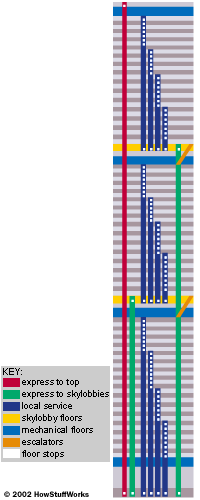
The WTC crew proposed a completely different system for the huge towers. Instead of building enough elevators to move everybody from the ground floor to their destination, they decided to split the trip to the upper floors between multiple elevators. If people wanted to get from the ground to the top floor, they would need to jump from elevator to elevator, in the same way you might switch cars on a subway system.
First, they would take an express elevator from the main lobby directly to the sky lobby on the 78th floor. From there, they could go to their destination floor directly. To keep things orderly, all the 55-person elevators had doors on each side — you would enter on one side, move to the front and exit on the other side. This way, the passengers could keep their place in line all the way up.
Essentially, each tower functioned as three buildings stacked on top of one another. The system turned out to be a great success — with 99 elevators total per tower, each serving only specific floors, occupants could get around quickly and easily. Most super skyscrapers built after the WTC used the same basic system.
Advertisement
The World Trade Center Bathtub
Before the Port Authority could build up, to erect the massive towers, they had to build down to establish the buildings' foundations. Massive skyscrapers need to rest on bedrock, the solid rock underneath the ground's soil, or they won't be able to stand up. To get to this level, the crew has to dig up a huge mass of dirt as the first stage in construction.
At the WTC site, the bedrock is between 55 feet and 80 feet (17 and 24 m) down. Digging to this level is no simple task, obviously, but it's par for the course in skyscraper construction.
Advertisement
The WTC crew faced an additional, atypical challenge, however: The build site was immediately adjacent to the Hudson River, and only a few feet down, they found completely saturated soil — if the crew started digging, the excavation site would be flooded.
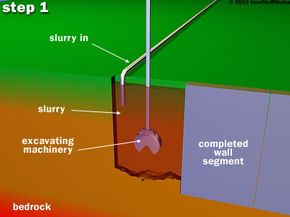
Draining the Hudson River would have been a logistical nightmare. Among other things, it would have compromised the stability of other buildings along the shore. Instead, the Port Authority decided to use the unconventional "slurry trench method," previously employed mainly in subway construction.
The process was pretty simple, at least conceptually. The crew used excavating machinery to dig 3-foot (1-meter) wide trenches down to bedrock level. As they dug, they piped in a slurry made of water and an expansive clay called bentonite. The bentonite slurry material would expand along the sides of the trench, blocking the groundwater.
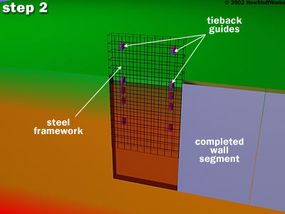
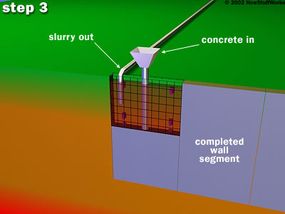
Once they finished a 22-foot (6.7-m) section of trench, the crew lowered a narrow, seven-story steel framework into the hole. Then they poured in concrete from the bottom of the trench while pumping the slurry out through the top.
In this way, they built solid, steel-reinforced concrete walls underground. They repeated the process with 152 framework segments, each measuring 22 feet (6.7 m) across, to form a large box measuring four city blocks by two city blocks (about 500 x 1,000 feet, or 152 x 304 m). This box, commonly referred to as a "bathtub," formed a water-tight perimeter wall for the two towers' foundation structure.
With the bathtub in place, the world trade center's construction crew could start digging down to the bedrock to lay the two buildings' foundation support. The only problem was that the soil inside the bathtub was the primary support means holding the walls in place — remove the dirt inside, and the weight of the dirt and water outside would push the walls inward.
To keep the walls in place while they built up the foundation, the crew had to run underground tiebacks, cables extending from the perimeter walls to rock surrounding the bathtub. This provided temporary support until the crew could finish a support structure inside the bathtub.
Advertisement
World Trade Center Construction
With the perimeter walls secured in place, the crew could begin excavating the foundation site. They ended up digging up more than 1 million cubic yards (764,555 cubic meters) of fill, which they dumped in the Hudson, extending the shore. The excavation actually added 28 acres of prime New York real estate, forming what is now Battery Park City.
When they had dug down to the bedrock, they blasted away large pits for the towers' support structure and set about building the massive foundation structure for the buildings above. Additionally, the basement structure had seven levels of usable space, which housed parking decks, stores and subway stations.
Advertisement
Putting the Twin Towers up was a major logistical challenge, in addition to a mind-boggling engineering problem. The buildings required a massive amount of steel — some 200,000 tons total — but the construction site only had room for a little bit at any one time. To keep construction moving without taking up too much construction site space, the Port Authority had to institute "just-in-time steel delivery."
In this system, all the steel was transported from the manufacturers to a giant railroad yard in New Jersey. Every major piece of steel had a long ID number, indicating where and when it would be used. According to the construction schedule, the Port Authority would ship the steel pieces from the yard to the site exactly when necessary — smaller pieces went by truck and larger pieces by tugboat.
The construction process worked from the inside out. First, the crew built the steel framework of the inner core to a particular height and then assembled the perimeter wall around it. The perimeter structure was actually formed from prefabricated sections of vertical columns attached to horizontal beams (called spandrels). The prefabricated sections were about 10 feet (3 m) wide, either two or three stories high, and weighed about 22 tons (20 metric tons).
The floor structure was then installed between the outer perimeter wall and the inner core. The floors also came in preassembled sections, consisting of 32-inch (81-cm) deep trusses topped with a corrugated metal surface. To finish each floor, the crew would pour concrete over the metal surface and top it off with tile.
The floor sections included preassembled ducts for phone lines and electrical cable, to make things easier for the electricians who would come in later. After the steel structure was in place, the crew attached the outer "skin" to the perimeter — anodized aluminum, precut into large panels.
This continued, section by section, as the towers climbed higher and higher. The crew lifted the steel sections into place using four large cranes (four per tower), mounted to long steel structures fitted inside the tube structure. The cranes could actually lift themselves higher, using heavy hydraulics, as the floors were finished.
While the crew kept building upward, other workers started to flesh out the floors below, down to installing blinds and painting the walls. A number of businesses actually moved into their new WTC offices years before the towers officially opened.
New Shape
In addition to utilizing an unconventional structural design, the Twin Towers were also an aesthetic departure from the older buildings in New York. Most of the city's skyscrapers have a "wedding cake" shape, with larger sections on the bottom tapering off into smaller sections on top.
This was partly due to the prevailing architectural style in the first half of the 20th century, but it was also a result of New York's zoning restrictions. To ensure that walls of skyscrapers didn't block all light from reaching the street, the city passed a resolution in 1916 dictating that all skyscrapers would have an overall pyramid shape.
A new resolution in 1962 shifted the focus, regulating overall height rather than shape. The new restrictions dictated a maximum number of floors, based on the district of the building and the total area of the plot. The Port Authority could build such tall towers because they had a huge plot of land with a large, open-area plaza. (Check out New York Skyscrapers: Regulations and Occupation for more information.)
Advertisement
The Life of the World Trade Center
While there were critics at the beginning, the WTC Twin Towers eventually became a cherished icon of New York and America.
The World Trade Center complex officially opened its doors on April 4, 1973, to a highly skeptical New York.
From its conception all the way through its completion, the WTC project was wildly unpopular with many New Yorkers. Business owners and residents were upset at being forced out of the construction site; citizens all over the city wondered why the Port Authority was sinking so much money into the project (estimated at more than $1 billion, the equivalent of about $6.8 billion today), apparently at the expense of public transportation facilities; environmentalists questioned some of the construction practices; and several prominent architectural critics said the towers were simply too big and ostentatious.
Advertisement
While it was not the tallest building in the world, it was the tallest building in the United States. The grand opening was certainly a celebratory day for the Port Authority, design team and construction crew, but the WTC complex had a long road in earning the city's acceptance.
Over the next decade, it did just that and then went on to win over the rest of the country. Boosted by prominent appearances in several movies — such as the 1976 "King Kong" remake, Woody Allen's "Manhattan," and the "Superman" movies — the Twin Towers gained widespread recognition as a piece of New York.
The towers' fame was also fueled by several notable stunts. In the years after the WTC's completion, skydivers successfully parachuted from the top of the towers, climbers scaled the building and a French acrobat walked back and forth between the buildings on a tightrope. In only a few years, the distinctive image of the Twin Towers was a staple on New York postcards, T-shirts and advertisements. The buildings had evolved into a proud symbol of the city, securing their place as an American icon.
The towers also won New Yorkers over by giving them a new view of their city. Visitors could climb to the top of WTC 2, the South Tower, for a breathtaking view of the skyline from the outdoor observation deck. On a clear day, it was possible to see more than 40 miles (64 km) in every direction.
Visitors with a larger budget could enjoy the view from a more elegant setting, the "Windows of the World" restaurant at the top of WTC 1, the North Tower. When the observation deck and restaurant opened, even staunch WTC critics showed up to check out the view.
Most New Yorkers (and most Americans) were familiar with the towers mainly from the outside, but the thousands of people who worked in the towers had a very different perspective — they appreciated not only the monumental size of the buildings but also the dizzying variety of activity going on inside.
The WTC had plenty of office space, supporting approximately 500 businesses with a collective 50,000 employees. This included offices for banks, law firms, brokerage houses, television stations, publishers, charitable organizations and airlines, among many other things. Additionally, the towers included nine chapels of various faiths.
On a typical business day, as many as 200,000 visitors from all over the world passed through the complex. With the huge range of activity going on, the towers were almost a city unto themselves.
In Memoriam
The late Minoru Yamasaki, chief architect on the WTC project, had this to say about the Twin Towers, on their completion in 1973:
"I feel this way about it: World trade means world peace and, consequently, the World Trade Center buildings in New York ... had a bigger purpose than just to provide room for tenants. The World Trade Center is a living symbol of man's dedication to world peace. Beyond the compelling need to make this a monument to world peace, the World Trade Center should, because of its importance, become a representation of man's belief in humanity, his need for individual dignity, his beliefs in the cooperation of men, and through cooperation, his ability to find greatness."
Advertisement
September 11, 2001
On the morning of September 11, 2001, immediately after a terrorist attack, it looked as though the buildings might remain standing. While the plane crashes had taken huge chunks out of both towers, the overall structure seemed to be intact, at least to the observers on the ground and the millions of Americans watching the catastrophe on television. But within an hour, World Trade Center 2 had collapsed, followed by World Trade Center 1 only 40 minutes later.
In the weeks after the attacks, the Federal Emergency Management Agency (FEMA) and the Structural Engineering Institute of the American Society of Civil Engineers (SEI/ASCE) assembled a team of scientists and engineers to investigate exactly how the buildings collapsed. Based on video, eyewitness accounts and debris analysis, the team formed a likely hypothesis of what happened, which they made public in April 2002.
Advertisement
In August 2002, the National Institute of Standards and Technology (NIST), an agency in the U.S. Commerce Department, announced it would launch its own two-year, $16 million study of the collapse.
The following is a summary of the FEMA evaluation teams' findings, which were largely along the same lines as the numerous media evaluations in the weeks after the attacks. You can read the entire report at the FEMA Web site.
When the planes hit the two towers, the collisions damaged each building in two major ways:
In each case, the force of the speeding plane knocked out a number of vertical columns around the building perimeter, damaged large sections of floor, sent furniture and plane wreckage flying through the offices and presumably damaged support columns in each building's core. Most likely, the initial impact also destroyed the sprinkler system on those floors. The evaluation team estimates that the first plane — a 395,000-pound (180,000-kg) Boeing 767-200ER going about 470 miles per hour (756 kph) — fractured as many as 36 perimeter support columns over a four-story area of WTC 1's north face. The connected floors partially collapsed, and the central core suffered undefined damage. The second plane, a Boeing 767-200ER flying at about 590 miles per hour (950 kph), inflicted similar damage on WTC 2. The collision fractured as many as 32 perimeter columns over a five-story area, collapsing sections of the connected floor and damaging the central core.
In each attack, the crash ignited the plane's fuel supply, causing a massive fireball — an expanding area of burning gas. While the ignited fuel didn't really explode, the fireball did spread fire down the side of the building, throughout the nearby floors and down interior shafts to lower floors. The investigators hypothesized that nearly all of the jet fuel was consumed in the initial fireball and first few minutes of the building fire, but it ignited enough office equipment, paper and building materials to keep the fire raging until the collapse.
Amazingly, the initial damage to the support structure was not enough to topple the building. The report, as well as a number of prominent engineers, have claimed that the majority of skyscrapers on the planet would have collapsed within seconds of such a collision. But the collisions did divert the entire vertical load of the buildings to the remaining columns, significantly increasing the structure's stress level.
Without any additional loads on the support structure, the report claims, the towers could have stayed up indefinitely. But the extreme heat of the fire, which might have been in excess of 2,000 degrees Fahrenheit (1,090 degrees Celsius) at some points, exerted tremendous stress on the perimeter columns, the core columns, and the floor trusses in between them.
Advertisement
The World Trade Center Fire
The main factor was really the size of the fire — the total area it covered. Building fires typically start with a small fire — say a burning cigarette on a stack of papers — that gradually spreads through a larger area. In that situation, the fire is most intense where it has the most fuel (stuff that can burn), and it significantly weakens the support structure only at those most intense points.
If a fire starts in the northwest corner of a skyscraper floor, by the time the fire reaches the southeast corner, the starting fire at the starting point will have burned through most of the fuel, and the fire will not be as intense. The result is the fire doesn't put maximum strain on the total support structure all at once; it strains different parts of the support structure, in turn, over time.
Advertisement
In the case of the World Trade Center, the burning jet fuel spread the fire across several floors in a matter of seconds. This massive fire put an exceptional strain on the structure at nearly all points on those floors.
Additionally, the report suggests that the force of the collision removed much of the fire-resistant material sprayed on the steel, making the structure more susceptible to heat damage.
The heat expanded, twisted and buckled the steel support structure, gradually reducing the building's stability. Any number of things could have happened during this period.
For example, connections between vertical columns and floor trusses probably broke, dropping sections of floor on lower levels and breaking connections between the core and the perimeter wall, possibly causing columns along the perimeter to buckle outward. Every broken connection or buckled length of steel added to the force acting on connected steel segments, until the entire structure had weakened to the point that it couldn't hold the upper section of the building.
When this happened, the top part of each building collapsed onto the lower part of the building. Essentially, this was like dropping a 20-story building on top of another building. Before the crash, this upper structure exerted a constant downward force — its weight — on the superstructure below.
Obviously, the lower superstructure was strong enough to support this weight. But when the columns collapsed, the upper part of the building started moving — the downward force of gravity accelerated it. The momentum of an object — the quantity of its motion — is equal to its mass multiplied by its velocity. So when you increase the velocity of an object with a set mass, you increase its momentum. This increases the total force that the object can exert on another object.
To understand how this works, think of a hammer. Resting in your hand, it doesn't hurt you at all. But if you drop it on your foot, it can do some damage. Similarly, if you swing the hammer forward, you can apply enough force to drive nails into a wall.
When the upper structure of each tower fell down, its velocity — and therefore its momentum — increased sharply. This greater momentum resulted in an impact force that exceeded the structural integrity of the columns immediately underneath the destroyed area. Those support columns gave way, and the whole mass fell on the floors even farther down. In this way, the force of the falling building structure broke apart the superstructure underneath, crushing the building from the top, one floor at a time.
To put it another way, the potential energy of the building mass, the energy of position it had due to its height and the pull of gravity, was converted into kinetic energy, or energy of motion (the report puts the total potential energy for WTC 1 at 4x10¹¹ joules). This is the same basic principle that professional demolition blasters use to bring down unoccupied buildings.
WTC 2, the second tower hit, actually collapsed before WTC 1. This was most likely due to two different factors. First, WTC 2 probably suffered greater immediate damage — the second plane to hit was going faster than the first. Secondly, the plane that hit WTC 2 crashed lower on the building than the plane that hit WTC 1. Consequently, the strained support columns in WTC 2 had a greater load pressing down on them than the strained columns in WTC 1, so it would make sense that they reached the buckling point more quickly.
While the towers' support structure ultimately couldn't withstand the raging fire, it was strong enough to save thousands of people's lives. Around 99 percent of the people below the impact in each tower were able to evacuate before the buildings collapsed. If the towers hadn't been built with redundant structural stability, the death toll would have easily been in the tens of thousands.
Advertisement
The Aftermath of 9/11
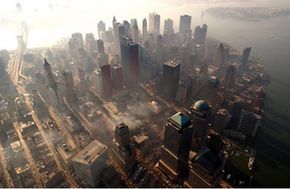
An aerial view of "ground zero" in early October 2001.
Photo courtesy FEMA
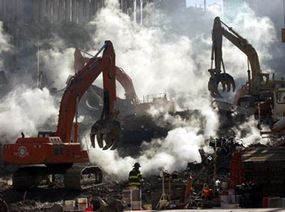
In the months following the attacks, the United States, and the world, had a lot of work to do. While most of us were doing a lot of emotional work to make sense of what had occurred, the more than 1,500 firemen, search and rescue teams, ironworkers, engineers, heavy equipment operators and other workers at ground zero were doing the very tangible physical work of cleaning up the World Trade Center wreckage.
The ground zero effort began as a search-and-rescue operation, with workers removing debris carefully, looking for voids where there might be survivors. In the first hours, rescue workers mainly employed bucket brigades, which allowed them to remove debris carefully and systematically. This was important not only for the safety of any survivors but also for the workers themselves. The wreckage was a precarious mess of twisted steel, concrete and debris, which could shift at any time.
Advertisement
The crew also brought in heavy equipment, including excavators and cranes. Setting up the massive cranes was a real challenge because the ground underneath wasn't entirely stable. When the towers and surrounding buildings collapsed, the falling steel punctured huge holes in the WTC plaza, filling large sections of the basement with debris.
The rescue workers weren't just sifting through a pile of wreckage above ground; they were working on top of a pit filled with debris. Engineers had to find and secure stable ground for their 300-ton and 800-ton cranes.
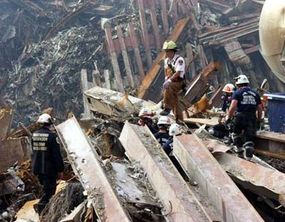
Rescue workers search through the rubble, two weeks after the attack.
Photo courtesy FEMA
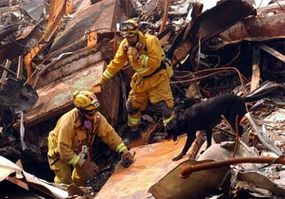
A search-and-rescue team working at ground zero.
Photo courtesy FEMA
Additionally, the ground zero crew had to address the underground bathtub's stability. The force of the collapse destroyed much of the underground support structure that held the bathtub walls in place, risking a massive underground collapse.
To maintain the basement's relative stability, the clean-up engineers had to reconfigure the tieback system that originally held the walls in place until they could construct a permanent support structure. This involved drilling into the ground and running new tieback cables between the walls and surrounding bedrock.
The clean-up effort was slow going — the crew had to proceed carefully, and they had to move a lot of debris, truckload by truckload, to a Staten Island landfill. After the clean-up finished in May 2002, the workers had moved 108,000 truckloads of debris — around 1.8 million tons (1.6 metric tons) of material.
But despite this massive undertaking and inherent slow speed, the crew finished the job ahead of schedule and well under budget.
Excavators sort through the rubble at ground zero, a month after the attack.
Photo courtesy FEMA
After clean-up finished, Americans turned their attention to the future of the World Trade Center site, and the varied visions are a poignant manifestation of the nation's emotion. Americans wanted a memorial to honor the dead and mark the pivotal day in history. But at the same time, most of the country wanted to put up new office buildings and get people back to work at the WTC site.
The prevailing sentiment is clear: Most Americans wanted the site to reflect the gravity and sorrow of September 11, but they refused to let the attacks crush the spirit that put up the towers in the first place. It's important to the nation, on a symbolic and practical level, that the American way of life goes on undeterred, that international trade prevails and that engineers and architects continue to dream big.