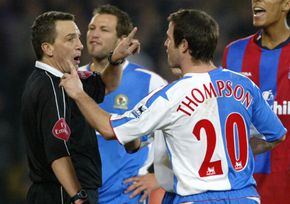
Your office is a civil place. Your co-workers regularly excuse themselves and step out of the way when passing one another in the hallway. Sensible, yet stylish, outfits from Ann Taylor and Calvin Klein are the norm, and it seems that at any moment someone will break out the tea service and cucumber sandwiches. The modern office is an extremely polite place, especially among large corporations. But occasionally a situation arises where even the most well-bred employee feels the need to break the genteel silence with a really dirty expletive.
Based on a study by researchers at Great Britain's University of East Anglia, employees should feel free to go right ahead and let it rip.
Advertisement
The study examined both the prevalence and effect of swearing in the work place. What researchers Yehuda Baruch and Stuart Jenkins found was that swearing may be more beneficial than the average Human Resources director would like. Baruch and Jenkins hung around a mail-order warehouse and watched the effect swearing had on the workplace environment. They found that, when used in a non-abusive manner, swearing enables the development of personal relationships among co-workers. After all, if an employee uses foul language in his everyday life outside of work, then this represents part of the employee's personality. The absence of this personal aspect could serve as a constraining barrier between employees, keeping them from really getting to know one another.
Swearing, Baruch and Jenkins found, can also act as a stress release among employees. Rather than keeping an emotional reaction bottled up, it could be healthier for an employee to swear, thereby releasing his frustration, and enabling him to move on. They found that swearing can also serve as a means for co-workers to become a cohesive group. Swearing among women was also found to be prevalent, especially when women are around other women.
The researchers discovered that swearing was more common among lower-level employees, and that those in management and executive positions were less likely to swear in the workplace. But Baruch says that although a manager may not swear, the researcher hopes that the study will open managers' minds to allowing swearing in the workplace [source: University of East Anglia]. This represents a radical shift from workplace philosophies regarding swearing, which has traditionally been frowned upon -- if not outright banned.
The researchers consider their study as a challenge to managers' leadership skills. While Baruch and Jenkins found that swearing improved morale among workers, there were definite situations where foul language isn't appropriate in the workplace. Swearing in front of customers or high-level management are two examples of counter-productive swearing, the researchers found.
It can be painful to witness a co-worker swear when he's unaware a customer is present. It's even more painful when a co-worker doesn't appear to understand the seemingly natural boundaries that surround swearing in social situations. There are simply some situations -- like those where customers or executives are present -- where swearing just isn't appropriate. Rather than relieve stress, swearing in these situations seems to impregnate the air with tension.
But how do we know in which situation it's appropriate to swear, and which situations prohibit it? Certainly prescribed rules can tell us the boundaries, but we humans also seem to have a sense built in that guides us in these situations. Read the next page to find out about the possibilities of intuition.
Advertisement