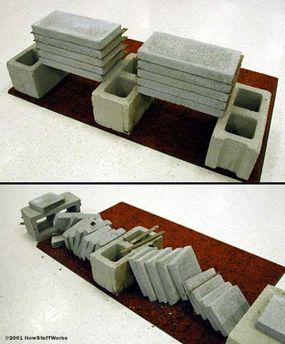
Karate is an incredible art form, built on the concept of merging body and mind into a defensive weapon. See how karatekas use this merger to break wood and cinder blocks with their hands and feet.
To the untrained observer, karate skills can seem like magical superpowers. Using only her body, a 5-foot 5-inch tall, 120-pound karate master can take down a 6-foot, 200-pound man in a matter of seconds. In strength and sheer bulk, the man has the upper hand by a considerable margin. But somehow, the karate master prevails with a few elegant punches and kicks. Using the same set of skills, advanced karate students can break thick bricks and boards with their bare hands and feet. How is all this possible?
In this article, we'll see how students of karate (called karatekas) accomplish such amazing feats. Karate is a highly complex art that takes many years to master. It is impossible to sum up this ancient, transcendental discipline in a short article, but we can get a handle on some of the underlying principles. Though its execution is highly complex, the root of karate is fairly straight-forward: By applying physical, mental and spiritual force intelligently and precisely, you can realize the maximum potential of your strength.
Karate is one of the most widely practiced martial art forms in the world. Martial arts rely on acute physical coordination and mental focus. They were developed in Asia (primarily India, China and Japan) over the course of several thousands of years. In all this time, there have been countless martial arts variations, and there are hundreds of disciplines practiced today. (Check out this site for more information on martial arts history.)
Modern karate developed out of martial arts forms practiced in Okinawa, an island that is now part of Japan. For hundreds of years, Okinawan martial arts experts honed a variety of combat styles, in part due to the political situation in the area. From time to time, the ruling authorities would ban peasants from possessing any weapons, leaving them with only their own bodies and household items to protect themselves. (This played a part in the development of martial arts elsewhere in Asia as well.)
Advertisement
A man named Funakoshi Gichin is credited with carrying the karate form beyond its geographical roots. In the early 20th century, he brought together elements from many Okinawan fighting styles and introduced the combat technique to mainland Japan and, eventually, the rest of the world.
Karatekas generally credit the creation of modern karate to Funakoshi Gichin's son, Funakoshi Yoshitaka. While his father practiced full contact karate, where fighters delivered unchecked blows, Yoshitaka believed in a more peaceful application of the fighting principles. In this form, properly called karate-do, or "karate way," karate is seen as an all encompassing approach to life, rather than only a system for combat. Karatekas curb their punches, concentrating mainly on physical, spiritual and mental development rather than competition.
The word karate is Japanese for "open hand" (kara means open and te means hand). Te signifies that your main weapon is your body. Instead of an arsenal of swords or guns, the karateka cultivates a personal arsenal of punches, kicks and deflection techniques. Kara relates to the psychology of karate. Karatekas are open to the world around them, making them better equipped to handle any attack.
In the next section, we'll look at some of the basic principles of karate, to see how karatekas execute such amazing physical feats.
Skill Levels
Karatekas wear a gi, an outfit consisting of white, loose-fitting pants and a jacket cinched closed with a belt. The color of the belt indicates the karateka's skill level, or kyu. The most advanced karatekas are ranked by their dan. Here is a typical ranking system, in ascending order:
9th to 6th kyu (novice): white belt
5th kyu: yellow belt
4th kyu: orange belt
3rd kyu: green belt
2nd kyu: blue belt
1st kyu: brown belt
1st to 8th dan: black belt
9th and 10th dan (rarely awarded): red belt
Advertisement
The Physics
When the ancient martial arts masters were developing their sophisticated fighting techniques, they experimented with fundamental principles of physics. In any fight between two people, both fighters bring a certain amount of energy to the situation. The total amount of potential energy depends on the fighters' size, muscle strength and physical health. The object of karate is to use your body to channel this energy.
Kathy Olevsky, an instructor at Karate International of Raleigh, channels her power into breaking five concrete blocks. Move your mouse from left to right to watch the break in slow motion.
Advertisement
Generally, a stronger, larger person can exert more energy than a weaker, smaller person. But this doesn't necessarily determine the victor. If you've read How a Block and Tackle Works, How Hydraulic Machines Work or any number of other HowStuffWorks articles, you know that there are all sorts of ways that energy can be expressed. Depending on the particular way you exert energy, you can vary the intensity and direction of the force you produce.
One crucial element of karate is focusing the energy of a punch or kick into a relatively small point of contact.
At its most basic, karate is a system for varying the forces of a fight to your own advantage. There are several ways to do this.
First of all, you concentrate all of your strength into a relatively small area. If you open your hands wide and shove somebody, the force of your attack spreads out across your palm and fingers. This dissipates the force of your attack over a fairly wide area; your opponent feels a relatively blunt force. But if you hold all of your fingers tightly together and hit the person with only the side of your hand, or with only your fingertips, that same amount of force is applied to a much smaller area. In that area, the impact is much more intense. If you try this on yourself (gently, please), you can appreciate the difference. The concentrated attack is a lot more painful.
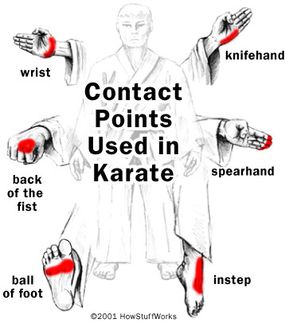
In karate, there are a number of punching and kicking stances, but most of them rely on this same basic idea. The point of impact is reduced to some small, usually bony area of your hand or foot, and the force of your attack is focused on this point. Karatekas strengthen their hands and feet so they can throw these punches and kicks without seriously hurting themselves. It is crucial to practice excellent technique; if a karateka continually punches incorrectly, he or she may eventually develop severe arthritis.
Karatekas maximize the force of the impact by putting their whole body into the punch or kick. If you watch karatekas fight, you'll see that they often pivot their torso and shift their weight from one leg to the other when they throw a punch. In this way, the energy of their moving body goes into each hit along with the energy of the arm muscles. Karatekas also practice hitting with great speed, as this increases the force of each blow.
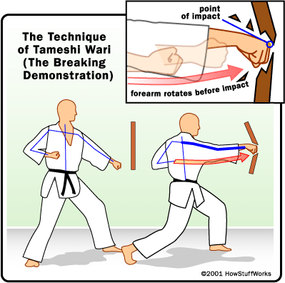
One of the most important elements in karate is following through on punches and kicks. When you hit something, say a piece of board, your natural instinct is to slow down your swing just before impact; you hesitate because you don't want to hurt your hand. Karatekas deprogram this hesitation instinct; they visualize pushing their fist to some point past their target (the other side of the board, for example). To maximize the force of each movement, it's essential that the karateka follows through. Before each attack, karatekas take a deep breath. As they release the punch or kick, they let this breath out. This helps them focus on each movement.
This is the basic idea behind karate offensive maneuvers. But how does a karateka deal with attacks from his or her opponent? In the next section, we'll see how karate defense works.
Ouch!
As recently as a hundred years ago, it was common practice for karatekas to intentionally break one or both of their middle fingers early on in the training process. This increased the size of the middle knuckle, making it a more effective punching weapon.
In the last section, we saw that two fighters bring a certain amount of energy to combat. A karateka channels his or her own energy in order to maximize the force of attack. But in karate, it's just as important to channel your opponent's energy. Karatekas do this with intelligent blocking maneuvers.
Advertisement
Like any moving object, a punch or kick has its own momentum, the product of its mass and velocity. Velocity (and by extension, momentum) is not only a measurement of speed, but also of direction. To put it another way, two objects with equal mass and speed have a different momentum if they're going in different directions.
The force of impact between two objects is largely determined by the objects' momentum. To see how this works, imagine a car speeding toward a wall. If the car crashes into the wall head-on, the direction of momentum is directly perpendicular to the wall. The front of the car and the area of wall it crashes into experiences the maximum force of impact, and both suffer maximum damage. But if the car collides with the wall from the side (as you might hit protective walls flanking a highway), the direction of momentum is at an angle to the wall. The momentum keeps the car moving forward, so the wall only feels a small fraction of the total force.
In this second scenario, the force of impact changes the car's momentum slightly. The wall pushes the car sideways, so the direction of the car's momentum carries it away from the wall (in other words, the car bounces off).
Flying feet and fists are something like speeding cars. If somebody punches you squarely in the chest, you feel the brunt of the fist's force. In karate, the object is to intercept the fist so that it contacts your body from the side and you redirect its momentum away from you. You do this by sweeping your opponent's arm or leg away from you with your own arm. Depending on the attack, karatekas may sweep a blow upward, downward or to either side. With this sort of blocking, you still end up colliding with your opponent, but you only feel a fraction of the force of the attack.
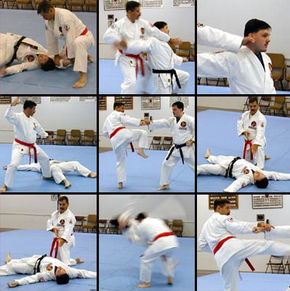
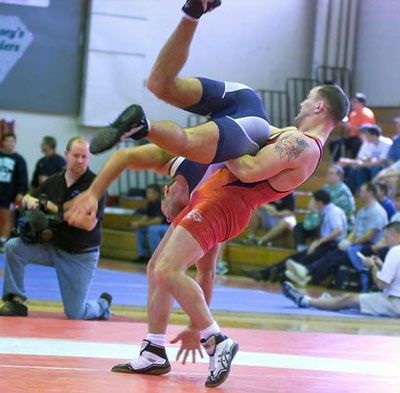
This also turns your opponents' momentum against them. When you sweep a blow away to the side, your opponents' own momentum pull them forward, upsetting their balance. This leaves them vulnerable to attack; you can land a successful hit or pin them to the ground. You might also grab attackers and pull them forward, increasing their forward momentum. Using this defense, a karateka can throw attackers to the ground. Throwing is not a central element in karate, but it does play an important part in other martial arts forms, notably judo and aikido.
In karate and other martial arts forms, you might pull opponents toward you to increase their forward momentum and throw them off balance.
To protect against attacks, karatekas take on particular fighting stances. Generally, karatekas stand with one leg in front of them and one leg behind them. This effectively shields the front of the body from attack, and gives the karateka better balance. Karatekas hold themselves with their center of gravity relatively low to the ground, so it is more difficult for an opponent to knock them down.
In a karate competition, both karatekas concentrate on guarding themselves against attack while waiting for an opening in their opponent's defenses. Often, a karateka can land a successful hit immediately after deflecting the opponent's attack, as this is when the opponent is most vulnerable. A lot of karate is based on paying attention to what's going on around you, so you can recognize an opportunity when it arises.
In the next section, we'll look at this sort of karate competition, as well as some other ways that karatekas demonstrate their skill.
Advertisement
Displaying Skill
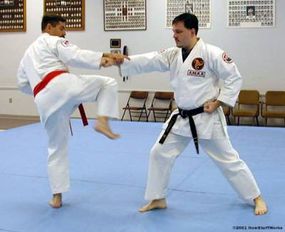
Rob Olevsky, a ninth-degree black belt, and Tony Letourneau, a fourth-degree black belt, practice freestyle sparring.
Karate developed out of martial arts styles designed to aid in combat. For the most part, these fighting styles were intended only for self-defense, but they did include a means of maiming or even killing a person. One element of this is close attention to human anatomy. By applying forceful blows to the most vulnerable parts of the body -- the face, the solar plexus, the groin -- a karateka can bring down an opponent in short order.
Advertisement
These days, karate is taught primarily as sport, not as a means of combat. Karatekas have several ways of demonstrating their skill without actually hurting another person.
To demonstrate mastery of punches, kicks and blocks, karatekas will work various combat simulations. In one exercise, called kata, karatekas carry out a pre-determined sequence of movements against an imaginary group of attackers. Kata is extremely important to beginning karate students, as it helps them perfect their technique.
More advanced karatekas may engage in kumite, a sort of freestyle sparring. In this activity, you fight with another karateka, but curb your punches. Typically, especially in the lower levels, karatekas will stop a few inches short of actually touching their opponent with a blow. Karatekas may also put on protective pads. Certain areas (below the belt, for example) are off limits.
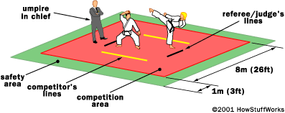
A typical sparring ring
In general practice, karatekas approach sparring as an open and engaging way to practice proper technique and concentration. But karatekas may also participate in more formal kumite competitions, known as "point sparring." In this sport, an umpire awards points, called ippons, when a karateka lands a successful hit while displaying excellent technique and attitude. The winner is the first karateka to score a certain number of points (typically three) or the karateka with the most points at the end of a certain time limit (usually one to three minutes).
Kata and kumite are effective demonstrations of karatekas' mastery of karate moves, as well as their attention and control. But they don't allow karatekas to demonstrate their full strength, as this would be extremely dangerous. Karatekas must use alternative means to show their full force.
Karate teachers may use a large shield to protect themselves from the full force of a student's attack. They might also use a protective, padded suit, but this is more common in general self-defense classes rather than conventional karate. One of the most popular displays of strength is tameshi wari, also known as the "breaking demonstration." With a great deal of practice and concentration, karatekas can break boards and bricks with only their feet and hands. Basically, they turn their appendages into natural chisels, breaking the structural integrity of an object by focusing the force of their entire body into a small area. As they progress to higher skill levels, karatekas practice breaking stronger and stronger blocks.
Advertisement
Karate Schools
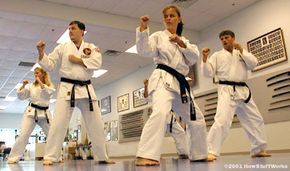
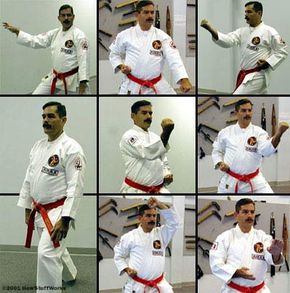
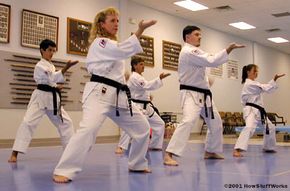
Advanced karatekas at Karate International of Raleigh practice their stances. (L-R) Michael Tuso is a first-degree black belt, Kathy Olevsky is a sixth-degree black belt, John Elliott is a third-degree brown belt, Tony Letourneau is a fourth-degree black belt and Mindy Mayernik is a third-degree black belt.
It is practically impossible to learn karate without the aid of a karate master. These days, most novice karatekas find their master through a karate school. In the past 25 years, schools have sprung up in shopping centers all over the United States and Europe. If you live in a larger city, you might have dozens of schools to choose from.
Karate schools mean different things to different people. Some students take up karate as a form of exercise or a way to relieve stress. Others only want to learn a few moves to aid in self-defense. Karate can also be an excellent way to build self-confidence. Whatever their original interest, many karatekas eventually fall in love with the practice: Karate becomes a way of life.
Advertisement
Larger karate schools typically cater to a wide range of students. They include elements of exercise, relaxation and self-defense. The goal of karate is not necessarily to progress through the different kyus; if a karateka gets what he or she needs from the experience, then the training is a success. But most karatekas end up advancing to higher levels if they come to class regularly.
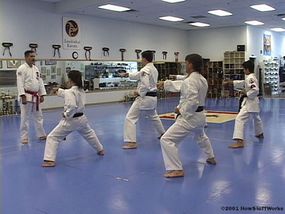
Master instructor Rob Olevsky leads karatekas through practice exercises.
Karatekas may come to class once every week, or they may come every day. According to Kathy Olevsky, a sixth-degree black belt and an instructor at Karate International of Raleigh, a karateka's rate of progress depends on a number of factors. A karateka who comes to class two or three times a week can progress to green belt (roughly halfway to black belt) in four months. After this point, Olevsky says, it takes longer to advance. A strong athlete who comes to class four or five times a week might make it to first-dan black belt in 18 months. But for the average student, it takes at least three years.
Karate schools may combine elements from multiple martial art forms. Robert Olevsky, the head instructor at Karate International, is not only a ninth-degree black belt in karate, but also a second-degree black belt in judo, a sixth-degree black belt in jujutso and a first-degree black belt in kendo. He incorporates throwing techniques and other combat moves from these disciplines into his instruction of karate. Among other things, these supplementary skills improve a karateka's self-defense ability.
Karate schools may also teach weapons techniques, even though this is not a traditional element of karate. In martial arts, students learn to use weapons as extensions of their own body. They channel their power into external equipment the same way they channel power to their fist or foot.
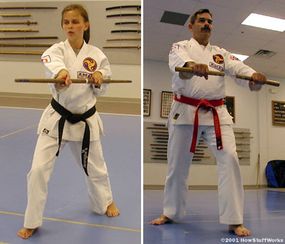
At Karate International of Raleigh, advanced karatekas may take up a traditional martial arts weapon. On the right, Rob Olevsky holds the Nunchaku. On the left, Mindy Mayernik wields the long staff.
A number of traditional martial arts weapons were originally developed out of everyday farm and household equipment. When the ruling class banned swords and other weapons, the peasants learned to use these everyday objects for defense. The nunchaku, for example, evolved from a threshing tool used in grain harvesting. Some karate schools also teach how to use improvised weapons -- such as brooms and telephones -- to fight off an unexpected attack.
If you're looking for a karate school, it pays to shop around. Make sure the school covers the areas you're interested in and that the class times fit your schedule. Also, look for a school that is in a convenient location; otherwise, you might be tempted to skip class. Attend a few trial classes to get a feel for the atmosphere and the instructor's style. Ask other karatekas about their experiences.
Kathy Olevsky suggests that women find a karate school that has a good attitude toward female karatekas. Look for a school that has advanced female students (and, ideally, female instructors), and find out whether they are happy with the class environment.
According to Olevsky, parents enrolling their kids in karate classes should look for a school with an open atmosphere. There should be an area for parents to watch their kids' classes, and there should not be hidden, off-limits training areas. Additionally, parents should seek out an instructor who is a good fit for their child. A child who is shy or has learning difficulties needs an instructor who is patient and encouraging, rather than intimidating and militaristic. Since children and adults learn at a different pace, look for a school that teaches kids separately.
Karate requires strength and good technique, but it also depends on mental focus and discipline. In the next section, we'll look at the role intelligence, attitude and spirituality play in karate.
Advertisement
Role of the Spirit
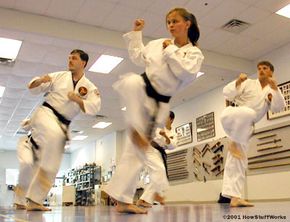
Karatekas practicing at Karate International of Raleigh. While the instructors at this school don't teach Zen Buddhism, they do help their students achieve inner focus and enlightenment. The spiritual elements of karate complement most major religions.
In the long history of martial arts, expert fighters have used their physical skills as a means of building mental and spiritual skills. This is especially true of karate; in fact, for many karatekas, the art is primarily a path towards spiritual fulfillment rather than a means of self-defense.
Karate and its martial arts forerunners are historically linked with Zen Buddhism. In this branch of Buddhist belief, people achieve enlightenment through everyday activities. By experiencing every moment for itself and leaving the mind open to all experiences, Zen Buddhists find inner peace. The cornerstone of Zen Buddhism is being in-tune with the world around you.
Advertisement
There are many strong connections between this philosophy and karate. In solitary practice, karatekas must learn to concentrate on their own movements, letting everything else go. This is a powerful form of meditation. In fighting competitions, karatekas need to react quickly to any action by their opponent. This quickly teaches the karateka to be open and attentive to whatever they encounter: If you're not paying complete attention in a fight, you lose the match.
Not all karatekas practice Zen Buddhism as such. Karate masters might be Jewish, Christian, Hindu or agnostic -- the martial arts discipline fits well with a wide range of religions and beliefs. But to advance through the higher levels of karate, it is essential that a karateka cultivate spiritual power, whatever their religious beliefs. The basic element of this power is ki.
Ki is an amorphous, undefinable force, but it is generally described as the energy of life itself. It binds all living things together and gives each person his or her spiritual, physical and mental power. In most schools, beginning karatekas won't worry too much about ki. They focus mainly on proper technique and breathing exercises. But in these basic activities, they are laying the groundwork for later ki exercises.
Through the power of ki, a karateka can break through concrete blocks as if they were made of paper. To break through these blocks, Kathy Olevsky imagined that they weren't even there. She focused her energy and just stepped down through them.
As karatekas develop heightened physical control, they become more aware of the seat of ki in their body. With concentration, karatekas can move their ki up and down, so their source of energy is higher and lower. Experienced karatekas generally center their ki, in order to achieve maximum balance and power. Ki is absolutely crucial in the higher levels of karate: It gives masters the power they need to break blocks and topple much larger opponents.
Karatekas say that the actual fighting principles they learn in karate help them in all aspects of life. To understand the connection between karate and real life, consider a stressful situation anyone might encounter -- let's say getting fired from your job. In this situation, there are any number of ways you could react. You could take it as a sign that you are an absolute failure and completely shut down mentally. This is the equivalent of taking a punch squarely in the chest. Or you could accept the turn of events and learn from the experience. This is like deflecting the blow and using your opponent's momentum to your advantage.
When looking for a new job, you might send out resumes blindly and interview at dozens of companies you don't know anything about. This is like fighting an opponent with no plan at all, waving your arms around wildly. Instead, you could fully focus your efforts on the positions that interest you, tailoring your letter of interest and resume to fit the company and job description. This is like focusing your physical force into the side of your hand and finding the weak spot on your opponent.
You could practice these principles without undertaking karate, of course. But karatekas claim that exercising this philosophy physically as well as mentally strengthens their resolve and character. In the study of karate, you learn to carry your body a certain way through many hours of practice. After a while, you deflect blows and land punches almost without thinking: It is simply part of who you are. And if you know to automatically deflect physical attacks and land effective kicks and punches, karatekas say, you will also know how to handle everyday threats and opportunities. Your body and mind know right away how to handle whatever crisis arises.
For more information on martial arts and related topics, check out the links on the next page.