Introduction to How Horoscopes Work
The earliest humans looked at the star-filled night sky and knew that the shapes and patterns of the constantly shifting cosmic panoply must somehow be important. Their attempts to explain the seemingly arbitrary events of life (changing seasons, wars, economic hardship, weather) and link their lives to the stars above resulted in a combination of religion and science -- astrology.

Dorling Kindersley/Getty Images
Believers call astrology a science, while non-believers call it nonsense.
In this article, we'll delve into the world of astrology, past the simplistic sun sign newspaper horoscopes and into planetary influences and oppositions and detailed star charts. We'll examine astrology's long past and see if we can use astrology to peer into the future. And finally, we'll find out why many people view astrology as mere superstition.
Astrology Basics
Astrology is the study of the influence that distant cosmic objects, usually stars and planets, have on human lives. The position of the sun, stars, moon and planets at the time of people's birth (not their conception) is said to shape their personality, affect their romantic relationships and predict their economic fortunes, among other divinations.What most people know about astrology is their "sign," which refers to one of the 12 constellations of the zodiac. This is a form of sun-sign astrology, which is the astrology upon which newspaper horoscopes are based. It is probably the simplest form, because nothing more than the date of someone's birthday is needed to generate a sun-sign horoscope. Many astrologers will tell you that this form of astrology is so simplistic that it produces very limited results.
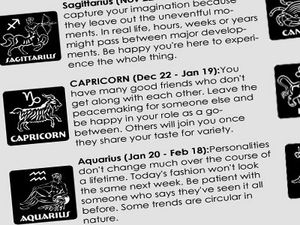
![]() Typical newspaper horoscope |
To produce a more accurate reading, astrologers check to see what sign each planet was in at the time of birth (see the next section). The planets and signs combine with other elements, such as houses and angles, to form a complex and often very specific profile of a subject's personality, life and future prospects.
There is no single unified theory or practice of astrology. Ancient cultures all practiced their own forms, some of which combined and evolved into today's common western astrology. Eastern cultures continue to practice their own forms of astrology: Chinese, Vedic and Tibetan astrology are among the most well-known.
Even within western astrology, there is a considerable diversity of methods and philosophies. Some divide astrology by the end result that is intended:
- Mundane Astrology - This is used to examine world events and make predictions about national affairs, wars and economies.
- Interrogatory Astrology - This branch can be further subdivided, but generally refers to astrology that seeks to make specific predictions or analyses about the subject's objectives or events within the subject's life.
- Natal Astrology - This is what most people think of when they think of astrology. Natal Astrology seeks to make predictions and analyses based on the date of a person's birth. It's based on the idea that everything that happens to something is expressed at the very beginning of that thing, sometimes known as the Law of Beginnings(Burk, pg. 5).
What's Your Sign?
I don't believe in astrology; I'm a Sagittarius and we're skeptical. - Arthur C. Clarke
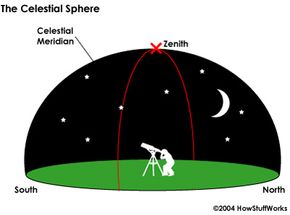
People's sign, or sun sign, is determined by which zodiacal constellation the sun was in when they were born. If it seems confusing to think of the sun being in a constellation at any time, think of the stars and planets that are visible from Earth as if they exist on a giant sphere that encompasses our planet. This is known as the celestial sphere, and it is used by astrologers and astronomers alike to make measurements of the things we see in the night sky.
![]() |
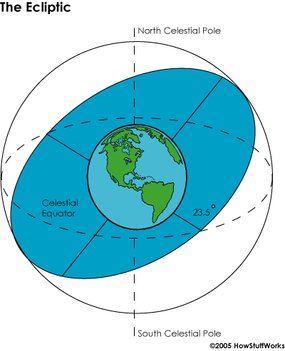
As the Earth revolves around the sun, the sun appears to move across the Celestial Sphere, following a path known as the ecliptic. Each day, the sun moves about 1 degree along the ecliptic, which is offset from the Earth's axis of rotation by 23.5 degrees. This degree variation is what accounts for seasonal changes in the amount of sunlight the Earth receives.
![]() |
Depending on the time of the year and the specific astrological system used, the sun will have a certain sign as its backdrop in the daytime sky. Ancient astrologers figured this out by watching which sign rose first at night and set last in the morning.
Therefore, when someone says, "I'm a Leo," that means that the sun was in the constellation Leo on the day that person was born.
Many astrologers divide the ecliptic into 12 equal regions and assign zodiacal names to each division, although the divisions don't necessarily line up with the appropriate constellation. This is known as the sidereal zodiac, and was actually developed around 400 B.C. Other astrologers use the tropical zodiac, in which the position of the signs are linked to the seasons. Because of the Earth's precession (basically, the Earth "wobbles" slightly on its axis as it rotates -- see What is the Chandler wobble? to learn more), the two methods don't really match up any more. They did about 2,000 years ago, but now the constellations have shifted considerably in the sky (Campion, pg. 11).
In the next section, we'll take a look at each sign of the zodiac and the traits associated with it.
|
|
The Twelve Signs of the Zodiac
Each sign has certain characteristics; but the signs are also categorized in several ways. First, they are grouped by element:- Fire signs (Aries, Leo, Sagittarius) are associated with action, enthusiasm and leadership, as well as an openness to change.
- Water signs (Cancer, Scorpio, Pisces) embody emotion, sensitivity and compassion.
- Earth signs (Taurus, Virgo, Capricorn) symbolize practicality and a focus on material goals.
- Air signs (Gemini, Libra, Aquarius) are the signs of the intellect.
![]() Image courtesy Skyscript |
Signs can also be cardinal, fixed, or mutable, which are related to movement, resistance to change and ability to change freely, respectively. And finally, each sign is either masculine or feminine, alternating around the zodiac. This designation is not related to what most of us think of as gender, but instead to the Chinese concept of Yin and Yang, in which, to oversimplify a complex subject, opposing forces or traits both define and create one another.
- Aries - The Ram
March 21 - April 20
Cardinal, Fire, Masculine
Proud, youthful, impulsive, brave, competitive, arrogant, violent - Taurus - The Bull
April 21 - May 21
Fixed, Earth, Feminine
Conservative, loyal, stubborn, materialistic, resistant to change, possessive, sensual - Gemini - The Twins
May 22 - June 21
Mutable, Air, Masculine
Persuasive, concerned with information, highly literate, curious, adaptable, absent-minded, loves to travel - Cancer - The Crab
June 22 - July 22
Cardinal, Water, Feminine
Cautious, family-oriented, romantic, domestic, imaginative, shy, thorough, interested in the past and tradition - Leo - The Lion
July 23 -August 21
Fixed, Fire, Masculine
Proud, courageous, stubborn, extroverted, vain, ambitious, optimistic, open, associated with royalty - Virgo - The Virgin
August 22 - September 23
Mutable, Earth, Feminine
Conservative, shy, prudish, kindly, uptight, skeptical, concerned with health, often introverted and melancholy - Libra - The Scales
September 24 - October 23
Cardinal, Air, Masculine
Extroverted, analytical, unbiased, secretive, tactful, concerned with harmony but prone to collapse in the face of conflict - Scorpio - The Scorpion
October 24 - November 22
Fixed, Water, Feminine
Vengeful, sarcastic, courageous, tenacious, protective of itself, known for survival in the face of disaster - Sagittarius - The Archer
November 23 - December 22
Mutable, Fire, Masculine
Daring, proud, impatient, dual-natured (refined and intellectual as well as bestial and passionate), extroverted, looking to the horizon, progressive, eclectic - Capricorn - The Goat-Fish
December 23 - January 20
Cardinal, Earth, Feminine
Neurotic, introspective, inhibited, conservative, fatalistic, methodical, practical, concerned with detail, a good planner - Aquarius - The Water Bearer
January 21 - February 19
Fixed, Air, Masculine
Intellectual, connected to civilization, rational, individualistic, iconoclastic, concerned with science, tolerant - Pisces - The Fish
February 20- March 20
Mutable, Water, Feminine
Emotional, self-sacrificing, adaptable, empathic, religious, versatile, talkative, often takes on the behaviors of others, creative, impractical
It's All in the Stars
We have seen that astrology can be used for many different applications, but for this article, we will focus on Natal Astrology, or astrology based on the date of the subject's birth. What can an astrological reading tell us, and how is this information gleaned from a star chart?An astrology reading begins with the date of birth of the subject. Sometimes, the exact time and location of the birth are considered as well.
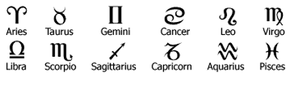
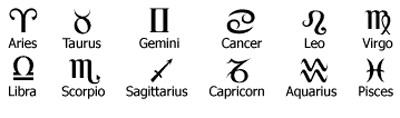
We've already learned how to figure out a sun sign. Here is another look at the symbols:
![]() Image courtesy Skyscript |
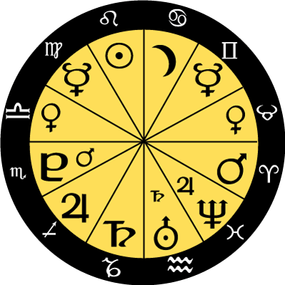
The next step is to figure out what signs the planets are in. It's very similar to figuring out the sun sign -- in fact, the sun and the moon are called "planets" in astrology because they are treated much like the other planets, albeit with more importance. Here are the symbols for the planets:
![]() Image courtesy Skyscript |
Using mathematical models and scientific knowledge of the movements of the planets, it is possible to calculate the position of a planet in the sky for any date, although the further you get from the present, the more complicated it becomes.
![]() Example chart showing the positions of the planets in relation to the signs for a given date |
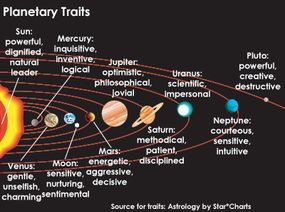
Each planet has its own aspects and influences, much like the signs. How the influence is exerted upon the subject depends on which sign the planet appears in, which other planets are present and if the planet is in retrograde motion.
![]() Read more about each planet's traits at AstroStarCharts: Planets. |
The positions of the planets relative to one another are important, as are various angles and mathematical calculations based on all of these factors.
Here's an example: Saturn often is often characterized by patience, discipline and a methodical nature. When Saturn is found in Sagittarius, a sign known for extroversion, confidence, a desire to explore and a disdain for rules and restrictions, some kind of interpretation of these two conflicting symbols is needed. Ten different astrologers will probably give you 10 different interpretations -- one possible version suggests that Sagittarius' exploration of universal truths combines with Saturn's patience and discipline to form a dogmatic belief in a particular system or idea (Burk, pg. 144).
The possible combinations and permutations of all these different factors approach infinity, which is why readings tend to vary so much from one astrologer to another, even if they use the same general astrological system.
|
There are many different house systems, but you can find a general guide to the houses at AnnabelBurton.com: Astrology Houses. |
What can Horoscopes Tell Us?
|
A poll conducted in 2004 revealed belief rates on the rise again, with 29 percent of Americans expressing belief in astrology. Women and young people were more likely to believe. |
However, a full, professional reading can be extremely detailed, packed with information about the interactions of the various astrological elements and how they affect the subject. Even if you believe that the stars can't possibly exert any influence over human lives, it can still be beneficial (or at least interesting) to read a psychological profile and consider how it relates to your own life. How you respond to authority, what you look for in a relationship, how you relate to your parents and your typical reaction when your boss asks you to work late are all things you might not examine thoroughly -- and if you do examine them, it's often not in relation to everything else going on in your life. A good astrological reading can bring these things together and force the subject to examine him or herself in a new light, possibly drawing important conclusions or making changes for the better.
Next, we'll find out where astrology came from.
The astrologer, Joan Quigley, wrote up star charts that detailed down to the minute when it would be best for Reagan to give speeches or meet with foreign officials. She gave this information to Nancy by phone, and it was then relayed to Chief of Staff Regan. Regan even took to using a color-coded calendar so he could keep track of which days were best to schedule important events for the President. And thus, the most powerful man in western world had his schedule controlled by the stars ... or by an astrologer who charged up to $3,000 every month for the service. |
A Brief History of Astrology
The nature of Mars is chiefly to dry and to burn, in conformity with his fiery colour and by reason of his nearness to the sun, for the sun's sphere lies just below him.
- Claudius Ptolemy, Tetrabiblos
Early astrological systems were concerned with weather patterns, seasons and crops. Because early humans didn't understand the causes of things like eclipses or the retrograde movement of planets, they created stories, passed on for hundreds of generations, that tried to explain them in a context they understood. Shapes in the stars and the planets themselves became gods -- or at least symbols of gods. Every ancient culture had some form of science/religion that was concerned with patterns of movement in the stars. At this point, astronomy and astrology were one and the same. Ancient scientists observed and recorded the patterns they saw in the sky (astronomy); then, they extrapolated those observations to fit their cosmology and life experiences (astrology).
The Mayan, Aztec and Inca cultures of South America had complex astrologies based on a zodiac of 20, including symbols like the jaguar, the earthquake, the ape, rain and the dog (Snodgrass, pg. 13). These systems have not been passed on or incorporated into modern astrology because the civilizations themselves died out.
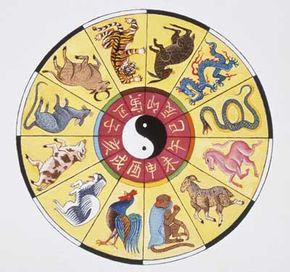
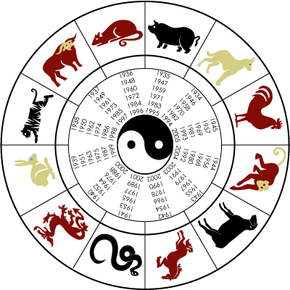
The Chinese had developed one of the most complex astrological systems by 1000 B.C., with some characters in written Chinese languages corresponding to their constellations. This system combined 24 divisions of the year with a 28-part lunar zodiac, as well as 12 branches that correspond to an animal (Campion, pg. 13). Someone born in a given year is thought to have certain characteristics -- for example, 2005 is the Year of the Rooster. In addition, each year has an element associated with it, further delineating someone's type as, say, a Fire Rooster or a Water Dragon.
In the 16th and 17th centuries, Jesuit missionaries brought western astrology to China, where it was incorporated to some extent into the traditional Chinese system. Today's Chinese astrology is a simplified system which only takes into account the animal years.
![]() Photo courtesy Current Chinese astrological chart |
The western zodiac itself, the foundation of much of astrology, has followed a winding path before it became the system with which most of us are familiar. The Babylonians are usually credited with creating the basic system, assigning certain characteristics to the planets of which they were aware. These characteristics were based on the Babylonians' observations and their metaphorical ideas about what these observations meant. Because Mars, which they called Nergal, was observed to be red, and blood is red, they aligned Mars with war. Ishtar, or Venus, appearing in the early evening when lovers were likely to be outside spending time together, was made to represent love and fertility. Mercury, hard to spot and fast moving, was associated with deceit and speed (Snodgrass, pg. 17).
This general system absorbed influences from the many cultures that populated the Mediterranean and Middle East thousands of years ago. The specific names for the modern western zodiac come from the Greeks. The word Zodiac itself comes from the Greek root word zoe, or life.
|
Another school of thought on astrology suggests that the forces involved in astrology exist beyond science, in a quasi-religious realm involving a person's soul; or perhaps the influences extend to an ethereal, other dimension, where our laws of science do not hold true. In this case, belief in the power of astrology is just that: belief. Just like belief in a god or gods, it can neither be proven nor disproven. Perhaps the most important criticism of the scientific viability of astrology are the empirical studies which have found that astrological predictions are no better than random chance. Divorce rates do not correlate with astrological compatibility. Sun signs do not show a greater chance of following one career path over another. Subjects who read horoscopes are just as likely to feel that the horoscope applies to them when the terms of the reading are reversed (i.e., instead of saying, "You're an outgoing, lively person," it might say, "You tend to be quiet and protective of your privacy."). These and other studies are outlined at Astronomical Society of the Pacific: Education. |
For more information on horoscopes, astrology and related topics, check out the links on the next page.
Lots More Information
Related HowStuffWorks Articles
- How Stars Work
- How the Sun Works
- How Nostradamus Works
- How ESP Works
- How Dreams Work
- How Hypnosis Works
More Great Links
- From Stargazers to Starships: The Ecliptic
- Astrological Psychology Institute (UK)
- About.com: Astrology
- James Randi Educational Foundation: One Million Dollar Paranormal Challenge
Sources
- Astrology by Star*Charts
- Astronomical Society of the Pacific: Astronomical Pseudo-Science: A Skeptic's Resource List
- Astronomical Society of the Pacific: The Universe At Your Fingertips Activity
- Burk, Kevin. Astrology: Understanding the birth chart. Llewellyn Publications, 2001.
- Campion, Nicholas & Eddy, Steve. The New Astrology: The art and science of the stars. Trafalgar Square, 1999.
- Lewis, James R. The Astrology Book. Visible Ink, 2003.
- Snodgrass, Mary Ellen. Signs of the Zodiac: A reference guide to historical, mythological, and cultural associations. Greenwood Press, 1997.
- Trull, D. The Astrological Administration: Star Power at the Reagan White House. ParaScope.com.
- White, Suzanne. Chinese Astrology: Plain and simple. Tuttle Publishing, 1976.
- Zodiackiller.com: FAQ