Cultural and Ethnic Influences on Baby Names
As long as there has been language, there have been names. Naming is the first task of speech through which we differentiate one person or thing from all others. Every society has a naming system, and all these systems have certain common elements.Throughout the world, each child is assigned a sound or series of sounds that will be his or her name. Because that name is a part of the language of the child's parents, it immediately identifies the child as belonging to a particular society. So our names identify us both as individuals and as members of a group.
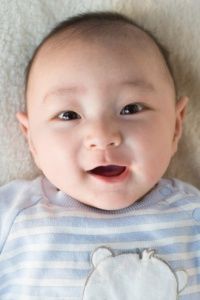
![]() This child's heritage may have had a strong influence on the name she was given. |
Many Native Americans developed naming systems in which a person's individual name included the name of his or her clan. For example, all the members of a clan that has the bear as its totem animal have names relating to bears, such as Black-Bear Tracks and Black-Bear Flashing Eyes.
In some groups, children are given secret names that are not revealed until the child reaches puberty or another important stage of life. In other Native American nations, an event that occurs at a child's birth may become the child's name. Today, a person living on a reservation may have one name at home but a different name when he or she is off the reservation.
In China, all given names are created out of words in the Chinese language that have an obvious, immediate meaning. Names are believed to reflect the character of the person, and great care is taken in selecting a child's name. Usually about a month after the child is born, the parents attempt to create an original name. Many girls are given names that signify beauty, such as Sweet Willow or Morning Star. Boys are given names that reflect strength and good health. In rural areas, many Chinese names still include a "generation name," a word or syllable that is the same for all children born in a family in the same generation. Three sisters, for example, might be named Yuan-Chun, Ying-Chun, and Xi-Chun, which mean "First Spring," "Welcome Spring," and "Cherish Spring."
With China's one-child policy, this custom is fading in urban areas, but some Americans of Chinese descent continue this tradition by giving all their children names containing the same syllable (such as Mar- as seen in Marco, Marisa, Marla, Marlene, Marshall, Martha, and Marvin). Most Chinese-Americans give their children American-style first names, though they often give a Chinese-language name as the middle name, as in Brittany Ngon Lee.
Jewish names are some of the oldest names in use today. A Jewish boy is named officially when he is circumcised on the eighth day after his birth. A girl is named as soon as possible after her birth. Traditionally, an Ashkenazic Jewish child is not named for a living person for fear that the Angel of Death will mistake the child for the older person if their names are the same.
African-American Names
In the 1960s, some African-Americans began to give their children names from African cultures. Some adults also changed their names to African or Muslim names. Because slaves were often assigned the surnames of their owners and given common first names, choosing African names is a way for African-Americans to acknowledge their heritage before slavery. However, only a few genuine African names, such as Ayana, Kwame, and Jabari, have become widely popular in the African-American community. Muslim names from the Arabic language, such as Iesha, Jamal, Malik, and Aaliyah, have been more popular recently, even with African-Americans who have not adopted the Islamic religion.
Since the 1970s it has become more common for African-Americans to create new names for their children by combining their own set of fashionable sounds and syllables. Names for girls formed in this way are called "Lakeisha names" after one of the prime examples. Lakeisha names are created by linking a fashionable prefix, such as Sha-, La-, Ka-, Shan-, or Ty-, with a fashionable suffix, such as -isha, -ika, -onda, -ae, -ique, or -ice. The resulting names are almost always accented on the second syllable.
In the 1970s and 1980s, names beginning with La- such as Lashonda and Lashay were most popular. In the 1990s, Sha- names such as Shameka, Shanae, and Shaniqua were fashionable. In 2004, names starting with Ja- or ending in -iyah such as Jakayla, Jamya, Janiyah, and Taniyah were in vogue. But the point of this custom for most parents is to create a unique name for their child, and many are successful. Even in states as large as Pennsylvania, each year the average African-American girl receives a name that no other African-American girl born in that state is given. It was not possible to include many of these unique names, such as Azanae, Kyaire, and Zaterria, but they are now the most typical kind of names for African-American girls. Names for boys that have been created similarly include DeJuan, Deonte, Jamarion, Ladarius, and Quantavious.
Hispanic-American Names
Traditionally, Hispanic-American babies were often given saints' names, and both male and female saints were considered appropriate. Hispanic-American boys are often given religious names such as Jesus, Angel, and Salvador. Girls are often named in honor of the Virgin Mary, using words from her devotional titles such as Araceli, Rocio, Consuelo, Dolores, and Mercedes.
Other traditional Spanish names popular in the Hispanic-American community include Carlos, Enrique, Fernando, Francisco, Jaime, Javier, Jorge, Jose, Juan, Julio, Luis, Marcos, and Miguel for boys and Adriana, Beatriz, Carolina, Daniela, Gabriela, Isabel, and Maria for girls.
Traditional boys' names remain especially common in the Hispanic-American community, because there is still the expectation that most boys will be named after their fathers or grandfathers, a custom that is now rare in other ethnic groups.
However, not all the names popular with Hispanic-Americans are traditionally Spanish names. Hector, Oscar, and Rene have long been popular names for boys in Latin America, and non-Spanish immigrants to Central and South America, as well as the modern media, have introduced many new names. In particular, Spanish-language television programs called telenovelas, most of which are produced in Mexico, have popularized the names of their stars and characters wherever they are shown, including in the United States. For example, Vanessa, a very British name, is popular in the Hispanic-American community because it was the name of the title character in a television program starring Lucia Mendez, one of Mexico's most popular actresses.
Other non-Spanish names more popular with Latinos than Anglos in the United States include Astrid, Daisy, Evelyn, Leslie, Lizbeth, and Yasmin for girls and Axel, Edgar, Edwin, Elmer, George, Giovanni, Omar, and Yahir for boys. Ariel and Alexis are very common names for Hispanic-American boys, while other ethnic groups now give them mostly to girls. Some Latino parents also create brand-new names for their children, especially daughters. At the moment, invented names beginning with the letter Y are in vogue, and many Hispanic girls are being given names like Yaritza, Yanelis, Yosayra, and Yuritzi.
Other Ethnic Influences
Historically, first-generation immigrants to the United States from Europe and East Asia have tried to adopt American naming customs, though since they are not completely assimilated into the culture they often give their children names that seem out of style. For example, recent immigrants from China and Korea are much more likely to name daughters Linda or Eunice than other Americans.
The second generation of an immigrant group usually gives their children names that are no different from those of the majority. The third and fourth generations, however, often begin to revive names from their ancestry. Many Irish-Americans began this process in the 1940s, re-introducing traditional Irish names such as Sean, Kevin, Sheila, and Caitlin that have gone on to become generally popular. This process has now begun with Italian-Americans, who, since 1990, have strongly increased their use of traditional Italian names such as Isabella, Gianna, Lorenzo, and Leonardo.
Because of the strong influence of Islam and Hinduism, immigrants from the Middle East and South Asia don't adopt "Western" names as readily, though they do often try to choose names from their religious traditions that they think will be easier for other Americans to pronounce. Muslim-Americans give their children names such as Ali, Fatima, Zaynab, and Ziad; Hindu-Americans use names such as Aryan, Diya, Mira, and Rohan. Many names popular with East Indian-Americans, such as Arjun and Shreya, have been influenced by the stars of India's huge Bollywood film industry.
From Around the World
Today, many parents in the United States want the name they choose for their baby to reflect their ethnic heritage. Although the names they pick may be unusual in this country, these parents are interested in choosing names that are popular in the country where their ancestors lived. Of course, names in other parts of the world go through fads and fashions just as they do in the United States. The names in the following lists have recently been popular in various parts of the world.
Victoria, Australia:
Girls: Emily, Olivia, Jessica, Sarah, Georgia, Ella, Grace, Emma, Hannah, Sophie
Boys: Jack, Lachlan, Thomas, Joshua, James, William, Matthew, Daniel, Benjamin, Nicholas
Quebec, Canada:
Girls: Lea, Rosalie, Noemie, Laurence, Jade, Megane, Sarah, Audrey, Camille, Coralie
Boys: Samuel, William, Alexis, Gabriel, Jeremy, Xavier, Felix, Thomas, Antoine, Oliver
England and Wales:
Girls: Emily, Ellie, Jessica, Amy, Sophie, Chloe, Lucy, Katie, Olivia, Charlotte
Boys: Jack, Joshua, Thomas, James, Daniel, Samuel, Oliver, William Benjamin, Joseph
France:
Girls: Lea, Manon, Emma, Chloe, Camille, Clara, Ines, Oceane, Sarah, Marie
Boys: Lucas, Theo, Matteo, Thomas, Hugo, Enzo, Mathis, Maxime, Clement, Leo
Germany:
Girls: Marie, Sophie, Maria, Anna, Leonie, Lea, Laura, Lena, Katharina, Johanna
Boys: Maximillian, Alexander, Paul, Leon, Lukas, Luca, Felix, Jonas, Tim, David
Ireland:
Girls: Emma, Aoife, Sarah, Ciara, Amy, Katie, Sophie, Rachel, Chloe, Leah
Boys: Sean, Jack, Adam, Conor, James, Daniel, Cian, Michael, Eoin, David
Israel:
Girls: Adi, Chen, Feigel, Hallel, Maayan, Maya, Neta, Noa, Noam, Shira
Boys: Bar, Fishel, Gai, Ido, Nachman, Natan. Oren, Tom, Yisrael, Zalman
Bologna, Italy:
Girls: Guilia, Sara, Alice, Martina, Francesca, Sofia, Anna, Elena, Chiara, Matilde
Boys: Alessandro, Francesco, Matteo, Filippo, Andrea, Davide, Luca, Riccardo, Lorenzo, Mattia
Japan:
Girls: Momoka, Haruka, Ayaka, Misaki, Sakura, Nanami, Yui, Hina, Rin, Haruna
Boys: Yuuki, Yuuta, Haruto, Souta, Kouki, Takumi, Kouta, Ryouta, Haruki, Kaito
Jordan:
Girls: Rawan, Suzan, Lana, Diana, Tala, Leena, Tamara, Reem, Randa, Amal
Boys: Sami, Rani, Samer, Kamal, Bisher, Imad, Raed, Hazem, Nader, Amjad
Netherlands:
Girls: Sanne, Lotte, Emma, Anne, Iris, Anna, Julia, Femke, Lisa, Amber
Boys: Sem, Daan, Thomas, Tim, Lars, Lucas, Bram, Milan, Max, Jesse
Norway:
Girls: Emma, Julie, Thea, Ida, Nora, Emile, Maria, Sara, Hanna, Ingrid
Boys: Mathias, Markus, Martin, Kristian, Andreas, Jonas, Tobias, Daniel, Sander, Alexander
Russia:
Girls: Anna, Antonia, Elena, Galina, Irina, Mariya, Olga, Svetlana, Tatyana, Valentina
Boys: Aleksey, Alexander, Ivan, Konstantin, Mikhail, Nokolai, Pavel, Sergey, Vladimir, Yuri
Spain:
Girls: Lucia, Maria, Paula, Laura, Marta, Alba, Andrea, Claudia, Sara, Nerea
Boys: Alejandro, David, Daniel, Pablo, Adrian, Alvaro, Javier, Sergio, Carlos, Marcos
Television shows and movies that become popular also give parents ideas for baby names. Check out some of these media influences in the next section.