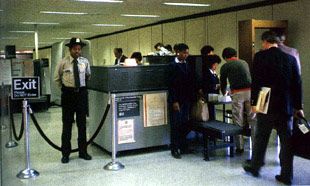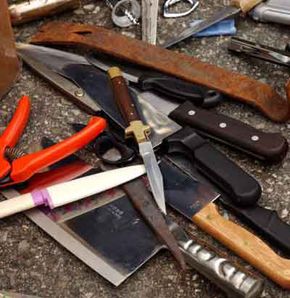
If you have ever flown on an airplane, you are well aware of the convoluted rules concerning prohibited items. It's easy to get confused. But who in their right mind would try to board a plane with an AK-47 or a 2-foot machete?
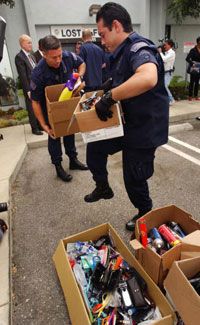
A lot of people, as it turns out. Every day people try to board airplanes with weapons. From 2002 to 2005, U.S. airport security confiscated an average of 14,000 potential weapons daily [source: Davidson].
Advertisement
So what happens when you and your prized Swiss Army knife are separated at the airport? And what is the fate of the other millions of weapons seized each year?
First, a disclaimer: Countries vary widely on their airport security policies, making it hard to generalize about the fate of you and your knife. This article deals primarily with weapons prohibited onboard U.S. and European flights. Even in the U.S. and Europe, though, the particular airport and the security lane may determine what happens to your treasured tool.
While especially dangerous weapons, such as loaded, unlicensed guns, usually are kept as evidence in prosecutions or destroyed, your knife could be returned to you or held at the airport gift shop for you to pick up later. Otherwise, it could be auctioned on eBay, sold at a state surplus supply store or donated to a local Boy Scout troop.
On certain airlines, some items that aren't allowed as carry-ons are permitted in checked baggage if passengers declare them. If you forget to declare said weapon, the U.S. Transportation Security Administration (TSA) may take pity on you and let the weapon through. However if the airport screener is unwilling to overlook your mistake, you'll likely never see your weapon again. It's up to the employee's discretion.
If you and your knife aren't reunited, it's likely to be funneled to one of the state surplus warehouses scattered across the country that accept weapons "voluntarily abandoned to the TSA" [source: CBS]. Once there, items are auctioned to the public in a retail-like store at the warehouse or through an online auction site like eBay.
It turns out that collecting confiscated items from airports and reselling them is a profitable business. Find out which state's auctions have earned it the envious title of an eBay "PowerSeller" on the next page.
Advertisement