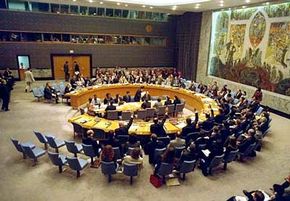
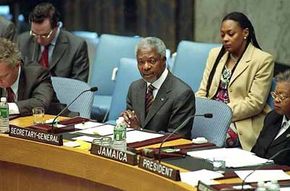
The goal of the Security Council, according to the U.N. Charter, is to focus on peace and security:
[U.N.] Members confer on the Security Council primary responsibility for the maintenance of international peace and security, and agree that in carrying out its duties under this responsibility the Security Council acts on their behalf... The Members of the United Nations agree to accept and carry out the decisions of the Security Council in accordance with the present Charter.
The Security council has five permanent members (Britain, China, France, Russia, and the United States) and 10 members elected by the general assembly that serve two-year terms (currently Angola, Bulgaria, Cameroon, Chile, Germany, Guinea, Mexico, Pakistan, Spain and Syria). Historically, this organization was developed to encourage all of the allies from WWII to participate in the new United Nations when it was forming.
On important matters, it is necessary to get nine members of the Security Council to agree. However:
- The five permanent members each have veto power, and any one of them can block any resolution of the Security Council.
- The smaller nations on the Security Council often get into extremely uncomfortable positions that can force them to vote in certain ways. In the Associated Press article "France battles U.S. to line up U.N. votes" (March, 2003), you can see the type of wrangling that occurs in the Security Council:
Mexico and Angola, mindful of their close trade ties with the United States, are also leaning toward backing the U.S.-British position, diplomats say. Shattered by civil war, Angola relies on income from the sale of oil and desperately needs U.S. aid, while Mexico does not want to anger its powerful neighbor. France is leaning on Cameroon and Guinea to vote no or abstain. Both nations are poor and don't want to offend Washington or Paris. For Guinea...the dilemma is acute, since Washington is its main aid donor and Paris its second-largest donor. Washington now is offering military training, and Britain is offering $6.2 million in aid.
Unlike the General Assembly, the Security Council is able to actively enforce its decisions. It can use economic sanctions or deploy forces as described in the U.N. Charter:
The Security Council may decide what measures not involving the use of armed force are to be employed to give effect to its decisions, and it may call upon the Members of the United Nations to apply such measures. These may include complete or partial interruption of economic relations and of rail, sea, air, postal, telegraphic, radio, and other means of communication, and the severance of diplomatic relations. Should the Security Council consider that measures provided for in Article 41 would be inadequate or have proved to be inadequate, it may take such action by air, sea, or land forces as may be necessary to maintain or restore international peace and security. Such action may include demonstrations, blockade, and other operations by air, sea, or land forces of Members of the United Nations.
The forces used are all contributed by the member nations and form coalitions that serve the commanders chosen by the Security Council. The Charter spells this out as well:
All Members of the United Nations, in order to contribute to the maintenance of international peace and security, undertake to make available to the Security Council, on its call and in accordance with a special agreement or agreements, armed forces, assistance, and facilities, including rights of passage, necessary for the purpose of maintaining international peace and security.
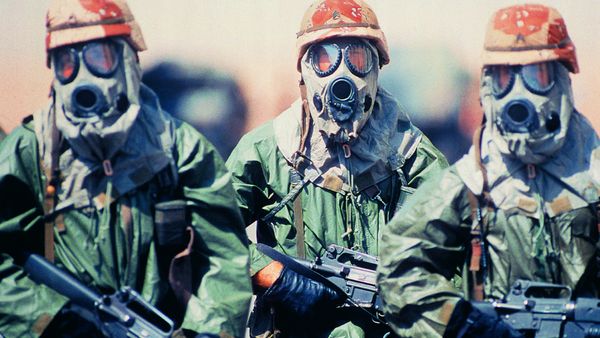
You can see that, when all members of the Security Council decide that force is needed, the United Nations can bring together an impressive arsenal to solve international problems. That is what happened in the 1991 Gulf War.
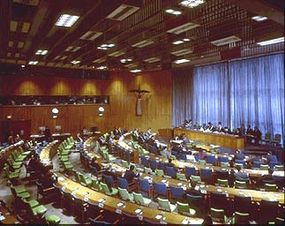
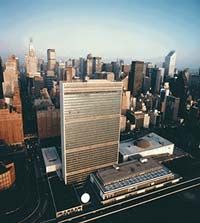
In the next section, we'll discuss the other U.N. organs.