How does someone become a saint?
Many of the world's religions bestow special status on people who demonstrate a life of almost perfect virtue. Religions differ on the title assigned to these people. The Catholic church calls them saints.
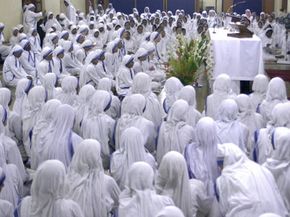
![]() DESHAKALYAN CHOWDHURY/AFP/Getty Images Nuns of the global Missionaries of Charity Order, founded by Nobel Peace Prize winner Mother Teresa, take part in a thanksgiving mass at Mother House in Calcutta, India, on Oct. 19, 2003. |
Canonization has been revised in the past 1,000 years, most recently by Pope John Paul II in 1983. Pope John Paul II, who canonized some 300 people, made several procedural changes to the canonization process, including the elimination of the "devil's advocate" from the review process. The devil's advocate was the person designated to attack the evidence offered in favor of canonization.
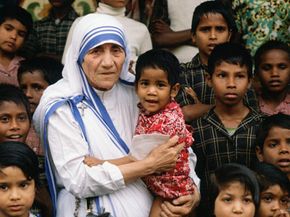
The process of becoming a Catholic saint is lengthy, often taking decades or centuries to complete. The canonization process has been in the news off and on over the past few years, primarily because of the movement to make Mother Teresa a saint.
Soon after her death in 1997, Mother Teresa's followers began pressing the Vatican to waive the rule that prevents the process of canonization from beginning until five years after a candidate's death. This rule has traditionally been used to allow for a more objective look at a person's life and achievements. In 1999, the pope did waive the five-year rule, allowing the canonization process to begin.
To read about the specific steps in the canonization process, go to the next page.
The Steps of Canonization
Here are the steps that must be followed in the process of canonization:
- A local bishop investigates the candidate's life and writings for evidence of heroic virtue. The information uncovered by the bishop is sent to the Vatican.
- A panel of theologians and the cardinals of the Congregation for Cause of Saints evaluate the candidate's life.
- If the panel approves, the pope proclaims that the candidate is venerable, which means that the person is a role model of Catholic virtues.
- The next step toward sainthood is beatification, which allows a person to be honored by a particular group or region. In order to beatify a candidate, it must be shown that the person is responsible for a posthumous miracle. Martyrs -- those who died for their religious cause -- can be beatified without evidence of a miracle. On Oct. 20, 2003, Mother Teresa was beatified. She is now known as Blessed Mother Teresa of Kolkata.
- In order for the candidate to be considered a saint, there must be proof of a second posthumous miracle. If there is, the person is canonized.
These alleged miracles must be submitted to the Vatican for verification. Sister Teresia Benedicta of the Cross was canonized in 1997 after the Vatican verified that a young girl who ate seven times the lethal dose of Tylenol was suddenly cured. The girl's family was said to have prayed to the spirit of Sister Teresia for help.
In Mother Teresa's case, her supporters are arguing that she has performed at least two posthumous miracles. In one case, a French woman in the United States broke several ribs in a car accident -- reportedly, her wounds were healed because she was wearing a Mother Teresa medallion. Another possible miracle occurred when Mother Teresa appeared in the dreams of a Palestinian girl, telling the girl that her cancer was cured.
![]() DESHAKALYAN CHOWDHURY/AFP/Getty Images Nuns of the global Missionaries of Charity Order, founded by Nobel Peace Prize winner Mother Teresa, take part in a thanksgiving mass at Mother House in Calcutta, India, on Oct. 19, 2003. |
To learn more about canonization, see the links on the next page.
Lots More Information
Related HowStuffWorks Articles
More Great Links