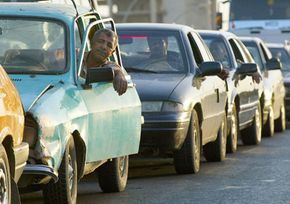
You're sitting in eight lanes of bumper-to-bumper traffic. You're more than ready to get home, but you notice, to your great dismay, that all of the other lanes seem to be moving. You change lanes. But once you do, the cars in your new lane come to a dead halt. At a standstill, you notice every lane on the highway (including the one you just left) is moving -- except yours.
Welcome to the aggravating world of Murphy's Law. This idiom says that whatever can go wrong will go wrong. And it may just be right. This isn't because of some mysterious power the law possesses. In reality, it's us who give Murphy's Law relevance. When life goes well, little is made of it. After all, we expect that things should work out in our favor. But when things go badly, we look for reasons.
Advertisement
Think about walking. How many times have you reached a destination and thought, "Wow, I walk really well"? But when you trip over a curb and skin your knee, it's a pretty good bet you'll wonder why this had to happen to you.
Murphy's Law taps into our tendency to dwell on the negative and overlook the positive. It seems to poke fun at us for being such hotheads, and it uses the rules of probability -- the mathematical likeliness that something will occur -- to support itself.
The law captures our imagination. Murphy's Law and its offshoots have been collected in books and Web sites. Several bands are named after Murphy's Law, and it's also a popular name for Irish pubs and taverns around the world. It was also used as the title of an action movie.
But Murphy's Law is a relatively new concept, dating back to the middle of the last century. Magician Adam Hull Shirk wrote in the 1928 essay, "On Getting Out of Things," that in a magic act, nine out of 10 things that can go wrong usually will [source: American Dialect Society]. Even before this, it was called Sod's Law, which states that any bad thing that can happen to some poor sod will. In fact, Murphy's Law is still referred to as Sod's Law in England [source: Murphy's Laws].
In this article, we'll explore Murphy's Law, its consequences and the impact it's had on our world. In the next section, we'll look at the story behind Murphy's Law.
Advertisement