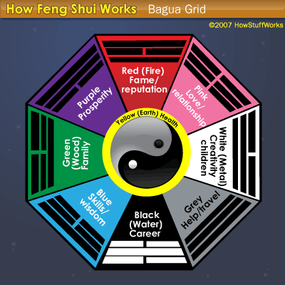
Whether you're looking for balance and harmony in your home, office or diet, feng shui is the latest (by Western standards, anyway) miracle cure for all that ails you. But, in fact, the concept of "chi," the energy that feng shui strives to balance, can be traced to Taoism, a Chinese philosophy that dates back to the sixth century B.C. The Taoist belief asserts that human language is incapable of explaining our existence in the world. Chi is a power beyond the physical world.
Some dismiss feng shui as an old Chinese myth or a fad for kooky new agers, but feng shui advocates say that it can improve everything from harmony in the home to wealth and well-being.
Advertisement
But what exactly is feng shui? Is it science or superstition? Where did it come from? And how do you use it? In this article, we'll address all of your questions about the art of feng shui.
Feng shui literally translates from Chinese as "wind" (feng) and water ("shui"). It's the art of arranging buildings, objects, space and life to achieve harmony and balance. Feng shui works on the assumption that the world is driven by unseen forces. The idea behind it is to "unblock" the way, so the forces may flow freely and create balance in a space (or life).
The main difference between the practices of feng shui (or "vastu" in the Hindu culture) and Western traditions is a belief that we as humans are connected to the spaces we inhabit. Believers in feng shui see sacred purposes and mystical meanings behind design -- not just artistically appealing buildings or superficially pretty surroundings. They view the world in terms of cosmic energy.
Advertisement