10 Strange Wedding Traditions

by

Most of the traditions in this article aren't nearly as strange as this bride.

iStockphoto/Thinkstock

10 Strange Wedding Traditions

What's the strangest thing you've seen at a wedding? A drunken best man? An unusual theme? A few seriously bad dancers? Such occurrences might be surprising, but they're hardly tradition. Some cultures, however, have wedding customs that make an inebriated groomsman seem passé.

Of course, strange is in the eye of the beholder, and most of these traditions have significant meanings and historical rationale. In fact, continuing to practice them often allows a couple to spice up their wedding ceremony while simultaneously paying tribute to their culture's past.

Even if you're not Jewish, you've probably heard the phrase "mazel tov" before. Find out how this exclamation is used and what it has to do with broken glass on the next page.

Mazel Tov!

Mazel tov is a Jewish exclamation of congratulations. "Mazel" means luck, and "tov" is the Hebrew word for good.

10: Stomping the Glass

Anyone who's been to a Jewish wedding has witnessed the groom stomping on a glass wrapped in a napkin or cloth. In most cases, the groom breaks the glass after the rings are exchanged, stepping on it with his right foot. Then the guests yell "mazel tov!"

The origin of this tradition varies, but many believe it's supposed to remind everyone of the temple in Jerusalem's destruction and the commandment in Psalms 137:6 to "set Jerusalem above my highest joy" [source: Shulman]. A lighter interpretation is that it will be the first and last time the groom gets to put his foot down, as the bride will be the one to run the household [source: Ohr]!

This is not what you want to see when you look out a window on your wedding night.

Digital Vision/Thinkstock

9: Wedding Night Interruption

Charivari (also known as shivaree) is probably the most annoying wedding-related tradition we've ever heard of. The word is defined as "a discordant mock serenade to newlyweds, made with pans, kettles, etc." [source: Dictionary]. Yes, it's as bad as it sounds, or it was, as this formally popular tradition (which hit its peak in the 19th century) has thankfully fallen out of favor.

On a couple's wedding night, a large gathering of friends, family members and other wedding guests would congregate outside the newlyweds' home and proceed to make as much obnoxious noise as possible. They'd bang on pots, sing out of tune and do whatever they could to disturb the couple.

It's bad enough to try to spoil someone's wedding night, but records indicate that the annoying noisemakers sometimes also became vandals. In one instance in 1910, a group of businessmen (associates of the bride's father) each insisted on kissing the bride; then the group demanded money before departing. Yet they still slashed the newlyweds' tires during their obnoxious serenade, forcing the couple to postpone their honeymoon [source: Star Tribune].

Indian Flowers

Flowers play a big role in Indian weddings, and garlands -- often made of marigolds -- are exchanged between the bride and groom. At the end of the ceremony, family and friends throw flower petals in the hope that the couple will enjoy a life free from sorrow.

8: Toe (Not Finger) Rings

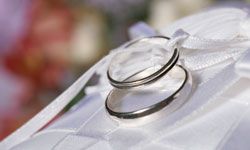
Whereas most jewelry exchanged at weddings involves placing rings on fingers, Hindu brides traditionally wear their wedding rings on their feet. The ring is usually silver and placed on a woman's left foot, on her great toe (which is next to the big toe). The groom slips the ring on the bride's foot during the ceremony, and these rings are only worn by married women.

In India, toe rings have historically played a similar role as wedding bands in the West, though grooms are exempt from wearing them. Hindu men may wear toe rings if they wish, but if they do, the jewelry is usually worn on the big toe and is never a symbol of marital status [source: Kunz].

Czech revelers often toss nuts, figs, coins and grain at the homes of newlywed couples.

Hemera/Thinkstock

7: A Traditional Tossing

In many wedding ceremonies, items are thrown at the newlyweds as they leave for their honeymoon for reasons ranging from luck to fertility. But at nuptials in the Czech Republic, items are often thrown before, during and after the ceremony.

Like most Western unions, flower girls start the process by scattering petals as a symbol of fertility for the couple. During the ceremony, a plate is thrown at the feet of the bride and groom, and the couple must clean it up together to show unity. When exiting the wedding site, friends and family throw peas, again as a symbol of fertility. Lastly, nuts, grains, coins and figs are thrown at the home of the newlyweds in an effort to appease the ancient pagan gods of house and home [source: Moravian Weddings].

6: Jumping the Broom

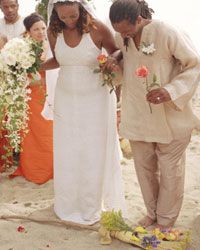
Jumping the broom was a wedding tradition used by slaves in the American South. Because they were technically forbidden to marry and had no property of their own, slaves used the physical act of a bride and groom leaping over a broom in place of a traditional wedding ceremony.

The practice was largely abandoned once slavery was abolished, but in recent years it's made a comeback with African-American couples looking to tie the knot and pay tribute to their past. However, not everyone is pleased with the practice's recent resurgence, as many believe that it remains a symbol of bondage.

Polish America

Chicago, Illinois has the largest number of Polish citizens in any city in the world except Warsaw, Poland [source: Regencia].

5: Stuffing an Apron with Cash

Polish weddings tend to be lively affairs with food and dancing. The last dance, however, is the most notable. Known as the Bridal Dance, this Polish tradition involves all the wedding guests, the bride, dancing, money and an apron.

Before the newlyweds leave the reception, a female friend or family member of the bride puts on an apron while the new Mrs. briefly dances with each of the guests. However, spins with the bride aren't free, as each guest is expected to place money in the apron. The father of the bride is usually the first to dance and deposit cash, and the groom is the last, but his donation is more than a few spare bills -- it's his entire wallet! After the groom drops his wallet, he carries his bride off, and the reception is officially over [source: Polish American Cultural Center].

Breaking plates may be fun, but outside of the Polterabend, it's not common at weddings.

iStockphoto/Thinkstock

4: Smashing Dishes

In another case of wedding-related smashing and stomping, German nuptials often feature a Polterabend, which is a party where dishes and cookery are destroyed. And yes, it's as fun as it sounds.

Polterabends typically start with extravagant feasts and finish with the entire wedding party making as much noise as humanly possible. Dishes are smashed, and pots are clashed. Whips are often brought out and cracked to hasten the departure of any nearby evil spirits.

The origin of the tradition is unknown, but it's thought that the cacophonous sounds caused by the smashing of the cookery represent the inevitable future disturbances that the couple will face throughout their married lives. By breaking the dishes beforehand, the community is preparing the couple for the obstacles ahead and simultaneously wising them luck [source: Monger].

So Some Brides Want to Get Dirty?

Trashing the dress is a recent trend where brides purposefully ruin their wedding gowns for the sake of a good photograph. Some brides pose in the surf, while others smear paint on themselves and their gown. A few ladies have even briefly set themselves and their dresses on fire!

3: Blackening the Bride

Now onto a tradition that really stinks. No, really. The point of blackening the bride is to create the grossest concoction possible. A mixture of any combination of dairy, sausages, vegetables, eggs, fish and feathers is poured on the bride-to-be sometime before her big day. After she has been thoroughly befouled, she's paraded through the streets of her town.

This hilarious but decidedly unclean tradition isn't just a ladies-only affair. Grooms are also often subjected to the blackening, in which case the sticky, stinky couple is paraded around town together. Friends, family members and well-wishers follow behind the couple's filthy procession, making as much noise as possible so that no one will miss seeing the pair [source: Sartain].

Birds of a Feather…

Korean grooms traditionally give the mother of the bride a wild goose. Because wild geese mate for life, the gesture is a symbolic promise from the groom to his future mother-in-law to always love her daughter. Today, a wooden goose is often used in place of a live bird [source: Korea].

2: Beating the Groom's Feet

Most men look forward to the conclusion of their weddings, but in South Korea, the groom has to endure a beating before he can retire with his bride. But don't worry too much; it's only a beating of his feet -- called a bastinado or falaka -- and though it can be painful, it's over quickly and is intended to be more funny than cruel.

The foot beating takes place after the wedding ceremony and is its own ritual. The groomsmen or family members remove the groom's shoes and socks and use a rope or sash to tie his feet together. They then lift his legs off the ground and take turns beating the soles of his feet with a stick, cane or fish.

Yes, a fish -- usually a cod or a dried yellow corvina. The purpose of this tradition is to test the groom's strength and knowledge, as he's often asked questions and quizzed during the ordeal. Beating the soles of a man's feet with a dead fish probably isn't going to make him any smarter, but it's a fun tradition that holds an important place in Korean wedding culture [source: Korea].

Sure, brides look great in white, but have you ever wondered why that's the only color they wear?

Creatas Images/Thinkstock

1: Brides Wearing White

It may seem perfectly normal, but when you think about it, Western brides' white garb is strange. Indian brides, for example, traditionally wear red saris, while brides in Africa don a multitude of vibrant colors and designs. What's even more shocking is that not so long ago, Western brides had more color options for their wedding wear. It wasn't until Queen Victoria donned a white gown in 1840 for her marriage to Prince Albert that brides began losing their taste for color. Queen Victoria's garb was extremely controversial in its day, as white was a color associated with mourning [source: Flock].

But how times change. Within a decade of the Queen's nuptials, white was the only color brides wanted to wear [source: Flock]. Today, any other hue is taboo (at least for first-time brides), and Queen Victoria's rebellious choice is now arguably the most recognized wedding standard in the Western world.

Although some of the wedding customs featured in this article might initially seem strange, don't judge them too harshly. For all we know, our grandchildren will slip rings on each other's toes after having their feet smacked with fish and call it tradition.

Lots More Information

Sources

  • Becher, Mordechai. "The Jewish Wedding Ceremony." Ohr. 2011 (Aug. 19, 2011) http://ohr.edu/1087
  • British Monarchy, the Official Website of. "Victoria." 2011. (Aug. 19, 2011) http://www.royal.gov.uk/HistoryoftheMonarchy/KingsandQueensoftheUnitedKingdom/TheHanoverians/Victoria.aspx
  • Flock, Elizabeth. "Queen Victoria was the first to get married in white." Washington Post. Apr. 29, 2011. (Aug. 17, 2011) http://www.washingtonpost.com/blogs/royal-wedding-watch/post/queen-victoria-was-the-first-to-get-married-in-white/2011/04/29/AFIYPmDF_blog.html
  • Korea Tourism Organization. "To the Scene of a Korean Wedding!" Apr. 13, 2004. (Aug. 17, 2011)
  • Kunz, George Frederick PhD. "Rings for the Finger." Farlang. 2007. (Aug. 17, 2011)
  • Lee, Eun-Joo, Duk-Soo Park and Jaehoon Yeon. "Integrated Korean: Advanced, Volume 1." University of Hawaii Press. Google Books. 2004. (Aug. 17, 2011)
  • Monger, George P. "Marriage Customs of the World: From Henna to Honeymoons." ABC-CLIO. Google Books. 2004. (Aug. 19, 2011) http://books.google.com/books?id=o8JlWxBYs40C&lpg=PA214&ots=g-Ly11FGmt&dq=German%20Polterabend&pg=PA214#v=onepage&q=German%20Polterabend&f=false
  • Moravian Weddings. "Czech Wedding Traditions." 2009. (Aug. 19, 2011) http://www.moravianweddings.com/pages/about_moravia/6.aspx
  • Phuket News. "Big List: Weird Weddings." 2011. (Aug. 19, 2011) http://www.thephuketnews.com/wp-post.php?id=24969
  • Polish American Cultural Center. "Polish Wedding Traditions." (Aug. 19, 2011) http://www.polishamericancenter.org/PolishWeddingTraditionsInstructionBooklet.pdf
  • Sartain, Sheree. "Hen-night with a difference: 'Blackening' the Bride." Women's Views on News. 2011. (Aug. 17, 2011) http://www.womensviewsonnews.org/2011/08/hen-night-with-a-difference-blackening-the-bride/
  • Shulman, Shlomo. "Guide to the Jewish Wedding." Aish. 2010 (Aug. 19, 2011) http://www.aish.com/jl/l/m/48969841.html
  • Star Tribune. "Yesterday's News: Charivari, or: You may all kiss the bride." 2011. (Aug. 16, 2011) http://www.startribune.com/local/blogs/104307309.html
  • Regencia, Ted. "Thousands gather to celebrate Chicago's Polish heritage." English.news.cn. May 08, 2011. (Aug. 20, 2011) http://news.xinhuanet.com/english2010/indepth/2011-05/08/c_13864287.htm
  • White Prague Wedding Agency. "Czech Wedding Traditions." 2005. (Aug. 17, 2011) http://www.destination-wedding.cz/clanky/49/czech_traditions.html