10 Big Questions in the U.S. Gun Control Debate

by

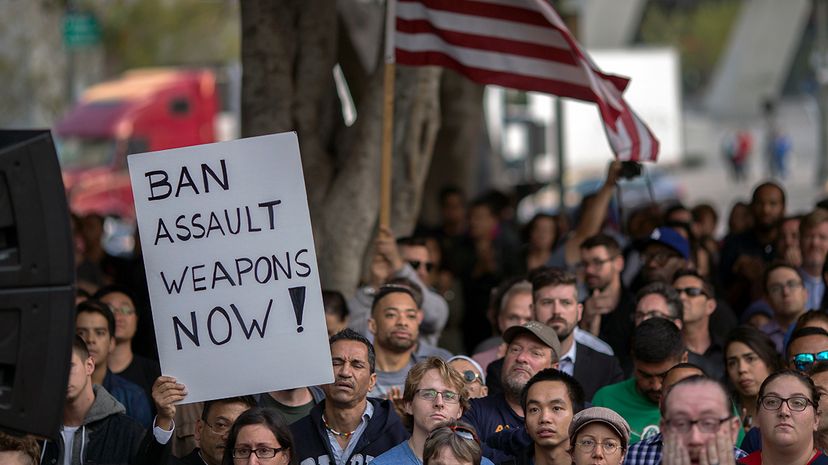
Image Gallery: Protests

Participants with One Million Moms for Gun Control, a gun control group formed in the wake of the 2012 massacre at a Newtown, Conn. elementary school, attend a rally and march across the Brooklyn Bridge in New York. See more protesting pictures.

Spencer Platt/Getty Images

10 Big Questions in the U.S. Gun Control Debate

In December 2012, a 20-year-old man wearing combat gear and armed with pistols and a semi-automatic rifle forced his way into a school in Newtown, Conn., and killed 26 people, including 20 elementary school students [source: Barron]. That event followed two other mass killings in 2012 -- a July attack on an Aurora, Colo., movie theater in which a gunman slaughtered 12 people and wounded 58 more, and an August assault on a Sikh temple in Milwaukee in which six worshippers were shot to death and thre others wounded [source: Krouse].

But this time, the age of the Newtown victims -- coupled with heart-rending accounts of Victoria Soto, a 27-year-old teacher slain while shielding her first-grade pupils with her body -- roused many Americans to demand action to prevent further gun violence [source: News Times]. A January 2013 Associated Press poll found that 58 percent of Americans wanted stricter gun control laws, and 55 percent wanted a ban on so-called assault weapons -- rapid-firing semi-automatic rifles modeled after arms used by the world's militaries [source: Raum and Agiesta]. In January 2013, thousands of demonstrators, many carrying pictures of victims of gun violence, marched in Washington, D.C., to demand gun control [source: Martinez and Schmidt].

But gun rights lobbyists say such laws would violate Americans' constitutional right to bear arms. They also argue that citizens need weaponry to defend against criminals -- and the possibility of future government tyranny.

As Wayne LaPierre, executive vice president of the National Rifle Association, warned at a January 2013 press conference: "When you hear your glass breaking at 3 a.m. and you call 911, you won't be able to pray hard enough for a gun in the hands of a good guy to get there fast enough to protect you" [source: Washington Post]. Some, such as economist and author John R. Lott Jr., argued that the answer to stopping gun violence was for more citizens to be armed [source: University of Chicago Press].

So which side is right? That's for you to decide. But to help you make an informed decision, here are answers to 10 big questions in the U.S. gun control debate.
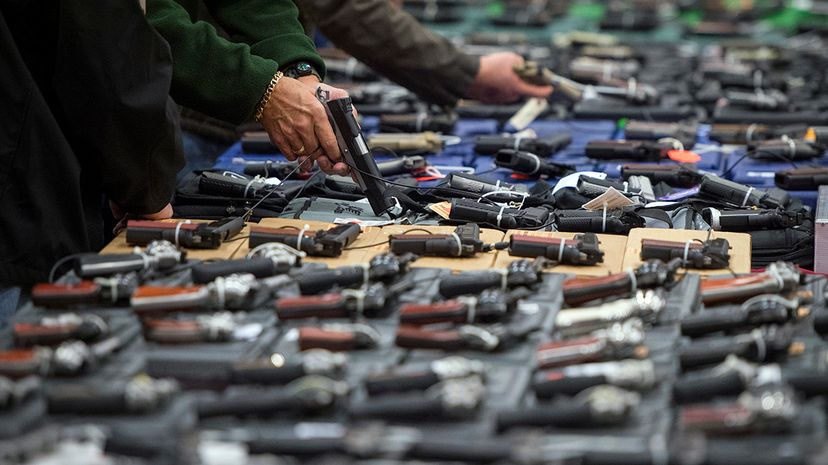
Gun enthusiasts explore products displayed on the exhibition floor at the National Rifle Association of America's annual meeting in Louisville, Ky., 2008.

Scott Olson/Getty Images

10: How Many Guns Are in the U.S.?

The U.S. has a lot of guns -- so many, in fact, that there's nearly one firearm for every person who lives in the country. According to the Bureau of Alcohol, Tobacco, Firearms and Explosives, in 2009 there were an estimated 310 million guns in the U.S., including 114 million handguns, 110 million rifles and 86 million shotguns [source: Krouse]. The 2012 U.S. population is nearly 314 million.

This already huge privately held arsenal is growing at a very fast rate. About 8 million firearms are manufactured globally each year, and 4.5 million are bought by people who live in the U.S. [source: Small Arms Survey].

That may lead you to the mistaken impression that everyone is packing heat. In truth, however, the majority of Americans still are unarmed. In a January 2012 Gallup poll, for example, 43 percent of Americans said they had a gun in their homes [source: Gallup]. That's consistent with the General Social Survey, which has found that over the past several decades, only 44.3 percent of Americans have kept firearms where they live [source: GSS]. In fact, the portion of Americans who are gun owners seems to be on the decline; Gallup, for example, found that the percentage who had guns in 2012 was 8 percent lower than in the mid-1990s. Some believe that gun ownership may be decreasing because gun owners tend to be middle-aged white males, a demographic that represents a smaller segment of the population in 2013 [sources: Statistic Brain, Brennan].

However, a relatively small number of heavily armed people -- about 20 percent of the population -- own 65 percent of U.S. firepower, a 2004 survey found [source: Hepburn et al.].

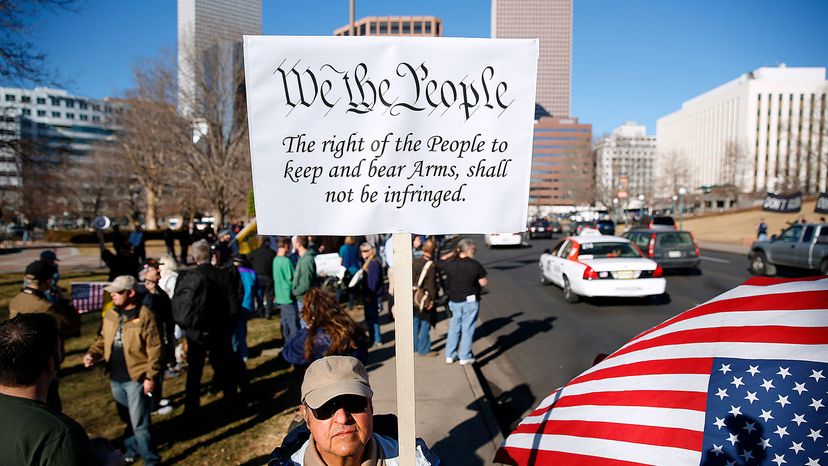
Second Amendment activist Joseph Gabriele of Littleton, Colo. gathers with other activists in support of gun ownership in Denver, 2013.

Marc Piscotty/Getty Images

9: What Does the Second Amendment Say?

The Second Amendment to the U.S. Constitution states the following: "A well-regulated militia, being necessary to the security of a free state, the right of the people to keep and bear arms, shall not be infringed." But what that means is the subject of intense debate. Pro-gun partisans argue that the Constitution's framers guaranteed peoples' right to possess and carry just about any sort of firearm. Gun control advocates say it was intended to allow states to maintain the equivalent of today's National Guard units [source: Krouse].

But as Supreme Court Justice Charles Evans Hughes once noted, "The Constitution is what the judges say it is" [source: Columbia University]. And so far, probably to both sides' frustration, the courts have never fully defined the Second Amendment and its implications. Instead, the U.S. Supreme Court has issued a series of rulings that mostly have upheld the government's authority to impose restrictions upon weapons.

For example, in the 1937 case U.S. v. Miller, a court upheld a federal statute requiring licensing of sawed-off shotguns, saying that some sorts of weaponry weren't needed by a militia and thus weren't constitutionally protected. (Gun rights advocates replied that this type of weapon had been used by militia before.) More recently, in the 2008 case District of Columbia v. Heller, the court found that citizens did have a right to possess handguns at home for self-defense. But the justices said the government still could impose other limits -- such as banning criminals and mentally ill people from owning guns, regulating gun sales and barring guns from schools and other places [source: Krouse].

Forensic personnel examine the corpse of a police officer murdered presumably by gangsters to steal his handgun, in Tegucigalpa, Honduras on December 5, 2012. At least 102 policemen have been murdered during the last two years in Honduras.

ORLANDO SIERRA/AFP/Getty Images

8: Is the U.S. Gun Homicide Rate Really That High?

In 2011, the most recent year for which statistics are available, the U.S. had 11,101 homicides committed with firearms, which amounted to about 70 percent of all homicides, according to the U.S. Centers for Disease Control and Prevention. That's a rate of about 3.6 gun killings per 100,000 people [source: Hoyert and Xu].

Whether that rate seems high to you depends upon your perspective. The U.S. isn't the country with the most gun murders, by any stretch -- that would be the tiny Central American nation of Honduras, which has 68.4 gun killings per 100,000 people, which is 19 times the U.S. rate. And there are a bunch of other countries with higher rates than the U.S., such as Mexico, Colombia, the Philippines and South Africa [source: UNODC]. But those places tend to be developing countries where law and order is weak, or else places with political unrest. Compared to other industrialized democracies, the U.S. gun homicide rate is through the roof. It's more than four times the rate in Italy, six times that of Canada and about 30 times the gun homicide rate in Great Britain or France [source: Newcomb].

So here's another question: Would the crime rate in the U.S. be lower if there were fewer guns available? Again it depends on which study you consult. Burglary and assault rates are higher in Britain than in the U.S., but homicide rates are much lower [source: Civitas Crime]. The UN Global Study on Homicide (by any weapon) put the British homicide rate at 1.2 per 100,000 while the U.S. rate was 4.6 per 100,000 [source: UNODC]. "While the specific relationship between firearm availability and homicide is complex, it appears that a vicious circle connects firearm availability and higher homicide levels," the study explains.

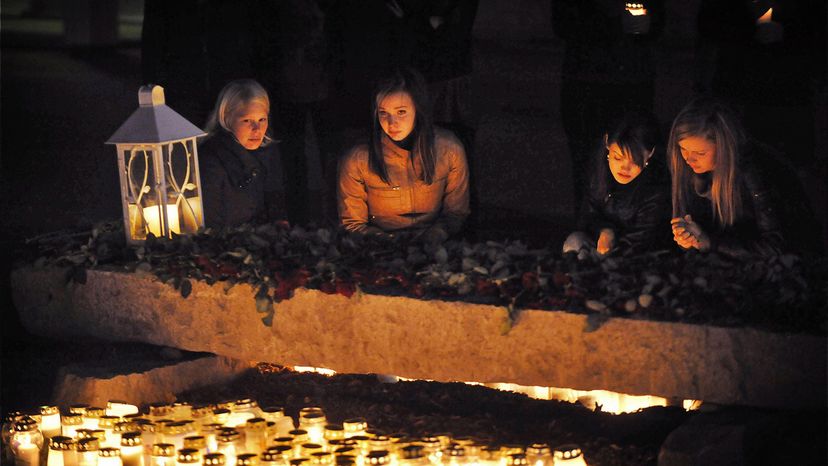
Candles were lit in the evening by the memorial next to the Kauhajoki vocational school in Kauhajoki, Finland on September 23, 2009 for those killed in the school shooting a year earlier.

VESA MOILANEN/AFP/Getty Images

7: Are There Countries With as Many Guns as the U.S. but Less Crime?

No, because there isn't another country in the world with as many guns as the U.S. The U.S. comprises 5 percent of the world's population, but owns between 35 and 50 percent of the world's civilian firearms. The rate of about 97 guns per 100 people is tops in the world, with only the unstable Persian Gulf nation of Yemen (90 per 100) coming even close [source: Small Arms Survey].

So let's reframe the question. Are there countries with relatively high gun-ownership rates -- 50 or more per 100 inhabitants -- and low crime rates? Yes. Finland, which has 69 guns per 100 people, and Switzerland, which has 61 per 100 people [source: Small Arms Survey]. Finland had just 14 gun homicides in 2010, a rate of 0.26 per 100,000 people. In Switzerland, with 40 gun killings in 2010, had a slightly higher rate of 0.52 per 100,000 [source: Gunpolicy.org].

But both those countries have stricter gun control laws than the U.S. In Finland, a nation where most use guns for hunting rather than protection, citizens must obtain gun licenses, which must be renewed every five years. They also must state the reason they wish to have a gun – and self-defense is not a valid reason [source: Finnish Police].

Police deny or revoke permission if an applicant is convicted of a crime -- or shows any sort of behavior that authorities think might indicate that he or she wouldn't be safe owning a gun. Large-capacity magazines aren't permitted, and weapons must be stored in locked cabinets and unloaded if taken outside the home [source: Ministry of the Interior]. But even so, Finland suffered mass shootings at schools in 2007 and 2008, in which gunmen killed a total of 18 people [source: Associated Press].

A man fires an SKS semi-automatic rifle June 3, 2012 at the St. Croix Rod and Gun Club in Hudson, Wisc.

KAREN BLEIER/AFP/GettyImages

6: What's a Semi-automatic Gun?

According to the textbook "Crucial Elements of Police Firearm Training," a semi-automatic firearm has a mechanism that automates most of the process of shooting. It automatically loads ammunition from an internal or external magazine into the firing chamber, extracts and ejects the spent cartridge when a shot is fired, and then uses some of the energy of the fired shot to load another cartridge from the magazine so that the shooter can fire again. This enables a shooter to fire a succession of shots quickly, as long as he or she squeezes the trigger again each time [source: Johnson].

The automation of the loading, firing and reloading process, and the utilization of energy from one round to put the next one in firing position, differentiates a semi-automatic from firearms such as bolt-action rifles and revolvers. In turn, the requirement that a shooter repeatedly depress the trigger again for each shot differentiates a semi-automatic from a fully automatic weapon such as a machine gun. That sort of weapon will continue to fire, as long as the shooter's finger is on the trigger, until it runs out of ammunition [source: Johnson].

Gun rights advocates often say that semi-automatic firearms should not be considered "assault weapons" because they are not fully capable of "spraying" automatically. But the 2008 edition of "Gun Digest Buyer's Guide to Assault Weapons," a book for gun enthusiasts, lays out a pretty specific definition: Semi-automatic rifles that accept detachable magazines holding more than 10 rounds of ammunition, and often include features -- such as a pistol grip, flash suppressor, folding stock or bayonet mount -- and are designed to make them cosmetically resemble fully-automatic military weapons. The first such weapon was the Colt AR-15, a semi-automatic rifle clone of the military's M16, introduced to the civilian market in 1964 [source: Peterson].

Assault weapons first earned an unsavory reputation in part because of events such as the 1989 Stockton, Calif., school massacre, in which a mentally unstable drifter shot five children to death with an AKM-47, a semi-automatic copy of a Soviet-Bloc military rifle [source: Associated Press].

Every person's nightmare: Being held up at gun point. Gun rights advocates say self-defense is a big reason why America needs a liberal policy on owning guns.

MILpictures by Tom Weber/Digital Vision/Getty Images

5: How Often Do Gun Owners Actually Prevent Crimes?

People opposed to gun control often have argued that they need firepower to protect themselves against criminals. Take this example from January 2013 when a Georgia woman shot a crowbar-wielding intruder who broke into her home and confronted her and her two young children [source: CBS News]. Gun control opponents say that a vast number of crimes are prevented by armed citizens, who either shoot an assailant -- an event that happened 326 times in 2010, according to a 2012 Wall Street Journal state-by-state analysis of crime statistics -- or more often, chase the would-be criminal away by brandishing a weapon [source: Palazzolo and Barry].

There is some social science to back up that thesis. Perhaps the most often-cited evidence is a 1995 study by Northwestern University School of Law researchers Gary Kleck and Marc Gertz. Based upon a random telephone survey of 5,000 Americans, they concluded that there were between 2.1 and 2.5 million defensive gun uses each year This works out to about 1 percent use of a gun for defensive purposes [source: Kleck and Gertz].

But critics questioned whether Kleck's and Gertz's findings were reliable. Harvard public health researcher David Hemenway published a paper refuting this and pointing out that "since only 42 percent of U.S. households own firearms and victims in two-thirds of the occupied households were asleep, the 2.5 million figure requires us to believe burglary victims use their guns in self-defense more than 100 percent of the time" [source: Hemenway]. Another mid-1990s study, based upon a Justice Department survey of nearly 60,000 households, came up with a much smaller estimate of about 21,500 defensive gun uses annually [source: Committee on Law and Justice].

Even if the low-end estimates are closer to the truth, this still could mean that tens of thousands of crimes are prevented by gun owners annually. But a 2009 University of Pennsylvania School of Medicine study found that people with a gun were 4.5 times more likely to be shot in an assault than those who were unarmed [source: Science Daily].

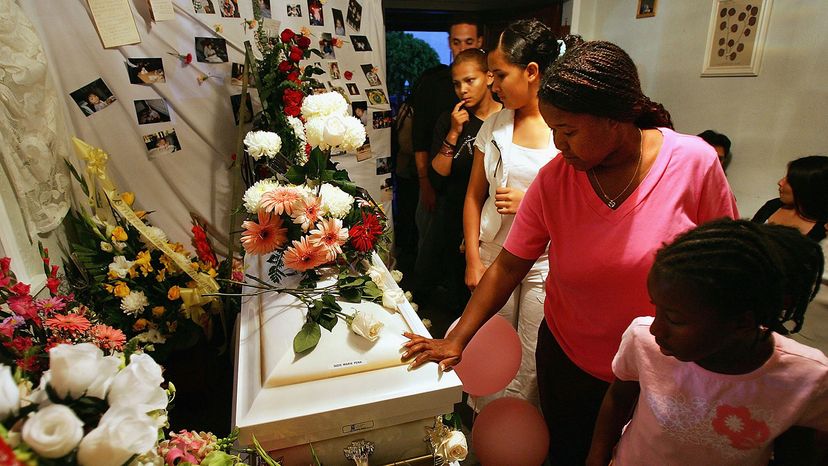
Mourners look upon the casket containing the body of 19-month-old Suzie Marie Pena who was shot to death by police as her father held her while shooting at SWAT officers during a 2 1/2-hour standoff in the Los Angeles community of Watts.

David McNew/Getty Images

4:How Often Are People Killed by Guns That They or Family Members Own?

This is the point that gun control proponents often cite to counter arguments that guns deter crime. People who have guns in their households, they argue, actually may be at greater risk of being hurt or killed by a bullet -- possibly one fired by an angry spouse or by a child playing with a gun that's been left loaded.

Again, there's some social science to support this. A 1997 study published in the American Journal of Public Health found that people in families where someone purchased a gun actually faced an elevated risk of death over the next five years [source: Cummings et al.]. A three-year study of gunshot injuries in Galveston, Texas, found that only two incidents occurred during burglaries, but there were more than 100 cases of family members, friends and acquaintances being shot by guns in a home [source: Hemenway].

One big risk is that having a gun within easy reach can escalate an argument or fight into a homicide. A 1992 study published in the Journal of the American Medical Association found that victims whose family members used a gun in an assault were 12 times more likely to die than when attackers used other weapons such as knives, or their bare hands [source: Saltzman et al.].

However, an article that appeared in the Harvard Journal of Law and Public Policy pointed out that many of the "acquaintance homicides" involved, for instance, drug dealers shooting at each other. "Approximately 90 percent of adult murderers have adult records. ... including four major adultfelony arrests," said the authors [Kates and Mauser].

Most Americans who die from gun violence in their own homes actually inflict it upon themselves: 19,766 people used guns to commit suicide in 2011, the most recent year for which statistics are available. That accounted for more than half of the U.S. suicides and is much higher than the 2011 gun homicide rate of 11,101 [source: Hoyert and Xu].

Paul Murray, manager of Shooters USA target range displays an ad for high-capacity magazines on September 11, 2004. Once the Assault Weapons Ban expired at midnight September 13, it would be legal for non-law enforcement people to buy them.

Mario Villafuerte/Getty Images

3: Did the Federal Ban on Assault Weapons Affect Crime?

In 1994, Congress passed a 10-year ban on the manufacture and sale of new assault weapons, which the law defined as semi-automatic rifles and handguns with certain military-style features -- such as folding rifle stocks and threaded barrels for attaching silencers -- that didn't have any value to hunters or self-defense. The law also banned magazines with a capacity of more than 10 rounds but exempted weapons manufactured before 1994. The law was allowed to expire in 2004, and how effective it was at preventing crime remains a subject of intense controversy, in part because there wasn't a systematic effort to gather data about its impacts.

A 2004 study by University of Pennsylvania researchers for the Department of Justice found that from 1995 to 2003, gun crimes involving assault weapons that were banned by the law declined in six U.S. cities by between 17 percent and 72 percent. But some of that progress was negated, the researchers found, because even though criminals couldn't buy new assault weapons, they still could easily outfit non-banned weapons with old large-capacity magazines from before the ban, which were plentiful and easily obtained [source: Koper].

Additionally, manufacturers were able to get around the ban by redesigning weapons and making a few changes to remove the military-style features [source: Peterson]. The Colt AR-15 that suspect James Eagan Holmes used to kill moviegoers in the Aurora cinema would have been outlawed under the 1994 ban. Yet he could have used a very similar Colt Match Target rifle that would not have fallen under the ban [source: Plumer].

Some of the 125 weapons confiscated during what the federal authorities say was the largest gang takedown in U. S. history. Scores of alleged gang members and associates were arrested on federal racketeering and drug-trafficking charges in 2009.

David McNew/Getty Images

2: Do States With Strict Gun Control Laws Have Less Gun Violence?

Critics of gun control often point to places such as the District of Columbia, which has a high rate of gun crimes despite strict gun control laws [source: Liptak]. But social scientist Richard Florida, who has analyzed crime and demographic data, has found a strong correlation between lower firearm deaths and tighter gun restrictions, such as bans on assault weapons and requirements for trigger locks and safe storage of guns. He says that gun violence is less likely to occur in states that have gun control laws. Interestingly, he found no correlation between states' unemployment rates or drug use and gun violence, but he did find that states with high poverty, low numbers of college grads and high numbers of working-class jobs also had more gun violence [source: Florida].

Gun control advocates say that states' efforts at gun control are undermined, to a degree, by lax laws in neighboring states. Mayors Against Illegal Guns, an organization lobbying for stricter gun legislation, points out that 27.2 percent of guns purchased in Virginia (a state with lax gun control laws) are recovered after being used in a crime within two years of the original sale, which is almost five points higher than the national average, and according to the mayors' group, a strong indication of gun trafficking to criminals [source: Trace the Guns]. A 2009 study by Johns Hopkins University researchers found that cities in states with little regulation of gun dealers had guns passing into criminals' hands at two to four times the rate of cities in states with strict laws [source: ScienceDaily].

Gang interventionist Reverend Bell (L), and Danielle Lewis (C), mother of murdered junior football star (who was mistaken for a rival gang member), stand at the South Central Los Angeles location of his death holding up peace messages.

MARK RALSTON/AFP/Getty Images

1: Has American Public Opinion Shifted on Gun Control, Over Time?

In the early 1990s, Gallup polling showed that 78 percent of Americans favored tighter gun control laws. But that support declined dramatically over the next two decades, and by the mid-to-late 2000s, support dipped to just 44 percent, with nearly as many Americans (43 percent) saying that laws already were strict enough. But in the wake of the Newtown massacre, a December 2012 Gallup poll found a sharp rebound in support, with 58 percent favoring tougher gun statutes, compared to just 34 percent who said they wanted laws to remain the same [source: Saad].

But Gallup data contains another important but often overlooked point. Though the number of Americans who want stricter gun control has gone up and down (and now up again), the overwhelming majority of Americans over the past 20 years have supported having laws that restrict firearms. In the December 2012 poll, only 6 percent of Americans favor looser legal controls on guns [source: Saad].

However, that same 2012 poll found that a record 74 percent were opposed to a ban on handguns for anyone but police or other authorized personnel. This was the highest level since Gallup first asked that question in 1959. Pollsters speculate this could reflect Americans' wish to keep the right of self-defense in the wake of high-profile gun violence.

Lots More Information

Author's Note: 10 Big Questions in the U.S. Gun Control Debate

I grew up in western Pennsylvania, where the movie "The Deer Hunter" was set, and where a lot of my neighbors were avid hunters. So the idea of law-abiding people owning guns was never something I questioned. But except for my toy pistols, we didn't have any guns in our home, because my father, who wasn't a hunter, didn't want them around. He'd been a combat medic in the U.S. Army during World War II, and he had a huge, scary scar on his left bicep where a German machine gun bullet had hit him on a battlefield in 1945. He'd had to bind up his own arm in a battlefield tourniquet, which enabled him to escape having it amputated. I still have a vivid picture in my mind of what a bullet can do to a person's body. I think that's given me a real-world perspective on the gun issue that a lot of debaters, who tend to get caught up in legal and constitutional abstractions, often seem to lack.

Sources

  • Associated Press. "Ban on Assault Rifles Takes Effect in Los Angeles." The New York Times. March 3, 1989. (Jan. 27, 2013) http://www.nytimes.com/1989/03/03/us/ban-on-assault-rifles-takes-effect-in-los-angeles.html
  • Associated Press. "Deadliest Mass Shootings Around The World." Huffingtonpost.com. July 20, 2012. (Jan. 27, 2013) http://www.huffingtonpost.com/2012/07/20/deadliest-mass-shootings_n_1688820.html
  • Barrett, Paul. "How Often Do We Use Guns in Self-Defense?" Bloomberg Businessweek. Dec. 27, 2012. (Jan. 27, 2013) http://www.businessweek.com/articles/2012-12-27/how-often-do-we-use-guns-in-self-defense
  • Barron, James. "Nation Reels After Gunman Massacres 20 Children at School in Connecticut." The New York Times. Dec. 14, 2012. (Jan. 26, 2013) http://www.nytimes.com/2012/12/15/nyregion/shooting-reported-at-connecticut-elementary-school.html?hp&_r=0
  • Bass, Frank. "U.S. on Pace for Slowest Decade of Population Growth Since 1930s." Bloomberg.com. Dec. 31, 2012. (Jan. 26, 2013) http://www.bloomberg.com/news/2012-12-31/u-s-on-pace-for-slowest-decade-of-population-growth-since-1930s.html
  • Brennan, Allison. "Analysis: Fewer U.S. Gun Owners Own More Guns." Cnn.com. July 31, 2012. (Jan. 30, 2012) http://www.cnn.com/2012/07/31/politics/gun-ownership-declining/index.html
  • CBS News. "Georgia mother hides children, shoots intruder 5 times during home invasion, police say." Cbsnews.com. Jan. 7, 2013. (Jan. 26, 2013) http://www.cbsnews.com/8301-504083_162-57562397-504083/georgia-mother-hides-children-shoots-intruder-5-times-during-home-invasion-police-say/
  • Centers for Disease Control and Prevention. "Violence-Related Firearm Deaths Among Residents of Metropolitan Areas and Cities --- United States, 2006 -- 2007." Cdc.gov. May 13, 2011. (Jan. 25, 2013) http://www.cdc.gov/mmwr/preview/mmwrhtml/mm6018a1.htm?s_cid=mm6018a1_w
  • Civitas Crime. "Comparisons of Crime in OECD Countries." (Jan. 31, 2013) http://www.civitas.org.uk/crime/crime_stats_oecdjan2012.pdf
  • Columbia250. "Charles Evans Hughes." C250.columbia.edu. Undated. (Jan. 27, 2013) http://c250.columbia.edu/c250_celebrates/remarkable_columbians/charles_hughes.html
  • Committee on Law and Justice. "Firearms and Violence: A Critical Review." National Academies Press. 2004. (Jan. 27, 2013) http://www.nap.edu/openbook.php?record_id=10881&page=103
  • Congressional Research Service. "CRS Annotated Constitution: Bearing Arms: Second Amendment." Law.cornell.edu. Undated. (Jan. 27, 2013) http://www.law.cornell.edu/anncon/html/amdt2_user.html#amdt2_hd2
  • Cook, Philip J. and Ludwig, Jens. "Defensive Gun Uses: New Evidence from a National Survey." Journal of Quantitative Criminology. 1998. (Jan. 27, 2013) http://home.uchicago.edu/~ludwigj/papers/JQC-CookLudwig-DefensiveGunUses-1998.pdf
  • Cornell University Legal Information Institute. "Second Amendment." Law.cornell.edu. Undated. (Jan. 27, 2013) http://www.law.cornell.edu/constitution/second_amendment
  • Cramer, Clayton J. and Burnett, David. "Tough Targets." Cato.org. 2012. (Jan. 27, 2013) http://www.cato.org/sites/cato.org/files/pubs/pdf/WP-Tough-Targets.pdf
  • Cummings, P. et al. "The association between the purchase of a handgun and homicide or suicide." American Journal of Public Health. June 1997. (Jan. 27, 2013) http://www.ncbi.nlm.nih.gov/pmc/articles/PMC1380933/
  • Finnish Police. "Finnish registers for a total of 1.6 million weapons." Poliisi.fi. Aug. 19, 2007. (Jan. 27, 2013) http://www.poliisi.fi/poliisi/bulletin.nsf/PFBD/9319AD7CAED55862C2257346003A066A?opendocument
  • Florida, Richard. "The Geography of Gun Deaths." Theatlantic.com. Jan. 13, 2011. (Jan. 28, 2013) http://www.theatlantic.com/national/archive/2011/01/the-geography-of-gun-deaths/69354/
  • Florida, Richard. "Gun Violence in U.S. Cities Compared to the Deadliest Nations in the World." Theatlanticcities.com. Jan. 22, 2013. (Jan. 27 2013) http://www.theatlanticcities.com/politics/2013/01/gun-violence-us-cities-compared-deadliest-nations-world/4412/
  • Gallup. "Guns." Gallup.com. January 2013. (Jan. 26, 2013) http://www.gallup.com/poll/1645/guns.aspx
  • General Social Survey. "Have Gun in Home." 2006. (Jan. 27, 2013) http://www3.norc.org/GSS+Website/Browse+GSS+Variables/Subject+Index/
  • GunPolicy.org. "Finland -- Gun Facts, Figures and the Law." Gunpolicy.org. Undated. (Jan. 27, 2013) http://www.gunpolicy.org/firearms/region/finland
  • GunPolicy.org. "Switzerland -- Gun Facts, Figures and the Law." Gunpolicy.org. Undated. (Jan. 27, 2013) http://www.gunpolicy.org/firearms/region/switzerland
  • Hemenway, David. "The Myth of Millions of Annual Self-Defense Gun Uses." Chance. 1997. (Jan. 27, 2013) http://www.stat.duke.edu/~dalene/chance/chanceweb/103.myth0.pdf
  • Hemenway, David. "Risks and Benefits of a Gun in the Home." American Journal of Lifestyle Medicine. 2011. (Jan. 27, 2013) http://www.medscape.com/viewarticle/753058_4
  • Hepburn, L. et al. "The US gun stock: results from the 2004 national firearms survey." Injury Prevention. 2007. (Jan. 27, 2013) http://injuryprevention.bmj.com/content/13/1/15.full
  • Hoyert, Donna L. and Xu, Jiaquan. "Deaths: Preliminary Data for 2011." Cdc.gov. Oct. 10, 2012. (Jan. 25, 2013) http://www.cdc.gov/nchs/data/nvsr/nvsr61/nvsr61_06.pdf
  • Johnson, Brian R. "Crucial Elements of Police Firearms Training." Looseleaf Law Publications. 2008. (Jan. 27, 2013) http://books.google.com/books?id=mwvu-am3wbcC&pg=PA63&dq=semiautomatic+weapon&hl=en&sa=X&ei=eLsFUfmmC6-C0QHwkoDoDQ&ved=0CGUQ6AEwCQ#v=onepage&q=semiautomatic%20weapon&f=false
  • Kinard, Jeff and Tucker, Spencer C. "Pistols: An Illustrated History of Their Impact." ABC-CLIO. 2004. (Jan. 27, 2013) http://books.google.com/books?id=ZVnuHX_6bG0C&pg=PA176&dq=invented+the+first+semiautomatic&hl=en&sa=X&ei=j8EFUeG4OKLC0QG4-4C4BQ&ved=0CEAQ6AEwAw#v=onepage&q=%20semiautomatic&f=false
  • Kleck, Gary and Gertz, Marc. "Armed Resistance to Crime: The Prevalence and Nature of Self-Defense." Journal of Law and Criminology. 1995. (Jan. 27, 2013) http://www.saf.org/lawreviews/kleckandgertz1.htm
  • Koper, Christopher S. "Updated Assessment of the Federal Assault Weapons Ban: Impacts on Gun Markets and Gun Violence, 1994-2003." U.S. Department of Justice. July 2004. (Jan. 31, 2014) https://www.ncjrs.gov/pdffiles1/nij/grants/204431.pdf
  • Krouse, William J. "Gun Control Legislation." Congressional Research Service. Nov. 14, 2012. (Jan. 26, 2013) http://www.fas.org/sgp/crs/misc/RL32842.pdf
  • Limbaugh, Rush. "Limbaugh: The Term "Assault Rifle" Is A "Political Invention." Realclearpolitics.com. Dec. 17, 2012. (Jan. 27, 2013) http://www.realclearpolitics.com/video/2012/12/17/limbaugh_the_term_assault_rifle_is_a_political_invention.html
  • Lindenberger, Michael A. "Ten Years After Columbine, It's Easier to Bear Arms." Time. April 20, 2009. (Jan. 31, 2013) http://www.time.com/time/nation/article/0,8599,1891416,00.html
  • O'Keefe, Ed. "Lawmakers unveil new assault weapons ban." Washington Post. Jan. 24, 2013. (Jan. 28, 2013) http://www.washingtonpost.com/blogs/post-politics/wp/2013/01/24/lawmakers-to-unveil-new-assault-weapons-ban/?hpid=z1
  • Martinez, Michael and Schmidt, Emily. "Gun control advocates march as nation reels from school shootings." Cnn.com. Jan. 26, 2013. (Jan. 26, 2013) http://www.cnn.com/2013/01/26/us/gun-control-rally/index.html
  • Mayors Against Illegal Guns. "The Source States for Crime Guns: Virginia." Tracetheguns.org. Undated. (Jan. 28, 2013) http://www.tracetheguns.org/#/states/VA/imports/
  • Ministry of the Interior, Finland. "Firearms Act." Finlex.fi. 2003. Jan. 27, 2013. http://www.finlex.fi/en/laki/kaannokset/1998/en19980001.pdf
  • Newcomb, Alyssa. "US Gun Homicide Rate Higher Than Other Developed Countries." Abcnews.com. Dec. 18, 2012. (Jan. 27, 2013) http://abcnews.go.com/blogs/headlines/2012/12/us-gun-ownership-homicide-rate-higher-than-other-developed-countries/
  • Newstimes.com. "Teacher from Stratford shielded students." Newstimes.com. Dec. 15, 2012. (Jan. 25, 2013) http://www.newstimes.com/local/article/Teacher-from-Stratford-shielded-students-4120759.php
  • Palazzolo, Joe and Barry, Rob. "More Killings Called Self-Defense." Wall Street Journal. April 2, 2012. (Jan. 30, 2013) http://online.wsj.com/article/SB10001424052702303404704577311873214574462.html
  • Peterson, Phillip. "The Gun Digest Buyer's Guide to Assault Weapons." Gun Digest Books. 2008. (Jan. 28, 2013) http://books.google.com/books?id=fd9Qc0neMjYC&printsec=frontcover&dq=history+of+assault+rifles&hl=en&sa=X&ei=GuUBUYfBBqS00QHYy4GIDg&ved=0CEkQ6AEwBQ#v=onepage&q=history%20of%20assault%20rifles&f=false
  • Raum, Tom and Agiesta, Jennifer. "AP-GfK poll: After Conn. school shooting, nearly 6 in 10 Americans back stricter gun laws." Ap-gfkpoll.com. Jan. 16, 2013. (Jan. 26, 2013) http://ap-gfkpoll.com/uncategorized/our-latest-poll-findings-19
  • Saltzman, L.E. et al. "Weapon involvement and injury outcomes in family and intimate assaults." Journal of the American Medical Association. June 10, 1992. (Jan. 27, 2013) http://www.ncbi.nlm.nih.gov/pubmed/1588718
  • ScienceDaily. "Protection Or Peril? Gun Possession Of Questionable Value In An Assault, Study Finds." Sciencedaily.com. Sep. 30, 2009 (Jan. 27, 2013) http://www.sciencedaily.com/releases/2009/09/090930121512.htm
  • ScienceDaily. "Regulation And Oversight Of Gun Sales Reduces Trafficking To Criminals, Study Finds." Sciencedaily.com. July 7, 2009. (Jan. 28, 2013) http://www.sciencedaily.com/releases/2009/07/090707111749.htm
  • Small Arms Survey. "Completing the Count." Smallarmssurvey.org. 2007. (Jan. 27, 2013) http://www.smallarmssurvey.org/fileadmin/docs/A-Yearbook/2007/en/full/Small-Arms-Survey-2007-Chapter-02-EN.pdf
  • StatisticBrain. "Gun Ownership Statistics and Demographics." Statisticbrain.com. July 20, 2012. (Jan. 30, 2012) http://www.statisticbrain.com/gun-ownership-statistics-demographics/
  • United Nations Office on Drugs and Crime (UNODC). "UNODC Homicide Statistics." Unodc.org. 2013. (Jan. 27, 2013). http://www.unodc.org/unodc/en/data-and-analysis/homicide.html
  • University of Chicago Press. "An interview with John R. Lott, Jr." Press.uchicago.edu. 1998. (Jan. 26, 2013) http://www.press.uchicago.edu/Misc/Chicago/493636.html
  • Washington Post. "Remarks from the NRA press conference on Sandy Hook school shooting, delivered on Dec. 21, 2012 (Transcript)." Washingtonpost.com. Dec. 21, 2012. (Jan. 26, 2013) http://articles.washingtonpost.com/2012-12-21/politics/36018141_1_mayhem-with-minimum-risk-nra-wayne-lapierre
  • Weatherby. "New Home Defense Pump Shotgun and Threat Response Rifles." Weatherby.com. Oct. 20, 2009. (Jan. 27, 2013) http://www.weatherby.com/company/pressroom/pressrelease/item/view/44079